Day 6 – 15 October 2025, Wednesday
I planned to wake up extra early today to catch the sunrise, but I woke up naturally even earlier than expected, at 4:55am. After lying in bed a little longer, I washed up, climbed the short wooden ladder behind Haryugetu Guesthouse and sat on the concrete storm protection barrier to look out at the ocean. It was a pleasant 22 degrees C and the sky was already starting to get brighter at 5:45am.
As I sat there alone, I enjoyed the tranquility of the scene before me. The rocky shore was not the prettiest but the sound of waves crashing gently every few seconds was extremely soothing. The constant rhythm of the waves accompanied me as I reflected on the past five days of cycling.


As always, it is a privilege to be able to travel (wherever it is in the world) and to pursue my interests. In this case, a solo bikepacking expedition in Shikoku. I really enjoy cycling and the freedom it provides, allowing me to stop whenever I wish. I also enjoy the satisfaction that cycling brings, knowing I have covered all this distance purely on my own physical effort.
I also thought about how lucky I have been so far. When you travel, you require a fair bit of luck, especially with regards to the weather. Good weather will greatly enhance your enjoyment of the trip, but Mother Nature is something beyond our control. I have been blessed with great weather thus far and I hope it will continue for the next six days.
Being on a solo bikepacking trip, my family were naturally concerned about my safety and wellbeing. Not long before I came on the trip, an acquaintance introduced me to Polarsteps, a travel app that allows your family and friends back home to track your trip on a map in almost real time. I have been using it for this trip and I must say it has been very useful and cool!

How Polarsteps works is that it automatically tracks your route by placing little white dots called Travel Tracker steps on your map. At each step, you can post photos and videos, and write a long caption to accompany the post. The best thing is that the steps plotted on the map are quite accurate to the location and it allows you to see the route that you took, so you can look back at the trip years later and see exactly where you went.
But more importantly, my family and friends can see all the places I visited. They can also post comments and “Like” my posts. Thus, it feels like they are travelling with me, albeit virtually. As I plot my steps throughout the day, they can also see that I am getting closer to my destination each day, giving them peace of mind that I am at least still alive and kicking.
I find it useful that you can capture your thoughts at that very moment, which makes it contemporaneous and valuable as a travel journal. However, you don’t always have to do it on the spot. You can also post the photos and captions later, as long as the Travel Tracker steps were captured properly by Polarsteps’ automatic tracking. It’s a great way to document your trip and I highly recommend Polarsteps to anyone who loves to travel.

After sitting there for 45 minutes, I went back to the guesthouse at 6:30am to do my final packing and suit up before breakfast. When I went to the dining room at 6:50am, breakfast was ready. Mayu had prepared a very wholesome meal comprising of toast, a sunny side up egg, salad, banana and of course, coffee. I was shortly joined by Ah Fok, MC and CK, my fellow Shikoku Challenge adventurers from Hong Kong, and we enjoyed our breakfast together.


It started to drizzle while we were having our meal. The forecast showed that the light rain was expected to stop around 8:00am. However, I couldn’t wait till then to start my ride because today will be the longest day of cycling and I needed to get started as early as possible.
The itinerary for Day 6 of the Shikoku Challenge is to cycle 130.2km from Shishikui to Kochi, with an elevation gain of 518m. There are four roadside station checkpoints today. Coming into the midway point of the Shikoku Challenge, this will be the longest distance of all 11 days. Based on my cycling speed for the past five days, I took an average of 1 hour to cycle 15km. Hence, I will need around 9 hours to cover the 130km today, not factoring in breaks for lunch and rest stops. Thus, it was crucial for me to start cycling as early as possible so that I can reach my hotel before sunset because I didn’t want to cycle in the dark.

At 7:45am, I put on my waterproof cycling jacket, bade farewell to my hosts Hiro and Mayu, my fellow Hong Kong adventurers, and started my ride. I really enjoyed staying at Haryugetu Guesthouse and I wished I could have stayed for another night. The house was cosy and homely, and Mayu prepared the best meals for us. She even made two onigiri (rice balls) for each of us to take on the road, so sweet of her!
I love how Hiro and Mayu can lead a simple life away from the busy parts of town, and devote their time to raise their kids in a beautiful environment while still earning enough to make a living. I also loved meeting fellow travellers and hearing their stories. If I ever return to Shikoku, I will definitely book a stay at Haryugetu Guesthouse again.

It was my first time encountering rain on this trip. I don’t like rain when I’m cycling but I was well-prepared to deal with it. All my gear and bags are waterproof, and I’m no stranger to cycling in the rain. But I was very cautious and cycled slowly because the roads were slippery.
Before coming to Shikoku, I told myself that I must not fall down and hurt myself, because I fell during my Tour de Taiwan trip in 2023 and the resulting open wounds meant that I couldn’t enjoy the hot springs. Hence, I was extra careful while cycling here in Shikoku, especially in wet weather. Thankfully, the rain didn’t last long. When I reached Shishikui Onsen at 7:53am, it was not raining anymore, just as the weather forecast predicted. So, I was caught in the light rain for less than 10 minutes, which was wonderful.

As mentioned in yesterday’s blog post, I already knew that Shishikui Onsen roadside station was not open yet but I wanted to try my luck. This was one of the checkpoints for Day 5 (yesterday) of the Shikoku Challenge but it was located 3km after Haryugetu Guesthouse, so I didn’t manage to come here yesterday. The silliest thing is that the stamp and ink pad are kept inside the retail shop, and the shop opens only at 9:00am. This resulted in my Challenge Pass being incomplete, lacking this one stamp. Such a bummer. I gave the closed roadside station a thumbs-down before resuming my ride.

Even though it was a cloudy day, the conditions were good for surfing. About a dozen people were already surfing in the sea while a few others were doing stand-up paddling. I’m not big on water sports but I can imagine it must so fun for them to enjoy the water activities here, when the temperature is comfortable and the conditions are ideal.


At 8:10am, I crossed over from Tokushima to Kochi Prefecture. Kochi is the largest but least populous of Shikoku’s four prefectures. This is because its terrain is predominantly mountainous, with few plains except near the coast. As such, today’s route will largely follow the coastline.


Despite the gloomy weather, the scenery was awesome as the route hugged the coast so I had the most amazing views of the ocean as I cycled, right next to the mountains. Best of all, there was hardly any traffic due to the low population in Kochi. It felt like I had the entire road and ocean to myself, which was exhilarating. The road was also flat so you can really do some serious cycling here. I couldn’t stop beaming as I pedalled. It was probably the most scenic cycling route I have done in my life – so far.


About two hours into the ride, the grey clouds made way for blue skies and the sun came out. At 9:50am, I stopped for my first break at Meoto Iwa in Sachimacho, Muroto. Meoto Iwa means “Married Couple Rocks” and they are a kind of rock formation considered as significant in Shinto religion. The two rocks represent the union in marriage of man and woman, and they are joined by a heavy rope of rice straw called Shimenawa. Couples pray before the two rocks (representing the deities Izanagi and Izanami), hoping that their marriage will be as strong and lasting.


There are many Meoto Iwa around Japan so the one here at Muroto is not unique. In fact, there are seven Meoto Iwa in Shikoku alone. On the day of my visit, there was no one else. I found a quiet spot and ate my first onigiri that Mayu prepared for me. It was a simple but delicious snack. At 10:10am, I resumed cycling, mindful that there was still about 100km to go.


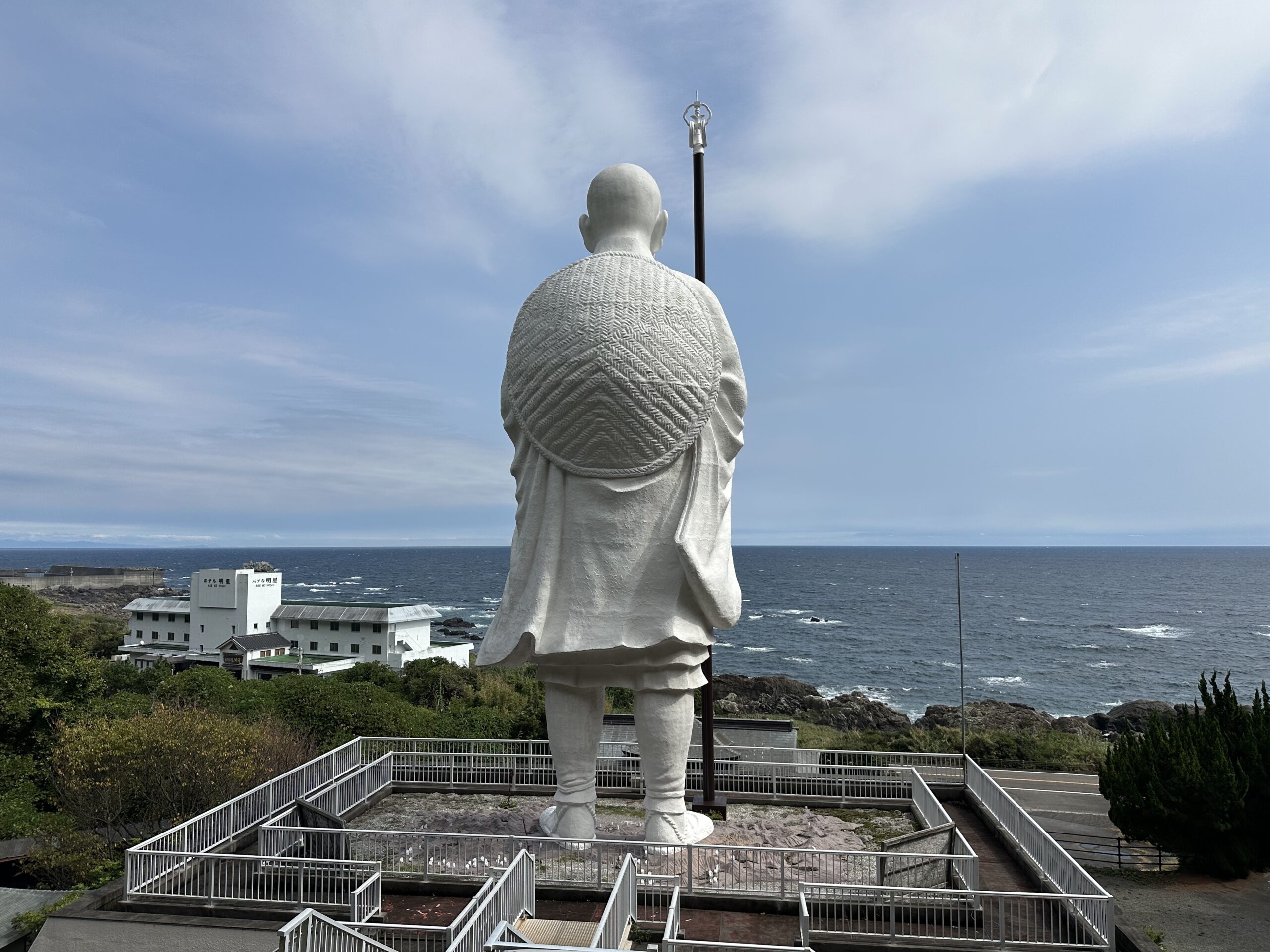
Half an hour later, I chanced upon a large white statue of a monk perched on a hill. It stood out because it was gleaming white and surrounded by vegetation. My interest was immediately piqued so I cycled closer. I saw that it was a statue of Kobo Daishi and it was part of Raiei Temple. There seemed to be no one else around. I parked my bicycle and climbed the steps past the pair of orange Nio, which are guardians of Buddhist temples.


I soon encountered a small building, which looked like a ticketing booth. A middle-aged lady was seated inside and she was having her lunch and didn’t seem to notice me. I wasn’t sure if there was an admission fee or whether the temple was closed for lunch break so I tried to ask her. However, she was visibly displeased by my presence, or perhaps by the fact that I didn’t speak Japanese, and waved me away irritably. I took that to mean that I could enter so I trudged up the steps as quietly and quickly as possible. (As I write this post now, I just discovered that there is an admission fee of 300 yen. I’m sorry I didn’t pay it. I hope to return to Shikoku one day and pay it back.)


The statue of Kobo Daishi was even more massive up close. I will admit that the first thought that entered my mind when I saw the statue up close was Gulliver’s Travels, where Gulliver appears as a giant among the tiny inhabitants of Lilliput. From its lofty position here at the hilltop, the statue of Kobo Daishi had a commanding view of the ocean beyond, staring far into the horizon and watching the waves crash onto the shore. It was an impressive sight on this gorgeous day.


I then saw a golden statue of Sleeping Buddha on the upper level so I climbed up another short flight of steps to see it. The statue was much smaller than that of Kobo Daishi but no less impressive. It glinted in the sun, with the soothing ocean and surrounding breeze providing a peaceful backdrop for Buddha as he enters Nirvana. After taking several photos and videos, I left Raiei Temple at 11:00am. It was a short, 15-minute visit but well worth the time.


Somehow, I was hungry again and I decided to have a quick break nearby at Cape Muroto. I found a café called Geocafé Geoshop and dropped by to have a banana pancake (700 yen) and latte (250 yen). The pancake wasn’t the fluffiest but it was nice and sweet, and they prepared the food fast. I didn’t want to have a heavy lunch because I found that it made me sluggish after that, so this light meal and quick caffeine fix was just what I needed.


With about 43km completed, I had covered about one third of today’s distance. Still a long way to go. When I resumed cycling about half an hour later, the sun hid behind the clouds and it was gloomy once more. However, it was still ok because it wasn’t hot, and more importantly, it wasn’t raining. There was a bit of headwind as I cycled around the cape. The scenery wasn’t as dramatic as earlier but the route still hugged the coastline, with a mountain backdrop, so it was still lovely. At 12:20pm, I reached the first roadside station for the day, Kiramesse Muroto. I quickly collected my stamp and went on my way. Literally chop chop and go, no time to waste.


Just before 1:00pm, I encountered a group of four cyclists – one man and three women. They were bikepacking too as big bags were attached to their small-wheeled bicycles. They wore the same blue jersey but they weren’t attempting the Shikoku Challenge. I said hello as I cycled past them, and found out they were from Malaysia. Always nice to see fellow cyclists and bikepackers. Malaysia boleh!

A short while later, I chanced upon a bright red torii on the rocks by the sea so I stopped at the side of the road to snap some quick pics. It probably wasn’t anything significant but it looked pretty. That’s what I love about cycling, the freedom that it provides to let me stop whenever I feel like it.


At 1:40pm, I arrived at my second roadside station at Tanoekiya. After collecting my stamp, I wanted a cool treat so I bought a small tub of yuzu sorbet. However, it was frozen hard and I couldn’t eat it immediately, so I decided to have my lunch here while waiting for the sorbet to defrost.
I ordered a curry udon for 750 yen (S$6.53). It wasn’t the best lunch but it was the most convenient option. Actually, I wanted to have lunch at a sushi restaurant nearby but I discovered that it was closed when I arrived, even though it was shown as “Open” on Google Maps. Thus, the business operation hours listed on Google Maps are not always accurate.


After finishing my lunch and yuzu sorbet, I quickly resumed cycling. There was still over 50km to Kochi so it was a long way to go. The weather was fine and the scenery was unremarkable. I only made a brief stop to take photos of another torii perched on a small rocky outcrop. At 2:55pm, I reached the third roadside station at Oyama.


My heart sank when I discovered that the Oyama roadside station is closed every Wednesday. I thought I would miss out on another stamp on my Challenge Pass. However, I was delighted when I saw a small table outside the retail shop with the stamp and ink pad on it! This means that people attempting the Shikoku Challenge can have access to the stamp at all hours, even if the roadside station is closed. Being Japan, I’m sure no one would steal the stamp. Why can’t all the roadside stations do the same and leave the stamp and ink pad outside?


When I reached Aki city at about 3:30pm, the route diverged from the National Route 55 and brought me to a dedicated cycling path running parallel to the highway. The cycling path cut through some residential areas and it was generally well-paved. It was very pleasant to cycle here because it was quiet and away from traffic, with views of the sea. The cycling road stretched all the way to the next roadside station at Yasu.


But before I went to the Yasu roadside station, I made a slight detour to Tei Port nearby to see the movable bridge. It was something I bookmarked and I wanted to see it in person, even though I was rather behind schedule. It is a drawbridge about 32 metres long and it takes approximately six minutes for the bridge to open and close. You can drive across the bridge for about seven hours a day, so the bridge is mostly raised, as it was when I visited. It would have been super cool to see the bridge in action, being raised or lowered. Nonetheless, it was still cool to see the road with markings sticking up in the sky.


After the short detour, I cycled over to Yasu roadside station and arrived at 4:25pm. Once again, the stamp and ink pad were placed on a small table outside the retail shop, so they are accessible to Shikoku Challengers at all times. And unlike Oyama earlier, the retail shop here was open! Which makes me even more mad that I missed the one at Shishikui Onsen this morning because the shop was closed and the stamp was inside the shop. Now, I really wonder why they can’t standardise and put the stamp outside for all roadside stations. This is something for the organisers to improve on.


As my Apple Watch was low on battery, I took a break for 10 minutes to charge it before leaving. While I sat on the bench outside the toilet to munch on my second onigiri from Mayu, an elderly Japanese lady approached me and spoke to me. I didn’t understand what she was saying but from her actions, I thought she was asking me about a face mask, which left me puzzled. She was quite determined so she Google translated herself.
I read the translated text on her mobile phone and realised she was trying to tell me that there was hot water in the toilet for me to wash my face and freshen up. She must have thought that I was tired, and wanted to make sure that I was able to continue the rest of the journey safely. So sweet of her! I love encounters like these, which really demonstrates the kindness of the Japanese people.

With my Apple Watch sufficiently charged, I left Yasu roadside station at about 4:45pm and hastily made my way to Kochi. There was still about 25km to go. The sun was setting soon and it was already getting dark, especially since it was cloudy.
As the route brought me to the coast, I had a nice view of the ocean and the sunset. The skies were overcast but the sun still managed to pierce through the clouds. Even though I was running late and I really shouldn’t be stopping anymore, I took a few moments to enjoy the view and count my blessings. It was another beautiful day of cycling in Shikoku.


After this, I didn’t stop anymore. I went as fast as I could so as to minimise the time spent cycling in the dark. The sky got steadily darker from 5:30pm and I had to switch on my front and rear lights. In Singapore, we are so used to having street lamps at regular intervals but here in the outskirts of the city, there aren’t as many street lamps so it is quite dark everywhere.
It didn’t help that my front light was positioned on the right side of my handlebar due to my setup – I had to mount the light there to avoid clashing with the Quadlock mount for my mobile phone on the left. As I was cycling on the left side of the road, I needed the light to shine more on the left side where the kerb is, instead of the right. The traffic also got heavier as I approached Kochi city. The reduced visibility and heavy traffic meant I had to be extra careful.
After almost an hour of cycling in the dark, I finally arrived at my Dormy Inn Hotel in Kochi at 6:20pm. I was relieved that I managed to arrive safely because I really didn’t enjoy cycling in the dark. Nevertheless, it was an experience and I’m glad it was my first (and last) time cycling after the sun had set in Shikoku.


My Strava showed that I had cycled 130.23km today, with an elevation gain of 536m. This was the longest distance I’ve ever cycled in a day, an achievement unlocked. I was also on the road for about 10½ hours, making it my longest cycling day ever. I was undoubtedly tired, but also very happy and proud at achieving these milestones.


Dormy Inn was a very popular hotel. Many businessmen and tourists were gathered in the lobby or walking in and out of the hotel when I arrived. After checking in, I brought my bicycle into the lift and wheeled it into my room. The room was functional and relatively spacious, with a good king-sized bed. I quickly proceeded with my SOP of charging my electrical devices, hand-washing my clothes and taking a well-deserved shower.


At 7:25pm, I headed out for dinner. I was famished. Upon stepping out of the hotel, I realised that Dormy Inn’s location was excellent, right in the middle of the city centre and along the main shopping street of Obiyamachi. There were many shops and restaurants along the shopping arcade and I was spoilt for choice. I walked to the end of Obiyamachi and saw Hirome Market. I had bookmarked the place but I didn’t know that it opened till late. I thought it was a morning/day market.


Hirome Market is an indoor, air-conditioned market with around 60 stalls. Each stall had their own specialty, selling sushi, sashimi, takoyaki, yakitori, ice-cream, beer and other snacks. You can buy food from any stall and sit at one of the communal tables, so it essentially functions like a food court.
It was packed with locals and tourists when I was there at 7:40pm. Many of the stalls were already closed but there was still a good number of stalls that were open. After walking one round and surveying all the stalls, I bought a box of tuna sushi (1,200 yen/S$10.45) and katsuo no tataki or seared bonito (400 yen/S$3.50).


This was my first time trying seared bonito. This beloved dish is Kochi’s soul food and it consists of thick slices of bonito sashimi that have been seared around the edges while the inside is rare and melts in your mouth. Bonito is a fish that is related to tuna and mackerel. The fish is also used to make dashi (broth) and katsuobushi, the bonito flakes that are sprinkled on top of takoyaki.
The tuna sushi and seared bonito were delicious and fulfilled my sushi/sashimi craving for the time being. However, I wanted to save my stomach for a fuller meal at an izakaya so I didn’t buy more food here at Hirome Market. As usual, I turned to Google Maps and searched for izakayas, and many results showed up. I walked around and shortlisted a few potential ones based on their Google review ratings.


I then stumbled upon a narrow alley called 55th Street, which had many small izakayas. I intentionally chose the tiniest one that had good reviews. It was called Haruya (晴家). I peered into the glass window of the door and it looked really cosy and welcoming so I stepped in.


The restaurant was very compact, with an L-shaped counter table that could seat six people. All the plates and crockery were stacked behind the counter, and bottles of sake lined the shelves on the side. There were already five people inside and I took the last seat, sharing a wooden bench with another Japanese guy. I thought I saw from the Google reviews that they served sashimi so I asked for it. The female owner didn’t speak English, but she gestured to reply that it was not available.


The menu was handwritten so it was no use for Google Translate. I then asked the owner for anything she recommended. However, she didn’t seem comfortable to make any recommendations, perhaps in fear that I would not like it. As I was figuring out what to do next, she served food to the guy beside me. To simplify matters, I told her to prepare the exact same thing for me, and she obliged.

It turned out to be a meal called Obanzai, which apparently originates from Kyoto. Obanzai is traditional home-styled cooking featuring simple, healthy dishes with seasonal and local ingredients. The dishes of the day were placed in large bowls on the countertop, wrapped in cling wrap. You can pick the dishes that you want.

My meal comprised of three dishes, with each portion placed in a small bowl or plate, served within a rectangular wooden box. I also ordered a glass of Kirin beer to go with it, and my meal cost 2,100 yen (S$18.30). The three dishes were quail eggs (7 of them!), spaghetti and two meatballs in a stew with mushrooms. I’d not eaten quail eggs for a long time but they were delicious. Mum would love them for sure. The meatballs were yummy too.

The owner asked me where I am from. When I replied Singapore, the young female patron sitting at the end of the counter said that she went to the Universal Studios in Singapore before. And that was all it took for us to start chatting with each other. Even though I can’t speak any Japanese to save my life, and the other patrons spoke only basic English, we could all understand each other through gestures and the help of Google Translate.
I really loved Haruya and its cosy atmosphere. The intimate setting allows the owner and guests to talk to each other naturally so you won’t feel alone even though you’re a solo diner. I actually prefer that the owner doesn’t speak Japanese because it means that the place is more authentic and not catered to tourists. As long as the owner is not annoyed at me not being able to speak Japanese, of course!
This was not what I expected when I first searched for an izakaya for dinner tonight (I imagined yakitori, other fried food and lots of beer), but it was a wholesome meal indeed. When I was leaving, I asked if it was ok for me to take a photo of the restaurant. The owner and the other diners were all so friendly and gamely posed for my picture. Such a happy and welcoming place. I’m so happy I went there for dinner.

After my late dinner, I strolled along Obiyamachi. Almost all the shops were shuttered but there were a few buskers and individuals who had set up makeshift tables along the street. A particular young lady caught my eye, or rather, ears. A small crowd of local men gathered around as she played an acoustic guitar and sang in the most sonorous voice. Her face was expressive and full of joy. I stood there captivated by her performance.
I wanted to drop some money into her guitar case. Then I found out that she was a caricature artist as she put her guitar aside when a man asked her to draw him. Gosh, she’s so multi-talented! I love it when people who are good at what they do, and are passionate about it.


After that, I grabbed a strawberry ring from Mister Donut and headed back to my hotel to soak in the onsen. Dormy Inn’s onsen uses natural hot spring water from Nagaoka Hot Spring in the neighbouring Nankoku City, and it has an indoor and semi-outdoor bath. A very shiok way to end Day 6 of the Shikoku Challenge and the longest day of riding.


