Day 9 – 18 October 2025, Saturday
As usual, I woke up at 6:00am, washed up and went for breakfast at 6:45am at the hotel restaurant. Breakfast was a simple affair of toast, spaghetti, tempura, hard-boiled egg, grilled mackerel fish and coffee. After checking out of my room, I started my ride at 8:00am.


Originally, the itinerary for Day 9 of the Shikoku Challenge is to cycle 97.6km from Nakamura to Otsuki, with an elevation gain of 1,162m. This will be the greatest elevation gain among the entire 11 days of the Shikoku Challenge. However, I wasn’t able to follow the plan because of an unexpected situation that cropped up less than two weeks before my trip – the hotel I booked in Otsuki, Hatago Inn, had suddenly ceased operations because the owner fell seriously ill and couldn’t operate the inn anymore.
I had to scramble to rebook another accommodation. However, there were no other good options in Otsuki so I settled for Hotel Orange, located at a small town called Misaki, about 22km away from Hatago Inn. As a result, my cycling distance for Day 9 will be 22km shorter than planned, and consequently, 22km longer on Day 10. With a shorter distance to cover today, I can afford to start my ride a little later and take it a bit easier too.
It was another glorious morning with perfectly clear blue skies. The temperature was about 24 degrees C, the morning air was crisp and cool so it was really pleasant. The first part of the route followed the Shimanto River until the river finally emptied into the sea. The route turned inland and that’s when the climbs began. With the elevation gain in mind, I was careful to pace myself by not going too fast on the flat sections, only about 20km/h, so that I could conserve energy for the climbs.


Kochi is the largest but least populated of Shikoku’s four prefectures, and it really shows. The roads are refreshingly empty so it is very enjoyable to cycle here. The scenery through the mountainous area is pretty and the air just feels so fresh. I imagine you can live till a ripe old age here because of the good air quality, abundance of nature and slow pace of life.


After about 1 hour 15 minutes of cycling, I reached the coast at Shimonokae Seashore. The last two days were mostly inland so it’s been a while since I’ve seen the ocean. The sight of the boundless horizon where water meets the sky never fails to take my breath away. I paused for a few moments to listen and watch the repeated dance of the waves crashing onto the shore.


At 9:35am, I reached Okhi Beach lookout. The tide was low and a large section of the sandy beach in the huge bay was exposed. A few people were surfing, taking advantage of the good weather and conditions this morning.


At about 10:05am, I reached Tosashimizu city centre. This is the entry point to Ashizuri-misaki, or Cape Ashizuri. The official route takes you around the entire cape and you will pass by the Tosashimizu city centre again after completing the loop. Thus, if you’re really tired by Day 9, it is possible to skip the Cape Ashizuri loop and simply pass through Tosashimizu city centre and continue your way. By doing that, you can shave off around 26km from today’s distance. Of course, I’m here for the full experience so I went ahead and did the loop.


I discovered that the bulk of today’s elevation gain comes from the Cape Ashizuri loop. It was quite brutal, just like yesterday morning’s climb right after leaving Tosa-Kure. The difference is that this big climb comes 34km after leaving Nakamura so I’ve had time to warm up for it. However, it wasn’t a piece of cake at all and I had to push myself hard and keep pedalling, making many brief rest stops along the way. Over the next 7km, the elevation gain was 110m. I was really happy when I finally reached Cape Ashizuri at 11:10am.


Cape Ashizuri is the southernmost point of Shikoku. There are quite a lot of things to do here so I parked my bike and explored the area. First, I took the walking trail to Tengu no Hana Point. The winding trail goes through a forested area with a tunnel of camellia trees before emerging into the open. A small seating area at Tengu no Hana lookout point offers a good view of an 80m-high sea erosion cliff and the lighthouse in the distance. It was cloudy when I visited so the view was not as spectacular as it could have been.


As I placed my mobile phone on the post with an in-built smart phone holder to take a photo of myself, I noticed that someone had left behind a red and pink purse on the stand. There was no one around to claim the purse so I brought it to the tourist information booth at the entrance and passed it to the staff members there. They didn’t speak English so I used Google Translate to describe where I found the item. Hopefully it will be reunited with its owner.


After that, I went back in again and walked to the viewing platform. From there, I had an even closer look at the lighthouse. The shining beacon stands atop a dramatic cliff, overlooking the mighty Pacific Ocean. After nine days of cycling, I have covered the northernmost, easternmost and now, southernmost point of Shikoku island. Very soon, I will reach the westernmost part of Shikoku before circling back to Matsuyama, where it all started.


Next, I went to Kongofuku Temple, number 38 on the list of 88 sacred temples on the Shikoku Pilgrimage circuit. The distance from Iwamoto, the 37th temple, to here is the longest (80km) in the Shikoku Pilgrimage, a gruelling four-day, three-night walk. I saw a few Henro here. Even though I have visited several temples on Shikoku by now, every single one is unique. Kongofuku Temple has a large pond amid a tranquil mountainside setting.


I left Cape Ashizuri around 12:05pm. I was quite hungry so I searched for a place to have lunch. The first place I went to was closed, even though it was stated as “Open” on Google Maps. The second one I shortlisted was also closed, perhaps because it was Saturday. I eventually found another place on Google Maps called Café 69 Log. It seemed to have a nice view of the harbour, so I made my way over to try my luck.
I had to go off-route to reach Café 69 Log. When I reached the intersection, I had a decision to make. The café is located by the harbour, which means it is almost at sea level. The problem is that the main road is at a much higher elevation, so I would have to go down a long way to the café and get back up again after that. It was a gamble because I wasn’t sure if the café was really open. It could be a wasted trip for all I know. But I went for it and pushed my bike down a very narrow and steep road to Café 69 Log. Thankfully, it was open and the gamble paid off.

The café was very nice and chill indeed, with a view of the harbour below and lots of greenery on either side. There was a small house with indoor seating, and two outdoor tables with parasols. I chose the one facing the harbour. It wasn’t hot because the sun was obscured by clouds, but the view would have been better if it was a sunny day.


I ordered a taco rice (1,100 yen/S$9.57) and a mango lassi (700 yen/S$6.09). The taco rice comprised of white rice with taco chips, shredded lettuce, mayonnaise and tomato salsa sauce. It tasted good and it was nice to eat something non-Japanese for a change. The lassi wasn’t great though.


I left Café 69 Log at 1:15pm. From there, it was a long way up to get back to the Kochi Prefectural Route 27 main road. I pushed my bike up the steepest section before slowly cycling up to the main road. Shortly after that, the official route turned left instead of going straight through the mountain via a tunnel. The tunnel was more direct but the indirect route was infinitely more interesting. There have been many occasions when there is a shorter route available but the official route takes a longer and indirect way. It is planned like this to show us the different sides of Shikoku.

Instead of cycling through a staid concrete tunnel, the winding mountain road was narrow, only one lane wide, passing through a beautiful canopy of trees. It led to an open area where I had a nice view of a headland and the sea. I would never have seen this if I had taken the shortcut through the tunnel. It reminded me that in life, the shortest and most direct way of doing things may not always be the best way; sometimes life takes you through some detours that may actually be more interesting and end up enriching your life.


From here, the route marker showed that it was another 45km to Otsuki. But since I’m ending my ride at Misaki, I only have another 20km to go. It is currently 1:30pm so I should be able to complete my ride quite early today.

About half an hour later, the grey clouds that loomed overhead since noon finally gave way and it started to rain. At first, it was a light drizzle and I thought I could ride through it. However, it got heavier and I decided to stop at Tosashimizu city centre to put on my rain jacket. I had covered 61km thus far. This was the first time it rained hard during my ride. I knew it was inevitable that I would encounter rain at some point during my 11 days of cycling. I’m already thankful I managed to have eight rain-free days.


The moderately heavy rain lasted only for about 40 minutes and stopped by the time I reached Mejika-no-Sato Tosashimizu roadside station at 2:47pm. This is the only checkpoint for today. As I was dripping wet, I didn’t linger in the air-conditioned dining hall and retail shop for long. I quickly collected my stamp and carried on.


Before I knew it, I arrived at my accommodation in Misaki town, Hotel Orange, at 3:16pm. My Strava showed that I cycled a total distance of 73.09km today, with an elevation gain of 781m. The elevation gain today is 381m less than what I would have achieved if I ended my ride at Otsuki as per the original itinerary. This means I will not only have to make up the 22km distance, but also deal with this big chunk of elevation early in the ride tomorrow.


For the third day in a row, I was not allowed to bring my bicycle into the room, so I had to spend some time to strip my bike off the essentials. I was used to it by now, but it was a bit more cumbersome with wet gear. However, I was well prepared because I carried a small towel in my bag precisely for this purpose – to dry my wet gear before throwing them into a tote bag and bringing it to the room.
As I parked my bicycle under a shelter at the side of the hotel building, I noticed another bicycle there. It appeared that there was another cyclist staying at the hotel too. Perhaps he/she was also attempting the Shikoku Challenge? I’d love to meet him/her and share our experiences. I did not know it then, but I only realised the next morning that this was the same cyclist whom I spotted at Cape Ashizuri earlier.

Upon entering Hotel Orange, I immediately felt the retro and old school vibes. The furniture at the lobby resembled someone’s home rather than a hotel, with carpeted floor, mismatched sofas, random paintings on the wall, bookshelves and magazine racks in the corner. The common toilet looked like one you’d find at a primary school or an industrial building in Singapore from the 80’s.


The hotel did not have a lift so I climbed the stairs to my room on the second floor. The room was comfortably big, with five tatami mats. A low table with two seat cushions and a futon were already laid out on the floor. There was no attached bathroom but there was a wash basin in an alcove beside the door. Hence, all guests have to shower at the communal bath downstairs.


After unloading my stuff, I couldn’t wait to get out of my wet clothes and take a hot shower. The communal bath was also very basic but I was surprised that it was equipped with a small hot pool. It was nice to take a soak after being drenched in the rain.


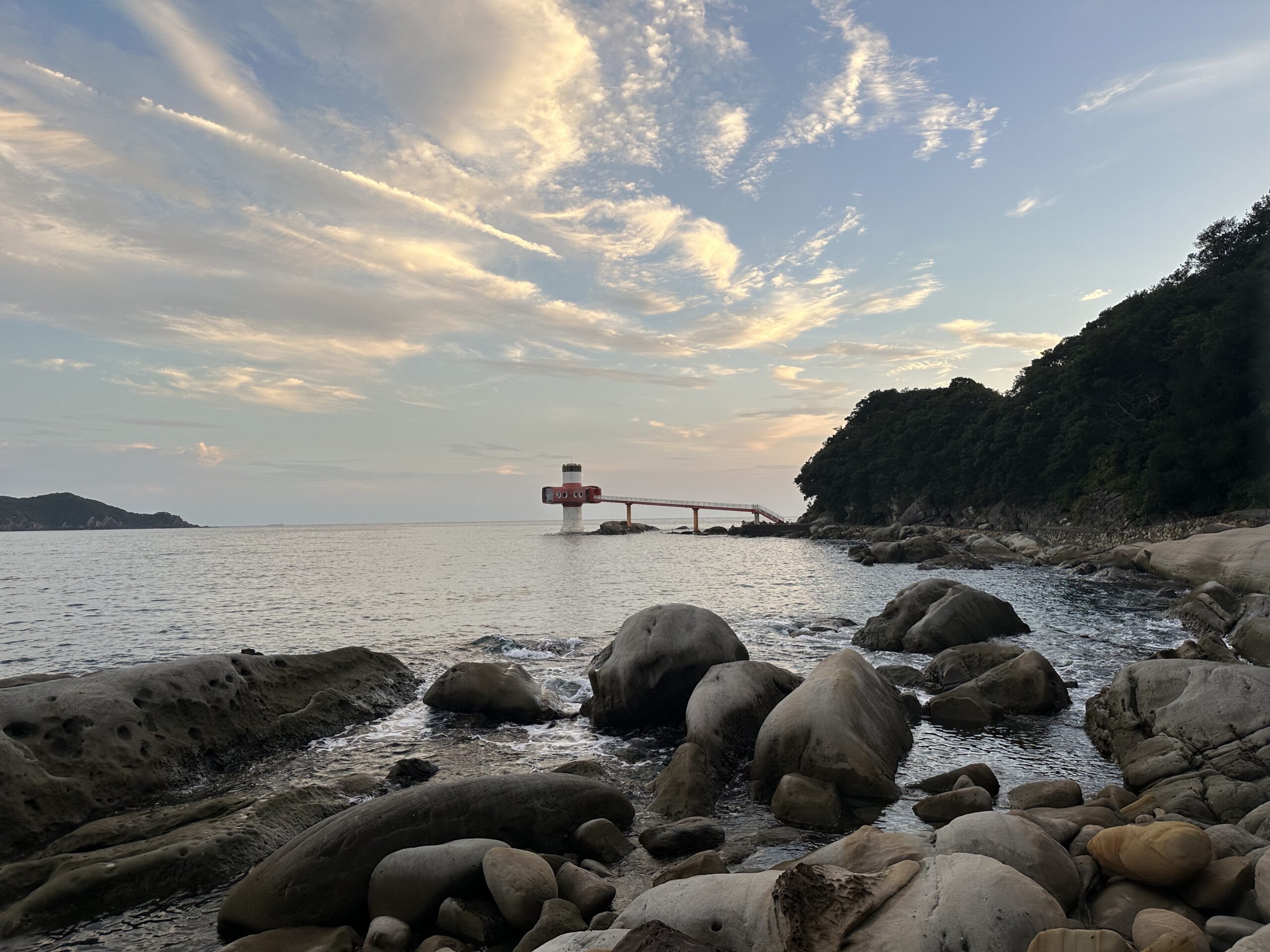
I went for a walk outside at 5:10pm. The rain clouds had cleared and the pale blue skies were beautiful as the sun was about to set. Misaki town is located within the Ashizuri-Uwakai National Park. Near my hotel are two family-friendly attractions – the Ashizuri Kaiyokan Aquarium SATOUMI and Ashizuri Kaiteikan Underwater Observation Tower. There is also a campsite called Snow Peak Tosashimizu Campfield with container-shaped sleeping cabins.


As I walked on the path towards the underwater observation tower, I saw lots of crabs scuttling across the ground near the rocky shore. Some of them were bright orange while others were dark brown. There were plenty of crevices in the rocks for them to hide in the shallow pools.


The observation tower was already closed so I didn’t walk all the way to it. Anyway, I could see it from afar. The quirky-looking tower is the symbol of the Tatsukushi/Minokoshi area ever since it opened in 1972. It comprises of an above-ground observation tower and a gallery below sea level with windows offering views of fish and other sea creatures.

As I walked back towards my hotel, I savoured each moment because I was acutely aware that my Shikoku Challenge was coming to an end soon. The tranquil environment and beautiful scenery allowed me to reflect and count my blessings. Nine days of solo cycling so far, and everything had been smooth. Even what I dreaded – the rain today – didn’t last that long so there was a lot to be grateful for.
I went to the dining hall for dinner at 6:20pm. I was the first to arrive. The low tables were placed on tatami mats and each table had a small handwritten sign indicating a room number. I found my table and sat on the low chair. The utensils and tableware were already set on the table.

At 7,200 yen (S$62.64) for one night’s stay, I wasn’t expecting much. However, dinner turned out to be a feast. There was a lot of food, including tuna sashimi, tempura, Nabe (hot pot), sushi rolls and of course, Katsuo no Tataki (seared bonito), since I was still in Kochi. I usually eat a lot, but even then, this was too much food for me. While not as exquisite at the meal at Kuroshio Honjin two evenings ago, the dinner at Hotel Orange was still marvellous.

A Japanese multi-course meal is meant to be savoured slowly, not rushed through, so I took my time to eat. The tuna sashimi was excellent, as was the bonito. The bonito sauce was a bit too salty but it paired well with the onion and spring onions. And you can’t really go wrong with tempura and hot pot. I was very proud of myself as I managed to finish everything, because I don’t like to waste food.
On a side note, I love how Japanese tableware are all so pretty, which really enhances the dining experience. Each plate and bowl has a different shape and size and each one has a specific purpose – to serve one type of dish.


After the sumptuous dinner, I retreated to my room to rest. It was pitch dark outside and there was nothing to see. Yet strangely, there were several other people staying in the hotel. I wondered who they were and why they chose to come to such a small and quiet town. Were they local tourists, or here for business? It was a mystery to me.

I went to bed early, exhausted after a day of good riding. At this point, the mind was willing but the body was feeling the accumulated effects from all the cycling. Day 9 of the Shikoku Challenge completed, just two more days to go. I can do this!