Day 7 – 16 October 2025, Thursday
After the longest cycling distance yesterday, today’s ride will be the second-shortest of the Shikoku Challenge. Hence, it will be a more relaxed day and I can squeeze in a bit of sightseeing in the morning before starting my ride.
I woke up at 6:00am to 22 degrees C weather. The forecast showed that it will be cloudy today with an 80% chance of rain, and the temperature hitting a maximum of 27 degrees C. After a morning soak at the onsen, I had breakfast at the hotel before heading out at 7:30am to explore Kochi city.


Compared to the energy and bustle last night when I arrived, Obiyamachi was very quiet in the morning. All the shops were still shuttered and the shopping arcade was empty, save for the odd passer-by and students riding bicycles.

I strolled through Toyodenka Central Park, a small park with an open plaza and a playground for children. The Koban (police station) was very cute, a tiny, three-storey building with a semi-circular shape. I love architecture like this. A building need not be flashy or big; it can be small yet thoughtful and interesting.


I soon reached Harimaya Street, where the famous landmark Harimayabashi is located. The bright, vermillion wooden bridge is only about 10 metres long. It was originally built during the early Edo period as a private bridge over the Hori River. The bridge is famous because it was mentioned in a popular folk song called Yosakoi-bushi.


As I walked along the main road of 1-Chōme, I saw the Otepia Kochi Library, a beautiful building harmoniously marrying concrete, glass and wooden panels in different shades of light brown. Understated and elegantly designed.


Across the road from the library is Kochi Otemae High School, and the Tosa Girls’ Junior and Senior High School next to it. Many students in their white and navy blue uniforms were busy making their way to school. It seems that most of the students here are very independent, either walking or cycling to school by themselves, rather than having their parents send them to school, like what many parents in Singapore do.


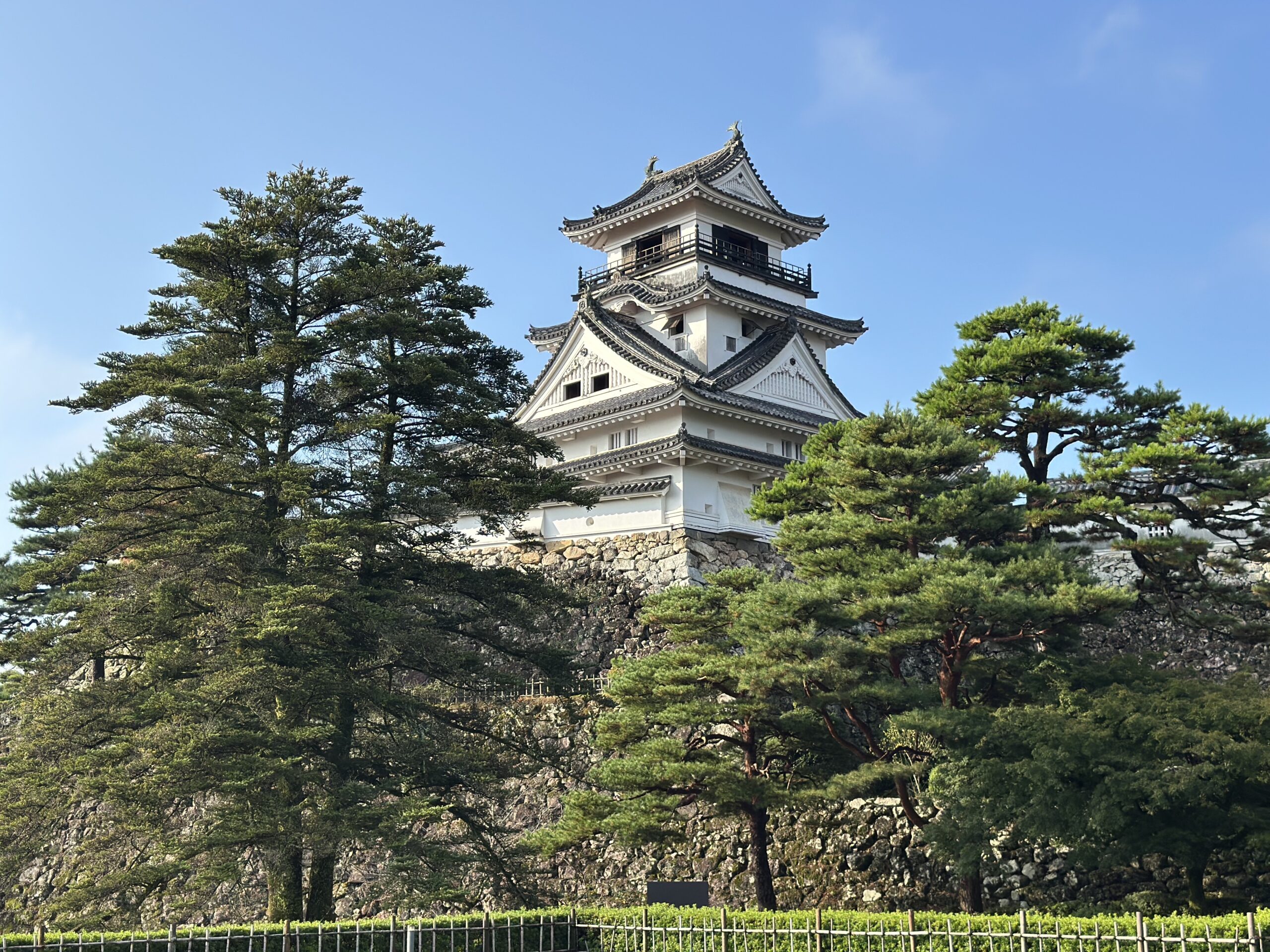
At 8:05am, I reached the entrance of Kochi Castle. The present castle was constructed in 1611 but a great fire destroyed most of the castle, except the wooden Otemon (main gate) and the structured stone walls of the original complex. The Tenshu (main keep, the highest tower) and other parts of the castle were rebuilt in 1753 in the original style. Kochi Castle is significant because it is the only castle in Japan with its original buildings (from the 18th century reconstruction) intact.


Walking through the historic Otemon is like entering a different world. All the traffic noise from outside ceased and I could hear only the sounds of insects and birds chirping. I climbed a series of steps to reach the upper parts of the complex. As I climbed, I was surrounded by lush, green foliage and imposing stone walls of the ancient castle. A few other early risers were taking their morning stroll within the grounds, but otherwise, it was very quiet and almost devoid of people.


I saw the magnificent Tenshu, which occupied the highest point of Otakayama Hill. To be honest, the tower looked similar to the ones I had seen at Matsuyama, Imabari and Marugame earlier, and even the famous Osaka Castle. It could be a case of if you’ve seen one, you’ve seen them all. But Kochi Castle is still worth a visit since the castle grounds are free to enter. You only need to pay if you wish to visit the Tenshu (500 yen admission fee).


After spending 20 minutes at Kochi Castle, I walked back to my Dormy Inn hotel. Most of the shops were still closed but there were more signs of life on the street as the morning went on. I’m glad I got to see a bit of Kochi, which looks like quite a vibrant city. Back in my room, I took a quick shower, did my final packing, geared up then checked out of my room and started my ride at 9:30am.


The itinerary for Day 7 of the Shikoku Challenge is to cycle 58.6km from Kochi to Tosa-Kure, less than half of yesterday’s distance. The elevation gain is 515m, which is comparable to yesterday’s ride. Along the way, there will be just one checkpoint. After yesterday’s super long ride, it should be pretty relaxing today.


45 minutes after leaving Kochi city, I hit the coast, where the ocean stretched endlessly into the horizon. It was just incredible how the sea was completely devoid of any ships or landscapes, with absolutely nothing breaking the perfect, straight line between the water and the sky. I stopped for a few moments to admire the view and listen to the soothing sound of waves crashing onto the shore.


At 10:48am, I stopped at Usa Shiokaze Park for a toilet break. This is where many ships dock and depart from Usa Port for whale-watching at Tosa Bay nearby. The main species of whale at Tosa Bay is Eden’s Whale. They can grow between 10 and 15 metres in length and are commonly found in the coastal waters around Kochi Prefecture, which are fed by the warm Kuroshio ocean current.
Whale watching tours run from May to end October, but the best period with the highest chance of seeing the whales is between August and September. As it was currently approaching the end of the whale-watching season, there weren’t any tour groups around. I bought a small bottle of apple juice drink from the vending machine, refuelled and continued cycling at 11:00am.


The next section of the route brought me to Uranouchi Bay, a long and narrow bay stretching nearly 9km from east to west within the intricate terrain of a ria coast, which is a drowned river valley that remains open to the sea, extending a distance inland. This unique geographical phenomenon results in a serene and picturesque landscape with calm waters and no waves.
As I cycled along the jagged coastline around the inland bay, the scenery looked the same after a while. But when you cycle for 7 or 8 hours a day, not every minute of the ride will be spectacular. In fact, most of it will be mundane. But as I mentioned before, you need the mundane to make the spectacular spectacular. It is all part of the journey and experience.

And while I was cycling through this rural area, I wondered to myself: Will I be able to live in a place like this, where the nearest big city is a few hours’ drive away? Can I survive without any shopping malls or concert venues nearby? How will I satisfy my entertainment fix? Having lived in Singapore my whole life, I think I am still very much a city boy at heart.
At 11:45am, I stopped at the first convenience store I came across at a little town centre in Uranouchi. I was starting to feel sleepy after that long mundane stretch and badly needed something to perk myself up. I bought a dorayaki and a can of cold milk coffee to inject some sugar into my body.


Shortly after that, I reached the innermost point of Uranouchi Bay. The route turned inland and the scenery got better. I cycled through valleys with rice fields and green hills on both sides. I was even happy to have a bit of a climb to break the monotony of the past couple of hours.


I reached Susaki city at 12:45pm. Finally, some signs of civilisation again! I received a text message from CK, who said that he and his two other Hong Kong buddies were having lunch somewhere in Susaki. I wasn’t sure exactly where they were, but I continued cycling to the checkpoint at Kawauso-no-Sato Susaki roadside station, arriving at 1:05pm. To my surprise, I saw three bicycles parked outside, and there they were!
It was great to see them again, even for a short while. They had already finished their lunch and were about to resume their ride. They needed to hurry because they booked an accommodation in Taisho, about 50km away from here. My accommodation in Tosa-Kure was only about 12km away. Hence, they had a much longer way to go whereas my cycling day was coming to an end.


After collecting my stamp, I bought a couple of roadside station stickers and a magnet from the retail shop as souvenirs. I also bought a scone and a small bottle of green tea to refuel. I initially wanted to have a light lunch in Susaki but the restaurants I shortlisted were either closed or didn’t look very appetising. Hence, I decided to settle for a snack since I wasn’t very hungry anyway.


I continued cycling at 1:40pm. 15 minutes later, I bumped into the Hong Kong trio again. As they restarted cycling earlier, they were ahead of me. However, they discovered that the official route ahead was closed so they backtracked out. It was closed because of a landslide and the authorities were working hard to restore the road. CK was about to text me to inform me about the road closure when I met them at the intersection. That’s what I love about the Shikoku Challenge, it brings people together and we help each other out!

As a result of the road closure, we couldn’t go by the more scenic coastal road, and had to use the shortcut through the hills. Today was meant to be a short ride but it became even shorter for me. After the brief meeting, we went our separate ways again.


At about 2:25pm, I arrived at Nakatosa, a fishing town at Kure Bay. Tosa-Kure is the main train station here. Before going to my accommodation, I stopped at FamilyMart to buy an egg sandwich and some snacks to munch on later.


I then continued cycling around the bay and climbed a steep hill to get to my accommodation, Kuroshio Honjin, arriving at 2:47pm. My Strava showed that I cycled 54.90km today, with an elevation gain of 428m. It was the second shortest distance for the Shikoku Challenge, and a relaxing ride overall.


As I wheeled my bicycle to the main entrance, the staff informed me that I could not bring my bicycle to my room. Understandable, because Kuroshio Honjin is a high-class ryokan, a traditional Japanese inn. So, I spent some time stripping my bike before locking it to the bike stand at the entrance. It was a hassle but it had to be done. Shoes are also not allowed to be worn in the premises so I deposited my footwear at the entrance and used one of the slippers provided.
Ryokans are where you experience the best of Japanese hospitality and the entire experience begins the moment you step in. After checking in with reception, a male staff member named Yano-san brought me on a tour of the ryokan to show me where all the facilities were located. He took me to the onsen on the lowest floor and showed me the rotenburo, a traditional Japanese outdoor hot spring bath. The view from the rotenburo was just wow. He then led me to my room on the 4th floor, which was the top floor. When he opened the door, my jaw dropped. The room was huge and gorgeous.

The main sleeping area had 10 tatami mats, large enough for five futons. Beyond the sliding screen doors was a sitting area with a low table and four chairs. The balcony had the most marvellous view of the Pacific Ocean. But that’s not all. The other side of the room had a toilet, a vanity room with a wash basin and tri-fold mirrors, and a separate bathroom. The bathroom had a standard sit-down shower area but also a small rectangular granite bath with the same amazing view of the Pacific Ocean. If you’re lazy to go to the onsen downstairs, you can simply soak in the indoor hot bath in the room.


After Yano-san introduced all the features of the room, he asked me what time I would like to have my meals. Kuroshio Honjin was the most expensive accommodation for my entire trip – I paid 27,650 yen (S$241) for my one-night stay here. The room rate included two meals – dinner and breakfast. For dinner, there are three sittings – 5:30pm, 6:00pm or 6:30pm. For breakfast, there are two sittings – 7:30am or 8:00am. I chose 6:00pm for dinner and 7:30am for breakfast. With all the necessary procedures completed, Yano-san took his leave.
I started to unpack my stuff and go through my usual SOP. However, I was very keen to try out the onsen so I took a cursory shower, put on the yukata and headed downstairs. I did not even hand-wash my cycling jerseys first, as I usually would. That can wait till after I’ve dipped in the onsen!

There are two baths and they alternate between men and women every day. This allows all guests to experience both baths during their stay, as the two baths come with slightly different designs and views. For today, the male bath is on the right side. The indoor bath is large and rectangular, with big glass panels offering a superb view of the Pacific Ocean in the distance. The indoor bath uses regular hot spring water.
The outdoor bath, or rotenburo, uses seawater and the hot pool is made of rocks to add to its natural appearance. At the far end of the outdoor area is a much smaller rock pool, right at the edge of the slope overlooking the ocean. The view here is even better but the water is cold. After taking a proper shower, I went to dip in all the pools to relax and soothe my muscles. It was especially nice to soak in the hot outdoor pool and feel the cool natural air on my face while gazing into the ocean and sky. After the onsen visit, I went back to my room to wash my clothes and rest up before heading for dinner at 6:00pm.


As instructed by Yano-san, I went for dinner dressed in my yukata. When I arrived at the restaurant, the very friendly staff escorted to my seat and the dinner experience began. I picked up the menu on the table, which showed that it would be a nine-course meal. The menu was written in Japanese but I used Google to translate it.


I can only describe the entire dinner as exquisite. It started with a small shot of sake for apéritif, followed by an appetiser of Tosa Wagyu Japanese-style roast beef with black potato, Shimeji mushrooms and vinegared chicken. Next came a plate of sashimi, which comprised of yellowfin tuna, Kanpachi (Greater Amberjack) and another type of unknown fish. The yellowfin tuna was so fresh!


After that came the Kuroshio specialty, Katsuo no Tataki, or seared bonito. This is Kochi’s signature dish, where bonito (skipjack tuna) is seared over a straw fire. The intense flames grill only the outer layer of the fish and charring it, while leaving the inside rare. The bonito is sprinkled with salt and traditionally served alongside condiments of spring onions, garlic, seaweed and ponzu, a citrus-based sauce that includes yuzu. I had tried seared bonito at Hirome Market yesterday but today’s one was even better. The bonito just melted in my mouth while the outer edges were smoky from the rice straw.

Next was the “warm food”, which comprised of golden-eyed snapper fish, burdock root, tofu and Japanese onion cooked in a small pot of boiling soup. This was accompanied by the “oily food”, which comprised of various types of tempura – deep-fried swordfish with seaweed, pumpkin, lotus root and a shrimp cracker, plus seaweed salt. The swordfish roll was especially delicious.


Of course, the meal wouldn’t be complete without chawanmushi. The steamed egg custard contained shitake mushroom, shrimp and scallop beneath its glossy surface. The chawanmushi was soft and smooth as silk, it was so good.

When I thought I couldn’t possibly eat anymore, the last main dish was served – bonito rice with small portions of vegetables and a bowl of soup. The bonito rice was quite similar to the one I ate at I-kko restaurant in Tokushima three nights ago, with small chunks of bonito fish, carrot and mushroom.

But there’s always room for dessert, which was yuzu jelly in soy milk with kudzu mochi. The yuzu jelly was served in a lemon-shaped bowl and it was very cute. When I finished my dinner an hour and 10 minutes later, I was completely filled to the brim.

I honestly didn’t expect there to be so much food. Actually, I was already very full when the boiled fish was served but the food kept coming so I kept going. The service and hospitality at Kuroshio Honjin is really first class. I could see that the service staff genuinely wanted me to enjoy the food and dining experience. When I gestured to the female server that I was very full, she encouraged me to eat slowly. So motherly and cute!

Upon returning to my room, I saw that my futon was laid out for me. That is part of the ryokan experience, sleeping on a futon on the tatami mat floor. I let my food digest a little before taking another evening dip in the onsen. By this time, it was pitch dark outside so there wasn’t any view of the Pacific Ocean anymore.
End of Day 7 of the Shikoku Challenge, just four more days to go. But let me enjoy my night in this expensive ryokan first!

