Day 13 – 22 October 2025, Wednesday
I woke up early this morning at 4:45am and had breakfast in my room – my favourite egg sandwiches from FamilyMart and drip coffee provided by the hotel. I checked out at 5:50am and walked to the airport limousine bus stop at Okaido in front of Mitsukoshi department store, just a 1-minute walk away from Candeo Hotels.

Matsuyama was quiet and deserted in the morning. It was another chilly day, with the temperature at 16 deg C, and slightly drizzling. There was a line of taxis waiting but no passengers took up the offer. When I reached the bus stop at 5:53am, I was surprised to see that I was not the first. There was one other lady already waiting.


The earliest bus service is at 6:11am. With my domestic flight to Tokyo departing at 7:30am, I was worried that I would be cutting it too close. Normally, I like to arrive at the airport very early because I want to eliminate the likelihood of meeting any unforeseen circumstances that will cause me to miss my flight. I was seriously contemplating if I should take the taxi instead. In the end, I decided to keep faith in Japan’s efficiency and pray that the road traffic and check-in process at the airport would be smooth.

The limousine bus arrived precisely on time, as expected. A few other people had joined the queue by then. I paid for the fare using the digital Suica card on my iPhone Wallet. The fare from Okaido to Matsuyama Airport is 1,180 yen (S$10.27). Along the way, we picked up several other passengers.
Traffic was smooth and we arrived at Matsuyama Airport at 6:38am. Even at that early hour, the airport was busy. There were about 25 people in front of me at the ANA check-in counters. I tapped my fingers nervously as I stood in line. Thankfully, the queue moved pretty quickly. As it was a domestic flight, most of the passengers were locals and they didn’t have any check-in luggage. Hence, the process was efficient and I cleared Immigration and Customs by 7:00am, phew. Boarding started 15 minutes later and my ANA flight NH582 departed Matsuyama at 7:30am, touching down at Tokyo Haneda Airport Terminal 2 at 8:52am.


To get to my accommodation in Shinjuku, I decided to take the Tokyo Monorail. It requires a transfer at Hamamatsucho Station. According to my research, the fare is 720 yen and the journey takes about 52 minutes. Alternatively, you can take the Airport Limousine bus, which is faster (about 45 minutes) but almost twice as expensive (1,400 yen).
Another option is the Keikyu Line train, which also requires a transfer, at Shinagawa Station. The journey takes around 50 minutes, similar to the Tokyo Monorail. The fare is cheaper at 535 yen but the train runs less frequently than the Monorail. Balancing all the pros and cons, I decided that the Tokyo Monorail is the best option.


The Monorail departed Haneda Airport T2 at 9:25am. Along the way, it stopped at T1 and T3 before going to Hamamatsucho Station. It was my first time taking the Tokyo Monorail, because I usually fly in to Narita instead of Haneda Airport. It was a pretty cute train, with seats not only on the left and right sides, but also in the centre. I sat at the forward-facing seats in the centre. The seat was elevated so I could see the view from both sides, which was great. The Monorail moved quite fast but the ride was slightly bumpy, rocking from side to side.

I alighted at Hamamatsucho Station at 9:43am. When I tapped out at the gantry, I saw that the fare was 519 yen. I then transferred to the JR Yamanote Line, taking the train at platform 3, heading for Shinagawa, Shibuya and Shinjuku. I boarded the train at 9:52am and alighted at Shinjuku station at 10:19am. I tapped out again and the fare was another 208 yen. Hence, my total fare was 727 yen (S$6.32) and the journey took 54 minutes.


You probably know that Shinjuku Station is the world’s busiest railway station, with over 200 exits. It can be a maze and a nightmare for first-time visitors. However, it is not as scary as it seems because the signs are very clear and they are all written in English as well. I exited at the South East Gate and walked just 2 minutes to reach my accommodation, Anshin Oyado capsule hotel.


I have stayed at this capsule hotel before so I am familiar with it. Since I was travelling alone, I wasn’t too fussed about staying at a nice hotel because accommodation in Tokyo is expensive. I chose Anshin Oyado because of its excellent location and facilities. At 6,980 yen (S$60.63) a night, it was an affordable option that ticked all the right boxes. It was still too early to check in so I deposited my big luggage with the front desk before heading out again.


It felt great to be back in Tokyo, perhaps my favourite city in the world. Unlike Shikoku, I have been to Tokyo many times so it feels like a homecoming in some ways. It was nice to be back in a familiar place, where I know all my favourite shops are, and how to find my way around. For my two days’ stay in Tokyo, I just wanted to relax, shop at my favourite record stores and revisit some places.
Cold weather always makes me hungry. The temperature was 13 deg C, even colder than in Matsuyama. I decided to go to Ichiran for a bowl of hot ramen. The nearest outlet was just 3 minutes’ walk away. I arrived at 10:34am and waited 15 minutes for a seat, which was not too bad. I ordered the Ichiran Select 5 for 1,850 yen (S$16.10). It comprises the classic tonkatsu ramen with dried seaweed, extra four pieces of sliced pork, Kikurage mushroom and a half-boiled salted egg. It was as delicious as always.


With my stomach filled, I went back to Shinjuku Station and took the JR Yamanote Line train to Ueno. The journey took 14 minutes and I arrived at 11:50am. I noticed that many Japanese read hard copy novels on the train. That is something you very rarely see in Singapore, where everyone is glued to their mobile phone screens.


I haven’t been to Ueno in years. I walked through Ameyoko Market but it was as off-putting as I remembered it. There were simply too many tourists and most of the retail shops were operated by non-Japanese. It started to rain so I went to the BOOKOFF PLUS+ store to hide. I managed to buy a few MJ and Janet titles there, which pleased me.


I then took the Ginza Line from Ueno-okachimachi Station to Ginza Station, arriving at 1:41pm. The fare for the 9-minute train ride was 178 yen (S$1.55). I also haven’t been to Ginza during my last few visits to Tokyo so I decided to check it out this time. I was badly in need for coffee after the early flight.


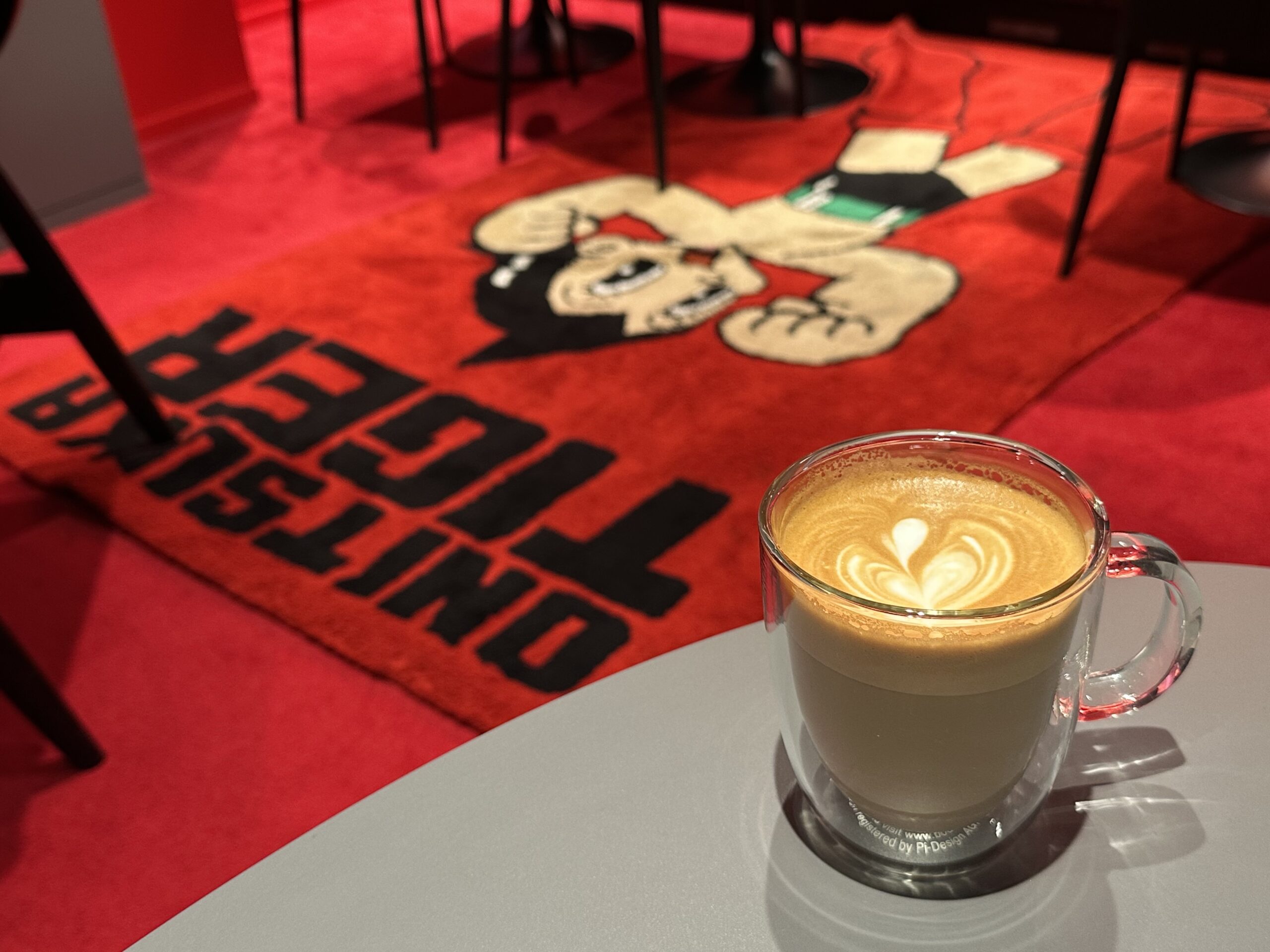
I went to Onitsuka Tiger Café located on the second floor of the Onitsuka Tiger Red Concept Store at Matsuya-dori. The retail shop on the ground floor was crowded but the café was surprisingly empty at 2:05pm. Like the store, the café is furnished with the same colour scheme – blood red carpets and walls with black leather seats and tables. At the far end, there was also an Astro Boy image on the carpet. The café gave off a futuristic, Matrix kind of vibe.


The menu was limited and they only had coffee, juices and kakigori (shaved ice dessert). The only food item available was quiche. I ordered a cup of hot latte. It was pricey at 1,000 yen (S$8.70) but it was good and strong. Just what I needed. The café was a quiet place to escape the madness that is Ginza and Tokyo. If you ever need a break from all the shopping, you can consider chilling at the Onitsuka Tiger Café.

After being in Shikoku for more than a week, Tokyo feels absurdly crowded and flooded with tourists. It’s funny I feel this way because I am also a tourist, but I miss the solitude of cycling alone and walking through the quiet streets in the small towns in Shikoku. I guess that’s how the locals feel about Japan being overrun with tourists, especially in major cities like Tokyo, Osaka and Kyoto.
The rain continued to fall for the rest of the afternoon in a light drizzle. It’s annoying to carry an umbrella when you’re shopping because you’ll need to keep your umbrella whenever you enter a store. Thankfully, the rain was not that very heavy so I just used my rain jacket to keep me dry.

I popped in to the GU and Uniqlo flagship stores at Ginza. GU is the sister brand of Uniqlo and it offers a similar range of casual wear but at a slightly lower price range. The GU store has five floors but that is nothing compared to the Uniqlo store, which has a massive 12 floors, including a café on the top floor.

The Ginza Uniqlo flagship store features some exclusive items but otherwise, the range is largely the same as the other stores. It was amusing to see tourists (especially Western tourists) snap up all the items. I didn’t buy anything because we have Uniqlo back in Singapore, and the price difference here isn’t enough to justify me lugging all the shopping home.


I also dropped by the Hankyu Men’s Tokyo department store and visited Ginza Records & Audio on the 7th floor. The selection wasn’t very big but I found a Janet promo 12” single at a good price. I was very tempted to buy the MJ 9 Singles Pack pressed on red vinyl but its 40,000 yen (S$348) price tag was way beyond my budget so I reluctantly put it back on the shelf.


I then took the Marunouchi Line from Ginza Station back to Shinjuku-sanchome Station, arriving at 4:54pm. The fare for the 15-minute ride was 209 yen (S$1.82). I was hungry again so I searched for a place to have an early dinner. I found a conveyor belt sushi restaurant called Oedo located near Shinjuku Station. When I stepped inside, I remembered that I have been here before on a previous visit.

It was a typical conveyor belt sushi restaurant with a long island in the middle where the sushi masters are stationed, and counter seats around the island. It was fun to sit at the counter and watch the sushi masters prepare the food and add on to the never-ending procession of sushi plates along the conveyor belt.

Conveniently for tourists, they have an English menu with photos of all the different types of sushi. The sushi was affordably priced, with 52 types of sushi priced at 190 yen (blue plates), 9 types of maki at 240 yen (green plates), 20 types of sushi at 280 yen (red plates), another 4 types at 340 yen (light blue plates) and 5 of the most premium ones at 380 yen (purple plates). You can place your order with the staff or simply pick whatever you like from the conveyor belt.

I had six plates of sushi, amounting to 1,560 yen (S$13.57) altogether. Besides the usual salmon and tuna, I also ordered Kujira (whale meat) and Basashi (horsemeat) because these are exotic meats not available in Singapore. To be honest, they taste…normal. In fact, the texture and taste are just like fish, nothing really extraordinary.


After dinner, I went back to Anshin Oyado to check in and get my capsule key. I took a nice hot bath to freshen up and dropped my backpack in the locker before heading out again at 6:25pm. One of the reasons I wanted to stay in Shinjuku is because there are many CD and record shops in the area. I first went to Disk Union, an all-time favourite.

There are four Disk Union stores in Shinjuku, all within walking distance of each other. Each store specialises in different genres. The main store has 8 floors specialising in J-Pop/Rock, anime/game music, progressive rock, Latin/reggae, 60s & 70s rock, 80s rock/alternative, and punk/hardcore. The second store specialises in soul/hip-hop/dance, jazz, soundtracks and all genres. The third store specialises in rock and heavy metal, and the fourth store specialises in classical and all genres. It really is a Mecca for music lovers – collectors of physical media like CDs and vinyl records.
I went to the second Disk Union store, which is closest to Anshin Oyado. It is the best one for me because in Japan, MJ/Jackson 5/The Jacksons are classified under “Soul” due to their Motown roots. Even though MJ is the King of Pop, he is still regarded as a Soul artist in Japan. On the other hand, Janet is usually classified under “R&B”. Disk Union never fails me and I found a few Japanese pressings of the Jackson family titles here.


Next, I went to HMV Record Shop. During my previous visit in October 2024, the store was located on the 6th floor of Shinjuku ALTA building. However, the shopping complex closed on 28 February 2025 after being in business for 45 years, and HMV Record Shop relocated to the 8th floor of Shinjuku Marui Main Building in May 2025. I’m just glad it didn’t cease operations. I wasn’t expecting much but I managed to find a few titles here so I was happy.

By 8:25pm, I was quite tired but also hungry again. I shortlisted a tonkatsu restaurant but there was a long queue so I settled for Yoshinoya, another of my go-to places for a quick and affordable meal. I ordered my favourite unagi rice bento set with a side portion of beef. It even came with a free drink of your choice, self-service from the vending machine.


As I made payment and left the restaurant, I noticed that the service staff here in Tokyo are more jaded compared to those in Shikoku. Their exhortations of “Arigato Gozaimasu” feel more customary and less enthusiastic compared to Shikoku, where I could really feel the warmth and sincerity of the service staff. That’s the difference between a big city and a small one. The hustle and fast-paced life can wear you out sometimes, especially when you have to deal with foreigners who don’t understand the language and culture well.
Earlier, while I was on my way to Yoshinoya, I came across three people on a street karting tour, braving the rain and 12 deg C weather to go-kart on the roads. I don’t think it’s much fun when it’s cold and wet. It reminded me of my own street karting experience in Okinawa in April 2025, when we had perfect, sunny but cool weather. You really need a bit of luck when you travel, and the weather plays a big part in how much you will enjoy your activities, especially if they take place outdoors.

After dinner at Yoshinoya, I went back to Anshin Oyado and called it a night. If you’ve not stayed at a capsule hotel before, you should definitely try it once. Anshin Oyado is a good starting point because it is considered a “luxury” capsule hotel chain so you will get the capsule hotel experience but with more comfort. They have six outlets in Tokyo. Three of them are men-only, including the one I’m staying at in Shinjuku. Two outlets are women-only, and the last outlet has separate floors for men and women.

For guys, Anshin Oyado Shinjuku is an excellent choice. Besides its great location and reasonable price, it is clean, safe and extremely traveller-friendly. You can deposit your luggage for free in the store room before checking in and after checking out, so you can continue to shop in Tokyo without worrying about your luggage.
The shared lounge on the third floor provides free soft drinks and free meals ranging from curry rice for breakfast to ramen for supper. Alcoholic drinks are also provided in the evening. There are even massage chairs and a manga library.


Everything that you need to survive is also provided for. Toiletries like toothbrushes, shaving kits, shampoo and shower gels are all available for free. Towels are also provided. There are also mineral water dispensers on each capsule floor so you don’t need to buy drinking water. But best of all, there is an artificial hot spring and sauna on the second floor so you can end your day on a relaxing note.

If you’re wondering what’s the process and etiquette when you stay at a capsule hotel, let me guide you through it. Before entering the building, you’ll need to remove your shoes and store them in one of the shoe lockers for free. You can then put on a pair of slippers for indoor use. Upon checking in, you’ll be issued a wristband with your capsule number on it. If you have a large suitcase, you will have to keep it in the store room next to the front desk (for free) because you won’t be able to bring it to your capsule.


Next, pick up a set of indoor clothes before heading to the changing room. The indoor clothes are like comfortable pyjamas, and everyone will wear the same attire when they are in the building. At the changing room, you can change out of your regular clothes and store them and any other belongings (like a backpack or day bag) in a personal private locker. Once done, you can head to your capsule, which is located on the 4th to 7th floor.

Anshin Oyado Shinjuku has 256 capsules altogether so each floor has 64 capsules. Each room has two rows of capsules, stacked on top of each other. The capsules on the upper level are slightly cheaper than those on the lower level because it requires a little more effort to climb to the capsule on top.


The common toilets and wash basins are located outside the rooms on each floor. There are no showers so you’ll have to take your bath in the public bath on the second floor, where the artificial hot spring and sauna are located.


The capsule itself is quite spacious and comfortable. I booked the Standard Capsule, which is 1m wide, 2m deep and 1m high. It was big enough for me without making me feel claustrophobic. I could sit up comfortably without knocking my head on the ceiling. If you’re taller than me (I am 1.75m tall) or you feel like you need more headroom, you can book the special capsule with a ceiling height of 1.4m. Of course, that is a bit more expensive.

Inside each capsule, there is a clothes hanger, mirror, TV (for video-on-demand), fan and even a power socket so you can have peace of mind and charge your mobile phone and electronic devices by your bedside. For privacy, each capsule also has a roller screen blinds. It cannot be locked due to government regulations but at least you can sleep in peace without your other roommates peering in as they walk past your capsule.

The only thing about staying in a capsule hotel is that you’ll need to be quite organised when it comes to packing your stuff. It’s similar to staying in a shared dormitory but the big difference is that in a capsule hotel, your suitcase is not in your room. It is not even on the same floor. Hence, you’ll have to prepare what you need for the night (e.g. travel adaptor, mobile phone chargers, any special toiletries) and carry them in a small bag to your capsule.


You’ll also have to plan your attire for the next day(s) and hang your clothes in the locker on the ground floor so you don’t have to keep pulling your suitcase out from the store room. The locker is also not very big and it can’t store all your shopping, so you’ll have to keep them in your suitcase if you buy a lot of things. In essence, you need to be quite strategic and organised when you stay at a capsule hotel.

But having said that, I enjoyed staying at Anshin Oyado and I encourage everyone to stay at a capsule hotel at least once. It is a quintessential Japanese experience and it will be something to remember. But for now, it’s time to hit the sack!