Day 12 – 21 October 2025, Tuesday
It felt different when I woke up this morning at 6:40am. I felt kind of…empty, and strange knowing that I won’t be suiting up in my Shikoku Challenge uniform anymore. For the first time in 12 days, I didn’t have to worry about keeping to a tight schedule. As usual, I went to the hotel’s onsen to wash up and have a morning soak before taking my breakfast in my room.

Today, the itinerary is to explore Matsuyama city…on foot. No more cycling, sadly. I extended my stay here for one day because I thought it would be a pity to come to Matsuyama and not see the city properly. When I set off at 8:25am, it was pretty chilly with the outside temperature at 16 degrees C. It was a cloudy day, with a weak sun straining to get past the clouds.
The hotel I’m staying at, Candeo, is located strategically in the middle of Matsuyama city. I can walk to most of the attractions or hop on a tram or bus to get to anywhere easily. My friend FA stayed at Candeo when he did the Shikoku Challenge in 2024, and he encouraged me to stay here too. Thanks FA for the great recommendation!


My first destination was Bansuiso, just a 5-minute walk away. Its entrance is located at the end of a small road tucked between the Saka no Ue no Kumo Museum and the Matsuyama Summary and District Courts.


Bansuiso is a French-style mansion built in 1922 during the Taisho era, when Emperor Taisho reigned from 30 July 1912 to 25 December 1926. The villa was built by Count Sadakoto Hisamatsu, a direct descendent of the former feudal lords of Matsuyama. The villa’s design reflects the Count’s appreciation for French-style architecture because he lived in France for an extended period as the resident military attaché.
Bansuiso was used as a social gathering place for prominent figures from various fields, like a club house for high society. Members of the Imperial Family also always stopped by Bansuiso when they visited Ehime Prefecture. Bansuiso survived the war unscathed and was designated a Tangible Cultural Property by Ehime Prefecture in 1985. The main building and the caretaker’s residence later became National Important Cultural Properties in 2011.

The villa is located on a small elevation and accessed via a long driveway. The entire area is shrouded with lush greenery and beautifully landscaped gardens. The main building really looked like a French Château, though much smaller in scale. With the green foliage of Katsuyama Hill as its backdrop and only the sound of birds chirping sweetly in the background, you could be forgiven for thinking that you were in the countryside of France rather than in the middle of Shikoku’s largest city.


The morning air was fresh and crisp. The blue skies and white clouds, together with all the greenery surrounding the villa, made it very serene. Besides me, I saw only one other tourist, a photography enthusiast who used his DSLR camera to snap many pictures from different angles. The silence was broken only by the occasional car that drove in, presumably by someone who worked here. In all, I spent about 20 minutes at Bansuiso, a short but sweet visit.
I then walked past the Matsuyama District and Summary Courts to the Ehime Prefectural Office. I have been here several times because this is where the 0km marker is located, and where I started and ended my Shikoku Challenge. But I never had the time to step inside the beautiful building so I came back to have a better look at it.


The Ehime Prefectural Office comprises four buildings – the main building, a 1st Annex and a 2nd Annex building to its left, and the Assembly Hall building to its right. The gorgeous main building was designed by Shichiro Giko, the same architect who also designed Bansuiso. It was completed in 1929, after Bansuiso.


The main building is symmetrical with a huge copper dome in the middle. It is a mix of Western and Eastern styles, with clean, Art Deco sensibilities mixed with flourishes of Japanese details, such as the bamboo-like embellishments lining the frames of the portico and main windows.

Climbing the steps and entering the building itself, I was reminded a little of the Soviet architecture in some of Russia’s metro stations. The square black-and-white floor tiles and the grand central marble staircase also reminded me of our Former Supreme Court in Singapore. I love symmetry because everything is balanced, which brings a sense of calm.


My photos don’t capture how busy it was in the morning, but the main building was a hive of activity, with government workers shuttling along the corridors and popping into the different offices. After snapping some photos, I left the Ehime Prefectural Office 10 minutes later and walked to Shiroyama Park next door.
Shiroyama Park sits within the moat of Matsuyama Castle, and it is a huge park with many large, open grass fields. The Ehime Prefectural Public Library, Ehime Museum of Art, Matsuyama Civic Centre and NHK television studio are also located here. The park is especially crowded on weekends with fairs and events, but also in the morning when many students cycle through the park to get to school.

My objective was to visit Matsuyama Castle at the top of the hill. When I looked at the park map, I realised that I made a mistake. I wanted to take the chairlift up the hill but I didn’t do my homework beforehand and ended at the wrong place. You can also take a ropeway up the hill. The ropeway runs parallel to the single-seat chairlift.
I discovered that the chairlift and ropeway entrance is located at the eastern side of the foothill, a considerable distance from where I was, which is the southern side. If I still had my bicycle, I could easily cycle over in a matter of minutes but I didn’t have my Gravier bike anymore.

Upon studying the map more closely, I saw that there are two walking trails to the top of the hill, located close to where I was. I decided to hike up the hill using the Kuro-mon Trail. I was hoping for an easy day today but it turned out to be more physically demanding than I expected. Luckily my legs weren’t aching too badly and I could still manage the 132-metres hike to the summit.

The Kuro-mon Trail was mildly steep, with a mix of paved road and stone steps. The first part of the trail brought me past the three gates, which acted as guard posts and formed the initial lines of defence for the castle. I then walked past Ni-no-maru (the second bailey) and a storehouse area before entering a forested area. The forest includes as many as 550 different varieties of plants, including camphor, blue Japanese oak, ferns and flowering cherry trees.


I took about 13 minutes to climb from Kuro-mon Gate to Hon-maru (the main bailey) at the top of the hill. It wasn’t difficult but I would have preferred to take the ropeway up. Here at Hon-maru, I saw many tour groups arriving. Seems like everyone used the ropeway except for me.
The stone walls of the main bailey are 10 metres high and very imposing, providing a strong defence for the castle. From here, I had a good view of Matsuyama city and the Seto Inland Sea. Walking through Tsutsui-mon Gate and Taiko-mon Gate, I entered a wide-open and flat area, with the Tenshu (main keep) of Matsuyama Castle at the other end. I paid the 520-yen (S$4.52) entrance fee and entered Matsuyama Castle at 9:40am.


Matsuyama Castle is one of the 12 “original” castles in Japan that have survived the post-feudal era since 1868 intact. It was constructed between 1602 and 1628. Its current three-storey main tower was reconstructed in 1820 after the original five-storey tower was destroyed by lightning. The main tower is connected to several other turrets via a series of passageways.

After entering one of the buildings, all visitors had to remove their shoes and deposit them in shoe lockers provided. If you liked, you could slip on a pair of bright green slippers for the rest of the visit. The reason for removing our shoes is to protect the floorboards of the historic building. Everything inside the building is made of wood, including the support beams, window frames and staircases.


It is easy to move around the castle because there is a recommended directional flow. However, there is quite a lot of climbing involved as you have to climb up and down some steep and narrow staircases to access the different floors and rooms. There are storyboards touching on the history of the various warlord families and many exhibits displayed throughout the different areas, such as samurai swords. You can even try on a suit of armour for free and do a photoshoot against a backdrop.


The top of the main tower serves as an observation deck, with viewing galleries on all four sides, providing a panoramic view of Matsuyama city below. The view from the tower is pretty remarkable. If you come in spring when the cherry trees on the flat hill top are in full bloom, the view will be even more incredible, a sea of pink contrasting against the greys of the buildings.


I spent about 40 minutes touring Matsuyama Castle. I must say the 520-yen admission fee is well worth it. Over the past 11 days, I saw many castles as I cycled around Shikoku but I think Matsuyama Castle’s hilltop location beats them all.

I didn’t leave Matsuyama Castle immediately after my visit. I wasn’t in any hurry because I was no longer chasing checkpoints or rushing to the next destination. I wanted to relax today. I went to the café to buy a cup of hot coffee and spent some time shooting a video clip for a vlog (that hopefully will see the light some day?).
When I finally left at 11:15am, I saw many school groups arriving. The children were all wearing bright yellow caps or bucket hats and they were being chaperoned by their teachers. Compared to the students that I’ve encountered in Singapore visiting our local museums for learning journeys, the Japanese students were definitely much better behaved.

I decided to walk down the hill and skip the chairlift/ropeway station to save some money, since the hard part is getting up and not going down. Where the trail ends (the southern side) is also closer to where I wanted to go next. I chose a different trail this time, the Kanchoura Trail. The path was smoothly paved but rather steep. Actually, going down steps would be easier.


The Kanchoura Trail ended at the rear of the Assembly Hall building. From there, I walked around the moat towards Iyotetsu Takashimaya, the largest department store in Shikoku. However, I wasn’t there to shop. I wanted to ride the ferris wheel on top of the building. I don’t usually ride ferris wheels but it’s not often you see one on top of a building so I wanted to try it.


I took the lift to the 9th floor and paid 500 yen (S$4.35) for a ticket. There was no one in the queue so I hopped on a capsule immediately. The Kururin ferris wheel is 45 metres in diameter and its highest point is 85 metres above the ground.


As the ferris wheel spun around slowly, I was treated to yet another panoramic view of Matsuyama city, albeit from a different angle. Matsuyama is the largest city in Shikoku and you really get a sense of how big it is when you’re high up above, with buildings stretching as far as the eye can see in all directions. When I reached the apex, it felt like I was as high as Matsuyama Castle in the distance. I could even see my Candeo Hotel with its distinctive beige exterior standing out amid the mass of greys and browns.


The ride took around 15 minutes. I won’t say it’s a must-do activity in Matsuyama but it’s quite fun and not that expensive. I won’t queue up for it but it’s something you can do if you just want to relax and enjoy the view.
It was time for lunch so I popped in to Matsuchika Town, a small underground shopping arcade below Iyotetsu Takashimaya. I chanced upon a tonkatsu restaurant with a set lunch promo for only 990 yen (S$8.61), limited to 20 meals per day. The staff confirmed that it was still available so I had my lunch there.


Despite being a promo meal, the tonkatsu was good as any other, with crispy crusts on a mini pork cutlet, a minced cutlet, a piece of fish, and vegetables (onion). It also came with miso soup and rice. I love a good set lunch deal!

For the afternoon, I didn’t have much to do so I decided to visit emifull MASAKI, a large shopping mall with over 200 shops. From the basement food hall of Takashimaya, I entered Matsuyama City Station and took the Iyotetsu train bound for Gunchu.
I love taking trains, especially old-school ones. The Iyotetsu train had a bright orange exterior with bench-style cushioned seats facing each other. The windows were large and the carriages were very clean, as you’d expect. I love that the train runs on street level and vehicles have to stop for the train to pass through. Being aboveground also means you can sightsee during the journey, which is great.


I also love that the train is manually operated. I moved to the first carriage so I could look through the glass window and observe the train driver as he worked. It was fascinating to see him do his hand actions and operate the levers. It looks fun to drive a train, actually!

There are two captains on the train and teamwork between them is crucial. The one in front is responsible for driving the train while the one at the back makes the announcements and operates the doors, making sure it is clear before doing opening and closing the train doors. Both roles are equally important.
Everything has to work with clockwork precision. I realised that there is only one railway track and the trains in both directions share the same track after leaving the station, which has dual tracks. Hence, the trains have to depart and arrive precisely at the stated time to avoid collisions.

The train ride took 13 minutes and I alighted at Koizumi station at 1:13pm. The fare for the 6-stop journey was 350 yen (S$3.05) by IC card. If you pay by cash, the fare is 20 yen more. The shopping mall was a short walk from the train station.
Emifull MASAKI is actually a cluster of buildings comprising Emi Mall (retail shops), Emi Gourmet (restaurants), Emi Amuse (a large Cinema Sunshine with 4DX theatres) and Emi Park (amusement rides). There are also large standalone stores for Nitori (home goods), GU (casual fashion) and DCM (home improvement) nearby.


I went to Emi Mall to do some window shopping. The mall is spacious and modern, with big-name retailers like Muji, Uniqlo, Loft, ABC-Mart Grand Stage, 3COINS+ plus, Tsutaya Bookstore, Murasaki Sports, Daiso and more. I went to the Godiva café and bought a dark chocolate shake for 750 yen (S$6.53), a little treat for myself.


After chilling at emifull MASAKI for around three hours, I took the train and arrived back at Matsuyama City Station at 4:23pm. I then went to street level and took the tram to my next destination – Dogo Onsen. If there’s one thing I love more than taking trains, that will be riding trams, mainly because we don’t have a tram system in Singapore anymore. The journey from Matsuyama City Station to Dogo Onsen took 19 minutes and the fare was 210 yen (S$1.83).


When I arrived at Dogo Onsen Station just after 5:00pm, it was packed with tourists gathered in front of a two-tiered clock tower called the Botchan Karakuri Clock. This clock was put up in 1994 to commemorate the 100th anniversary of the completion of the Dogo Onsen Honkan (main building).


The clock tower structure is modelled after the Shinrokaku, the iconic watchtower at the top of the Dogo Onsen Honkan. If you look carefully, you will see that there is a white heron at the top of the structure. Shinrokaku roughly translates to “White Heron Tower”. Legend has it that a white heron healed its injured leg by soaking in the hot spring waters, leading to the discovery of Dogo Onsen. Hence, the white heron is official symbol of Dogo Onsen.

On weekdays from 8:00am to 10:00pm, the clock puts on a “performance” every hour, where the doors of the clock tower “building” open. Figurines from the famed Japanese author Natsume Soseki’s novel Botchan emerge and move around, accompanied by music. On weekends and public holidays, the performance takes place every 30 minutes. The show lasts for slightly over 3 minutes and it is a tourist attraction, like the Astronomical Clock in Prague and Rathaus-Glockenspiel clock in Munich.
The crowd dispersed as soon as the performance ended. I followed the crowd and walked through the shopping arcade towards Dogo Onsen. The shopping arcade was lined with many interesting shops and the area was very vibrant. I regretted not coming here earlier. As I walked through the arcade, I saw many people dressed in yukata robes, as if it was the most normal thing in the world. I decided to head to Dogo Onsen first and check out the shops after.


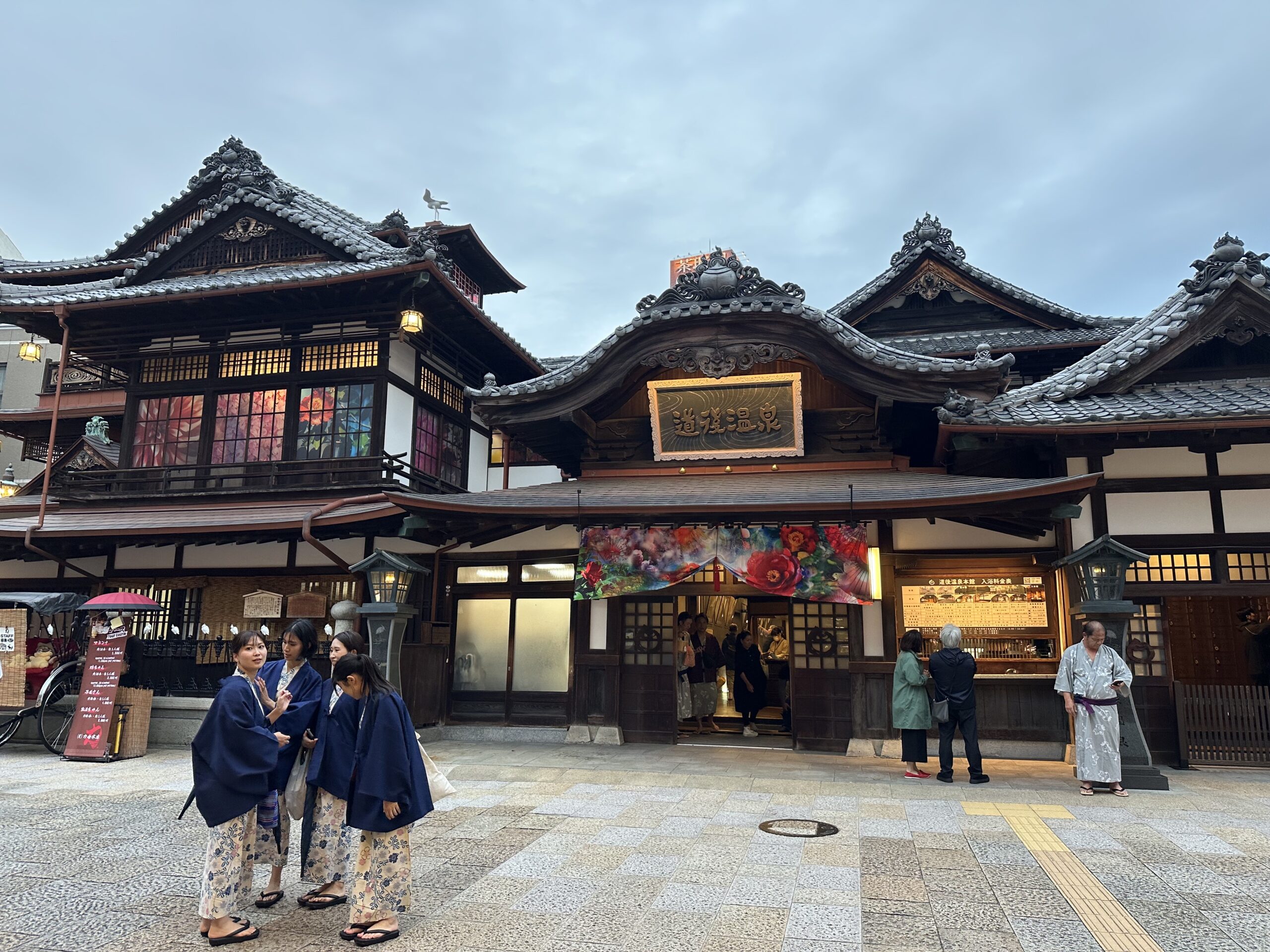
You cannot visit Matsuyama and not come to Dogo Onsen. The ancient hot spring is said to be the oldest onsen in Japan, with a history of about 3,000 years. The Honkan was built in 1894 and it was designated as a National Important Cultural Property a century later, the first public bathhouse to be bestowed the honour.
Dogo Onsen was a favourite retreat of the aforementioned author Natsume Soseki. Botchan, the main character in his novel of the same name, is a frequent visitor to the bathhouse. Dogo Onsen is also said to be the inspiration for Spirted Away, the acclaimed Studio Ghibli animated film by Hayao Miyazaki. Because of all these reasons, Dogo Onsen is a must-visit destination for everyone who comes to Matsuyama.

When I wanted to buy an admission ticket, I was a bit lost because I saw many options displayed on the price table (written in Japanese) above the ticket counter. Thankfully, there was a laminated menu in English that narrowed the options down to only four bathing plans.

What you need to know is that there are two baths in the Honkan – Kami-no-yu and Tama-no-yu. The most basic plan (Casual) costs 700 yen for adults and it provides access only to Kami-no-yu bath. The next plan (Main Course of Honkan) costs 1,300 yen and it allows you to bathe at Kami-no-yu and rest on the second floor seats, plus yukata rental and tea & snacks (sembei, or Japanese rice crackers).
The third plan (Most Popular) costs 2,000 yen and it includes everything in the second plan, but with additional access to Tama-no-yu bath as well as towel and bath towel rental. The fourth plan costs 2,500 yen and it includes everything in the third plan, but you get to rest in the private room on the third floor instead of the communal area on the second floor. You also get sweets (Botchan Dango) instead of sembei as a snack. The most logical choice is the third plan because you’ll want to visit both the baths. I paid the 2,000 yen (S$17.40) admission fee and entered Dogo Onsen at 5:12pm.


The interior of Honkan is like a maze with many stairways, passages and rooms. At the communal area on the second floor, I was presented my yukata and bath towels, and given a short briefing by a staff member on the bathing etiquette and time limit – 60 minutes including bathing and rest. After that, I was free to explore.

I brought my belongings and rented items to the changing room on the first floor and deposited them in the locker before heading to the baths. Kami-no-yu is the larger of the two baths and there is a large granite cauldron in the middle. As expected, it was very crowded and it wasn’t an entirely relaxing experience as I had to jostle with others to soak in the pool.


After I was finished with the baths, I put on my yukata and headed to the second floor to rest. I did a little photoshoot with the yukata before drinking my hot green tea and munching on the sembei cracker. Before I knew it, my time was up. All in all, I would say that at 2,000 yen, it was a bit overpriced because there are other onsens in the mountains or rural areas with nicer scenery and environment. But I guess you go to Dogo Onsen for the history and experience.


After leaving Dogo Onsen, I browsed the shops at the shopping arcade, which comprised mostly souvenir shops. It was past 6:00pm and many of them were in the process of closing for the day. I bought a couple of fridge magnets and two sets of noren, which are traditional Japanese fabric dividers hung in doorways. I also tried my hand at a gacha machine, which dispensed wrist tags similar to the ones used at bathhouse lockers.
As I walked further along, I saw a shop that had a large crowd so my interest was piqued. Upon closer inspection, I realised that it was a self-service orange juice bar called Ehime’s Dining Table 1970. Ehime Prefecture is known as Japan’s Citrus Kingdom and it is famous for mandarin oranges (Mikan) and many citrus fruits.

Urban legend has it that in the 1970s, people from all over Japan gathered at universities and boasted about their respective regions. Someone from Ehime Prefecture joked that “in Ehime homes, orange juice comes out of the tap!” Hence, this orange juice bar was born to faithfully recreate the dining table of Ehime in the 1970s. It is the first specialty store in Japan to dispense orange juice from a tap.
There are over 40 varieties of Ehime citrus fruits but only 20 are available in the store, including the most common Mandarin orange varieties like Unshu, Iyokan, Ponkan and rare hybrid varieties like Beni Madonna and Blood Orange. Each of the 20 taps dispenses one type of juice. The name of the citrus variety is labelled, alongside its sweetness, acidity, bitterness and price.


The price varies according to the variety, ranging from 220 yen to 400 yen a cup. You can pick your favourite juices, fill up the cups (which are labelled with the name of the variety) and pay at the counter. It’s quite fun because you can choose as many varieties as you like.


If you’re buying multiple cups, you can use a tray so you don’t make a mess of yourself. The trays have round holes so you can place the cups securely in the holes and carry it to the payment counter. The trays come in three options – with 3, 5 or 10 holes. I went for the 3-variety option and chose Iyokan, Unshu and Kawachi Bankan, which cost 220 yen (S$1.91) each. Iyokan and Unshu were sweeter while Kawachi Bankan was sourer. I prefer the sweeter ones.

When I reached Dogo Onsen Station, it was quiet and deserted. Most of the tourists had left and there were only a few people waiting for the tram. I took the blue line tram at 6:59pm and alighted at Okaido 10 minutes later.


For dinner, I turned to my trusty Google Maps and found a tiny backlane behind Candeo Hotels with several izakayas. From experience, I have learned that the best izakayas are those located away from the main streets and hidden from view. The smaller the alley, the better the food.

I went to one called Otokichi-ya because the staff were very friendly and welcomed me inside with a big smile. The menu was handwritten so I relied on my knowledge of Chinese characters to decipher the kanji. I ordered a plate of 6 assorted yakitori (quail eggs, a paddle of minced meat and other meats), assorted sashimi and a Kirin beer. The bill amounted to 3,460 yen (S$30.10).


The word I will use to describe the sashimi is: beautiful. It was so good. The yakitori was also delicious. The Kirin beer was ice cold and it was great even though it was a chilly day. Nothing beats pairing yakitori with a cup of ice-cold beer! I enjoyed the dinner immensely. Everything was perfect. Most of all, the service was impeccable. The staff were very attentive and ready to please even though they spoke limited English. When I left, they even went out of the restaurant to bow me farewell.
I still felt hungry so I went to Okaido shopping street to look for Round 2 of dinner. I had been craving for takoyaki since I first ate it on Day 1 of the Shikoku Challenge, so I went to Gindaco. I initially thought it was takeaway only, but the staff told me that they had seats so I went to the counter inside and ordered 4 takoyaki balls for 396 yen (S$3.45) before taking my seat.


The takoyaki was yummy as usual and I left the restaurant feeling satisfied. However, something embarrassing happened. As I walked towards FamilyMart, I noticed a guy walking close to me. He mumbled something but I didn’t hear him properly. I thought he was trying to sell me something so I brushed him aside and continued walking to FamilyMart. When I finished buying my snacks, I saw that he was still standing outside FamilyMart waiting for me. That was when I recognised him from Gindaco and realised that I had forgotten to pay for my takoyaki!
It was super embarrassing because he thought I was trying to evade payment, and he actually chased after me for it. Oh man, I wanted to dig a hole and bury my face right there! I apologised profusely and quickly walked back with him to Gindaco to make payment. I explained that I genuinely forgot to pay, and that I was not trying to cheat them. I hope they accepted my explanation.
So, why did I forget to pay? I think it was because I went to the counter to place my order, instead of sitting down at the table first and then placing my order. There are some restaurants where you order and pay first before you take a seat (mainly fast food chains like Matsuya or Yoshinoya). In this case, by placing my order at the counter before sitting down, it felt as if I had paid already.
When it was time to leave, none of the staff members looked at me or called out to me. In fact, I felt it was odd because the staff at Japanese restaurants usually thank you as you make your leave. Not a word was uttered and there was no eye contact from any staff member. It was strangely quiet and I left thinking that the service wasn’t good. Turns out I was the one at wrong here. It was a genuine mistake, and a very embarrassing one.
After that, I went back to my hotel to soak in the onsen again (can never have enough of that), relax and pack my stuff because I will be leaving Matsuyama tomorrow for Tokyo. After 13 days in Shikoku, it was almost time to leave.