Day 5 – 14 October 2025, Tuesday
When I woke up this morning at 6:00am, my body felt a bit tired. I think the accumulation of mileage over the last four days was starting to show. However, I wasn’t sore or aching, which was a good sign. I went to the onsen for a refreshing soak before having breakfast at the hotel at 6:55am. I think soaking in the onsen really helped to relieve the muscle fatigue because I hadn’t been doing any warm-up or cool-down stretches before or after my rides.
The restaurant was very busy as it was evidently a very popular hotel among businessmen and tour groups. After gearing up and packing up my stuff, I checked out of Hotel Sunroute Tokushima and started my ride at 8:25am.


The itinerary for Day 5 of the Shikoku Challenge is to cycle 91.3km from Tokushima to Shishikui, with an elevation gain of 609 metres. There will be three roadside stations along the way. However, I will be cycling a little less than that because my accommodation tonight is located about 3km before the official ending point at Shishikui town, where the final roadside station is. And this resulted in a miscalculation that left me quite disappointed, which I will elaborate later.

It was another sunny, cloudless day with the temperature currently at 23 degrees C but it got steadily hotter as the morning went on. The first part of the route was quite unremarkable and mundane, along a highway with no shade. I just kept cycling without stopping, taking advantage of the cooler weather in the morning to cover as much ground as possible.

At 9:45am, I arrived at the first roadside station at Kubo-no-Sato Nakagawa, about 20km in. There was a rather large farmer’s market here selling vegetables, fruits and local produce. I bought a mochi snack and a bottle of cold milk coffee to refuel. Actually, I wasn’t really hungry but I wanted to try some of the local snacks. And it’s true that in Japan, there are very few rubbish bins in public. I couldn’t find one here so I had to carry my trash with me until the next stop.


The next section through Anan city was inland as well and I cycled past lots of farmland, with vast stretches of padi and vegetable fields. The only noteworthy thing I encountered was a gothic-looking building near Doigasaki. The entire building was made of brown bricks and most of its façade was covered and overgrown with ivy. Intrigued by its appearance, I stopped to check it out.
There was a sign on the ground floor that said it was open for business and I saw a car parked in front of the building. However, I cycled to the upper floor and around the building but didn’t see any signs of human activity. There were abandoned vehicles and furniture lying around, giving the place a neglected feel. I got the shivers even though it was broad daylight so I decided to leave quickly.


As I write this post now, I discovered that there is a restaurant called Dai Bosatsu Tōgé located in the building. The entrance is quite hard to locate, which was probably why I didn’t manage to find it. Apparently, the food and coffee are delicious, and the atmosphere inside the restaurant is not as spooky as the outside. If you’re interested to visit, click here for its location on Google Maps.
A short while later, I cycled past a cute little house with an “Open” sign at its entrance so I stopped again. It was getting hot and I wanted a break. I had covered 38km so far, about a third of today’s distance. To my pleasant surprise, it sold ice-cream, which was just what I needed!


The café was called L’orto and it was tiny, with only one small square table for two persons, a counter with three seats and two additional seats. The café was nicely furnished, with air-conditioning, large windows, wooden floorboards and a high ceiling. It was very minimalistic and chill.
There were six flavours of gelato to choose from. I asked the staff for recommendations and she pointed me to a double-flavoured combo, which cost 550 yen (S$4.80). The white gelato tasted normal but the green one was unusual, like a vegetable. When I Google translated it, I realised it was asparagus. I wouldn’t have picked it if I had known beforehand it was asparagus, but it certainly was a unique flavour!


I resumed cycling at 11:50am. I’m glad I took the break because right after that, the climbs began. From 40km onwards, it was up and up all the way for the next 6km, reaching a maximum elevation of 121m. The route was pretty scenic though, passing through beautiful bamboo forests and lush vegetation.

I also cycled through several tunnels to get across the hills. Some of the tunnels were longer (more than 300m) and had wider cycling paths. The shorter tunnels (less than 300m) only had a narrow path at the side, which was difficult to cycle because it was close to the tunnel wall. Generally, if there is a separate path available, I will use it. But if the path is too narrow, it is actually safer to cycle on the side of the road; just pedal through the tunnel as quickly as possible and make sure your rear lights are switched on.


Despite the steep incline, the best part about the mountain road was that traffic was very light because most drivers preferred to use the alternative National Route 55, which skirts around the mountain. Hence, I could cycle slowly and enjoy the scenery without worrying about traffic. The beautiful green forests, blue skies and cool weather made the ride even more pleasant.


After emerging from the other side of the mountain, I decided to break for lunch at Hiwasa. I stopped at a small restaurant called Hara Tofu Shop at 1:05pm. The shop was small but cosy, with quirky and artistic décor. As it was closing soon at 2:00pm, there wasn’t much food left so I bought a bento set of fried chicken cutlet and a cola drink, amounting to 1,000 yen (S$8.70) in total. It wasn’t the most satisfying meal but it did the job.


A little further down the road from Hara Tofu Shop was Yakuōji Temple, which is No. 23 of 88 temples on the Henro pilgrimage circuit. I contemplated whether to visit the temple because of the time – it was already 1:40pm and I still had about 35km more to go. However, when I saw the red tower on top of the hill, I knew I had to pay a visit.
Even though the various temples have similar building structures and functions, each temple is unique because of its location and topography. Yakuōji Temple is near the coast and its hillside location offers a stunning view of Hiwasa Bay and the town below. The temple grounds were very serene and I saw many Henro during my visit.


My friend WY pointed out that the statue of Guanyin here was very interesting. The Gyoran Kannon (as she is known) carried a basket containing seafood – fish, lobster and clams. This is because she was a young woman in China during the Tang Dynasty who spread the teachings of Buddha while selling fish in bamboo baskets.


I climbed all the way to the top of the hill, where the red tower called the Yugi Pagoda was located. The Yugi Pagoda embodies the teachings of the Yugi Sutra, a sacred text of the Shingon sect. The five peaks on top of the pagoda represent Vajrayana wisdom. The single-storey tower has a square base and a cylindrical body, symbolising the non-duality of all things.


Yakuōji Temple was beautiful and well worth the 20 minutes spent visiting it. After that, I cycled over to Hiwasa roadside station just across the road to get my second stamp of the day before resuming my ride.

Shortly after leaving Hiwasa, it was time to climb again, an even bigger climb than the one earlier. The climb was steady and unrelenting, with an elevation gain of about 140m over 5km, reaching a maximum elevation of 150m. The weather had turned cooler and the skies were cloudy, which made it somewhat easier. However, it was still tough as the gradient at two of the steepest sections was 10%, which made me pause often to catch my breath. My strategy was not to hurry, and tackle it section by section. Eventually, I made it to the top.


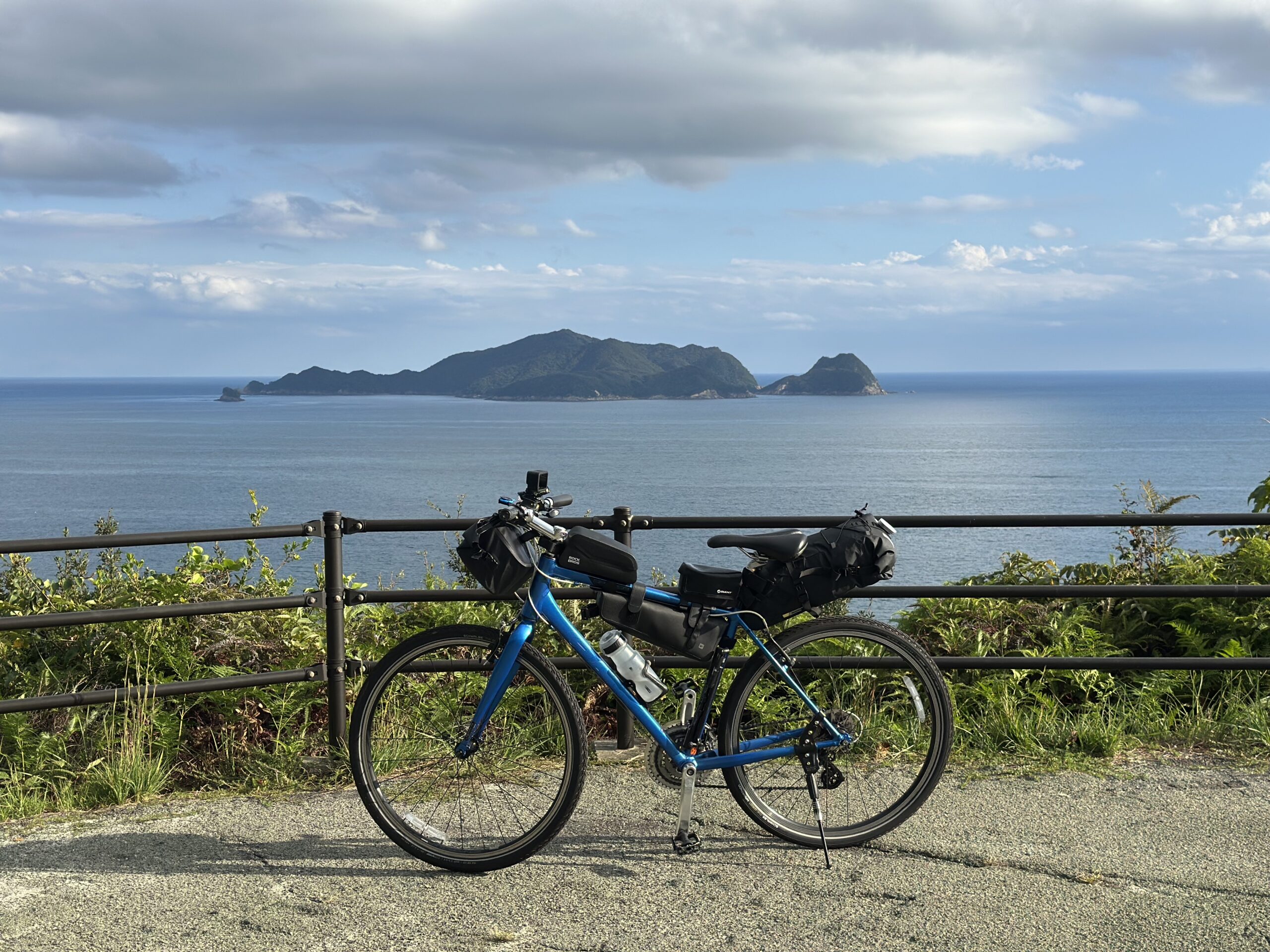
After cycling through the forest for some time, I finally emerged at an open road which revealed just how high I was. This was the Minami Awa Sunline Road, a 17km road stretching from Minami to Mugi town, offering breathtaking views of the coastline and the cliffs below. Even though I knew I had been climbing steadily for the past 20 minutes, it was still a surprise to see the height I had attained. There was virtually no traffic here, which made it all the more incredible.


There are four observation platforms along the Minami Awa Sunline Road. I reached the first observation platform at 2:40pm. This is the highest among the four and it has toilets and vending machines. The view was great but dark clouds were looming threateningly overhead so I didn’t linger for long.


This was undoubtedly a day of climbs. Each observation platform along the Minami Awa Sunline Road was located on a hill, so there were plenty of ups and downs between the observation platforms. I’m glad I mastered the use of the bicycle gears, which really helped a great deal. Looking back on the Tour de Taiwan cycling expedition in May 2023, that was my first time encountering big climbs. Back then, I was still a novice and I didn’t have a good understanding of switching gears to optimise my cycling effort.
With more cycling trips under my belt and more experience with hilly terrains, I am definitely a better cyclist today than I was two years ago. I now know how to switch to the appropriate gears when cycling uphill and downhill, how to pace myself in terms of knowing when to push myself and when to relax, and how to cycle confidently when going down steep slopes. As such, cycling becomes even more enjoyable.

The best thing about cycling is that I can just stop by the side of the road to take photos and videos because there were hardly any cars here at all. You can’t do this if you’re driving. And the higher you climb, the better the views. Even as I was cycling downhill, the view was just so good I had to stop several times to have a better look. Simply stunning. In fact, the scenery along the way was arguably even better than the view from the observation platforms.
I reached the second and third observation platforms at 2:58pm and 3:08pm respectively. There were no facilities here; only an open-air carpark. The views were also nothing to crow about, so I quickly moved on.


When I reached the fourth observation platform at 3:28pm, the sun was out again and the grey clouds made way for blue skies, making the view 10 times better. The fourth observation platform is the lowest in terms of elevation but the view is perhaps the best among the four platforms because it is unobstructed. I was reminded yet again that everything has its time and place. I spent 15 minutes here soaking in the views, taking photos and videos.


From there, it was a long downhill ride along the remainder of the Minami Awa Sunline Road to Mugi town. Unusually, I had a bad tummy ache so I stopped for a toilet break at the first Lawson konbini I could find. It’s really great that the konbinis provide clean toilets that you can use for free. It was a lifesaver. I took the opportunity to snack on a cream puff and a packet of fruit juice, and bought a bottle of mineral water to top up my water supply for the last 15km to Shishikui.
Even though I was pressed for time, I decided to make a stop at Matsuzaka Tunnel because it was along the way and required only a slight detour. However, I discovered that getting to the tunnel involved a slight climb but I had committed to it and there was no turning back. I arrived at 4:22pm. There was no one else here because all the vehicles used the newer Uchizuma and Furue Tunnels along the National Route 55 instead of this old tunnel.

Matsuzaka Tunnel is 80m long, 5.2m wide and 4m high. Based on how it looks, it is really nothing special. But what makes Matsuzaka Tunnel significant is that it is the oldest tunnel in Japan to be constructed using the on-site concrete pouring method. Construction of the tunnel began in September 1920 and it was completed in July 1921.
Concrete was introduced to Japan during the Meiji period (1868 to 1912) but it was still considered an unknown technology to the engineers of the time. Back then, stone and brick construction was the norm. Hence, Matsuzaka Tunnel was preserved for future generations for its modern civil engineering heritage as well as to recognise the enterprising spirit of the engineers who used this construction method.

There were no lights in Matsuzaka Tunnel and it wasn’t very well-maintained. It took less than a minute to cycle through the tunnel. To be honest, there wasn’t much to see but it was a cool little relic of history that you can experience if you’re not in a hurry. Otherwise, there’s no need to specially come here to see it.

At 4:55pm, I stopped at Pia shopping center at Kaifu to buy some snacks, not only for myself, but also for my hosts. My accommodation tonight is rather special because it is not a hotel but a guesthouse. My friend FA stayed there when he did the Shikoku Challenge last year. He recommended me to stay there too because the hosts were lovely and he enjoyed his stay very much. Hence, I thought I should buy something for them so I won’t arrive empty-handed.
Pia shopping center had a large supermarket, a Can-Do retail shop and a bakery called Houraido with a good selection of breads and local produce. Upon the staff’s recommendation, I bought a box of Japanese confectionery to gift my hosts. It wasn’t expensive but it made for a presentable gift.


I had a beautiful sunset as I cycled towards the guesthouse, a great end my day of cycling. Finally, I arrived at Haryugetu Guesthouse at 5:25pm, just before it started to get dark. My Strava showed that I cycled a total distance of 92.5km, with an elevation gain of 882m. The distance was a little longer than the official route, perhaps because of the slight detour to Matsuzaka Tunnel. However, I was expecting it to be shorter because my accommodation is located about 3km before the official ending point.


But it was the elevation gain that was startling – it was a lot more than the official route (882m vs 609m), a difference of 273m. Maybe some of the elevation came from climbing up the steps to the top of the hill at Yakuōji Temple, but that shouldn’t account for so much elevation. Or maybe the Strava tracking on my Apple Watch isn’t that accurate after all. I also recorded my ride on my Redmi Watch but unfortunately the Mi Fitness app doesn’t track elevation gain so I can’t compare how accurate it is. Nevertheless, it was a good workout and I was very pleased with my ride today.


Upon arriving at Haryugetu Guesthouse, I was greeted warmly by my two hosts, Hiro and his wife Mayu. Hiro had his hands full playing with his two young daughters while Mayu was busy preparing our dinner in the kitchen. Hiro passed me a key and led me to my room, which was named Pin Ball. He also showed me where all the facilities were – the toilets, bathrooms, washing machines, fridge, hot water dispenser etc. before he went back to his daughters.
After wheeling my bike into my room, I went through the SOP of charging my electronic devices, unpacking my stuff and taking a shower. Even though washing machines were available, I still handwashed my clothes and used my trusted towel-twisting method to wring the clothes before hanging them up to dry. With all the necessary chores done, I was ready to relax and have dinner at 6:30pm.


Hiro is one cool dude. He is a professional surfer certified by the JPSA (Japan Professional Surfing Association). He started building Haryugetu Guesthouse in 2010 with his carpenter friend and runs the guesthouse with Mayu. He hopes that this will be a place where children can gather driftwood at the beach while adults can drink beer while gazing out at the ocean. The aim is to provide their guests with an extraordinary experience and feel like they are returning to their grandfather’s house.
As such, the guesthouse is entirely made of wood and it is super cosy. It really had the homely feel that Hiro envisioned. As his family also lives here, the house is filled with their personal belongings and photographs. The shelves in the dining room were also filled with books and lots of children’s toys. It was very homely and I absolutely loved it.

I was not the only person staying at Haryugetu Guesthouse tonight. Hiro told me that they were also expecting three more cyclists. As soon as he mentioned it, I immediately knew he was referring to the three guys from Hong Kong whom I met yesterday. I knew our paths would cross again. As expected, it was the three Hong Kong guys who turned up just before 7:00pm. I was glad they made it here safely because the sun had set long ago and it was pitch dark outside.
Besides the four of us cyclists doing the Shikoku Challenge, there were also two Henro on the Shikoku Pilgrimage staying here. I met both of them at dinner. Peter hails from Munich in Germany and Julien is from Spain. They were both attempting the Henro individually and were meeting each other for the first time tonight as well. While the Hong Kong guys were settling down, I had a great conversation with Peter and Julien over dinner.
Dinner was absolutely amazing. Mayu cooked a really delicious meal for us, comprising karaage chicken, cold tofu, edamame, bonito sashimi, noodles with beancurd skin, daikon, fried rice with silverfish and tuna sushi. The food was fresh, made with love and bursting with flavour. We all agreed that it was the best meal we have had in Japan so far.


It was really interesting to hear from Peter and Julien why they embarked on the Shikoku Pilgrimage. The pilgrimage involves walking 1,200km to visit all 88 sacred temples on Shikoku and it takes around 45 days to complete. Peter and Julien said they tried to cover 30km a day, but the distance varied according to the terrain and how they were feeling. Peter was suffering from foot blisters so he would be staying at Haryugetu Guesthouse for two nights to rest and recover before continuing his journey.
I found it very inspiring that they are doing the Shikoku Pilgrimage on foot. I love to cycle because it is much more efficient than walking. Even for me as a bikepacker, it is already quite tough with all the climbs, and I’m only doing it for 11 days. Imagine carrying everything with you on your back and walking up and down the hills for 45 days. It will be a real test of your physical and mental strength. But I think it will be an immensely rewarding experience too, especially spiritually. Maybe one day, I will attempt the Shikoku Pilgrimage as well.

After taking their showers, the three Hong Kong guys came to the common dining room for dinner. Over the remainder of the evening, I chatted with them and shared cycling stories and places to go. Among the three of them, Ah Fok is the oldest at 67 years old while MC and CK are 55 and 52 years old respectively. The trip was initiated by CK and he booked it long ago, while MC and Ah Fok only decided to join him one month ago. As such, they didn’t have much time to prepare for the trip so it was quite tough for them. They also don’t cycle as regularly as CK does. But it was really admirable that they decided to join CK on this physically demanding trip.
It was wonderful meeting and talking to like-minded people from around the world. That’s what I love about travelling and staying at guesthouses or hostels like these. I’ve missed that camaraderie staying in hotels and being holed up in my own room. I also love the fact that travel brings people together. We may speak different languages and have different motivations for coming on the same journey (Shikoku Challenge or the Shikoku Pilgrimage), but what we have in common is the same spirit of adventure. I probably won’t see them any more after these few days but they will always be part of my memories of Shikoku.

Before I end this post, you may be thinking: So what was the miscalculation I mentioned that left me rather disappointed? Well, I realised while chatting with Ah Fok, MC and CK that we will not be able to collect the stamp at the Shishikui Onsen checkpoint because it opens only at 9:00am tomorrow. That was supposed to be the third checkpoint for today but I didn’t go because it is located 3km after Haryugetu Guesthouse, so I would have to cycle further along and backtrack to the guesthouse.
I thought I could collect the stamp tomorrow morning on the way forward, but I didn’t realise that the checkpoint opens so late. And I cannot afford to wait and start my ride at 9:00am because tomorrow will be the longest day of cycling (130km), so I have to start as early as possible.
It was a miscalculation because if I had known about the late opening, I could have cycled to the checkpoint today and collected the stamp before coming to Haryugetu Guesthouse. That would have involved cycling an additional 6km today (3km to the checkpoint and back) but I had sufficient time and energy so I could have easily done so.
Being the completist I am, I really wanted to collect all the stamps on the Cycling Pass. It irked me that one box on my Cycling Pass will be empty. And this is especially annoying since I made a detour to collect the stamp at Fureai Park Mino checkpoint two days ago, which was not part of the official cycling route. As mentioned before, it is not a requirement to collect all 29 stamps but I really wanted to complete my Cycling Pass. It was an unfortunate miscalculation and I kicked myself for it. Oh well.

Nevertheless, it’s Day 5 of the Shikoku Challenge done. This was possibly my favourite of the 11 days because of the amazing scenery, the reward that came after the tough climb, the quiet roads, the wonderful accommodation and meal, and the meeting of fellow adventurers. I went to bed early at 10:45pm with my heart full of gratitude.