Day 10 – 19 October 2025, Sunday
I woke up just before 6:00am, washed up and went for breakfast at 6:30am. This time, I wore my yukata to the dining hall. Just like Kuroshio Honjin, breakfast was another multi-course meal served to my table. There was miso soup, cold barley tea, seaweed, cold tofu and soba noodles with an onsen egg on top. The egg omelette was really tasty. I had two servings of rice to fuel myself for today’s long ride.


After checking out of my room, I was preparing to set up my bike when I met the fellow cyclist who was also staying at Hotel Orange. He was the owner of the second bicycle and it turned out that he was the one whom I spotted at Cape Ashizuri yesterday. He spoke quite good English so we struck up a conversation while setting up our bikes.
He is a 30-year-old Japanese from Fukuoka and he was attempting the Shikoku Pilgrimage by bicycle. He started his Pilgrimage journey in Tokushima, where Temple 1, Ryozen-ji, is located. He was the first Henro I met who was doing the Shikoku Pilgrimage on bicycle instead of on foot.
To walk the entire 1,200km circuit to visit all 88 temples usually takes around 45 days, which is pretty daunting in terms of effort, time and money. Doing it by bus or car is much faster but it feels a bit of a cop out. I think doing it by bicycle is the sweet spot between physical exertion, time and cost considerations, while keeping in line the objective of attaining spiritual enlightenment while embarking on the Pilgrimage.
I wished I met him last night so we could talk more but alas, our time together was very short. We bade farewell after setting up our bikes and went our separate ways. However, that is also the beauty of the Shikoku Challenge and Shikoku Pilgrimage – you meet many random people along the way. Some acquaintances are brief while some are longer, but together, they all make up your collective memory of the experience.

I started my ride early at 7:40am. According to the original plan, the itinerary for Day 10 of the Shikoku Challenge is to cycle 75.8km from Otsuki to Uwajima, with an elevation gain of 773m. However, my ride today will be about 22km longer to make up for the distance from here (Misaki) to Otsuki, and also the additional elevation gain of around 380m. Thus, I am expecting a tough ride today.
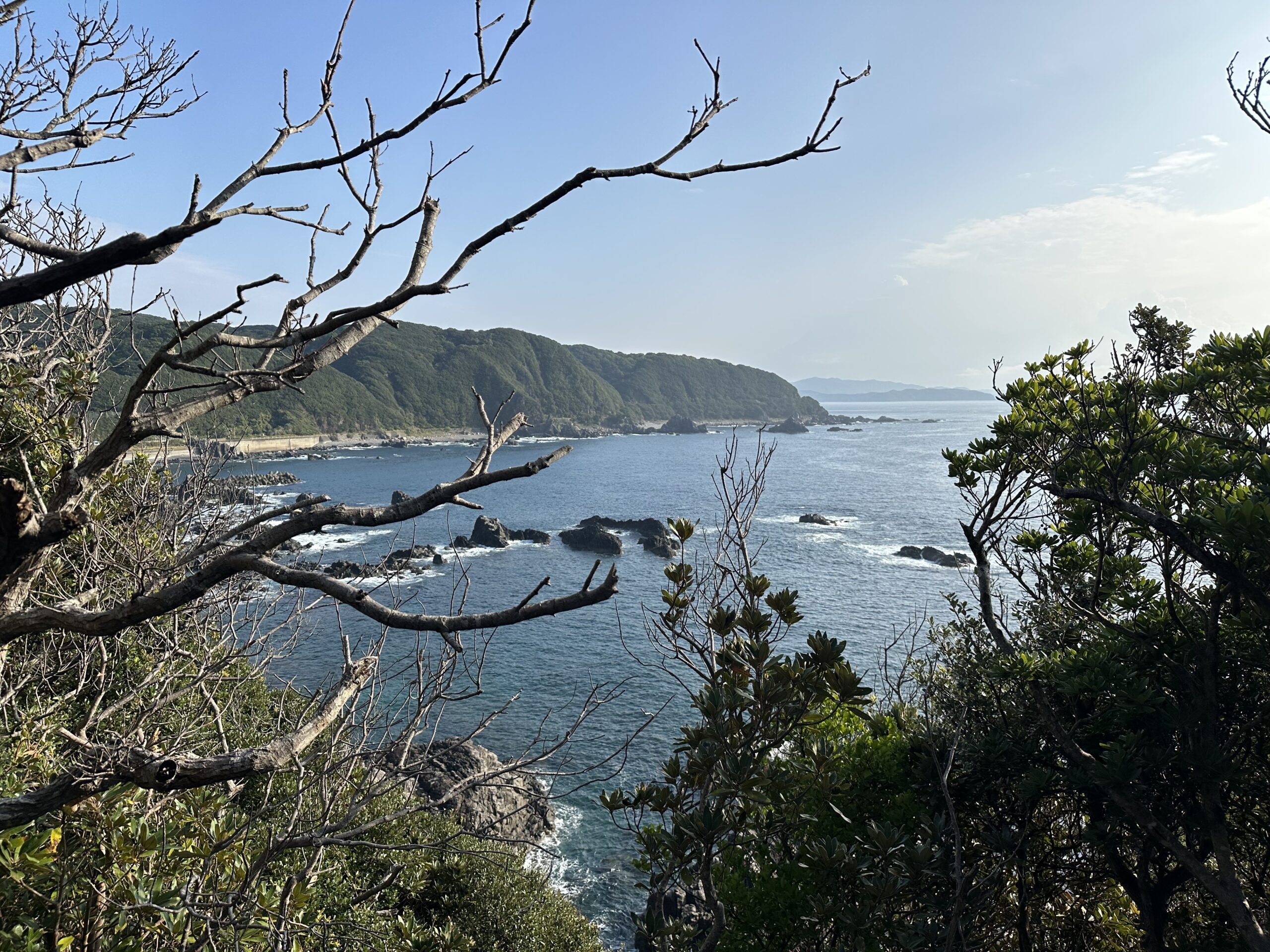
The first section along Route 321 is also known as Ashizuri Sunny Road, perhaps because it runs along the coast and offers spectacular ocean views with beautiful rock formations. It was a sunny day and the temperature was around 24 degrees C, making it a very pleasant morning ride indeed. I got a good dose of Vitamin Sea along with the breeze.


About 10km after leaving Hotel Orange, the biggest climb of the day began. I cycled up the hill via a long and mighty bridge. As I paused around the bend to catch my breath, I spotted a small lighthouse perched upon a cape in the distance. I saw a signboard and a small road leading to the lighthouse so I decided to make a detour to check it out. After parking my bike at the entrance sign, I walked a narrow path to reach the lighthouse. The path had no railings and it was steep on either side, but the scenery was gorgeous.


This is the Kanaezaki Lighthouse. It was built in 1911 and it has retained its original appearance despite undergoing various repairs. It is quite tiny, only 8.3m high, but it keeps shipping vessels safe from the treacherous Kanaezaki coastline. It is squat and cute and I’m glad I came to see it.


After the short detour, I went back to the main road and cycled through a tunnel and continued climbing. I took another pause at the highest point on the bridge, which had an elevation of 107m. It was very high up here and I had the best view of the sheer cliffs and dramatic coastline below. It was staggeringly beautiful.


After that energy-sapping climb, I was rewarded with a good long downhill section and I was back at sea level again, crossing the boundary into Otsuki town. However, the Otsuki roadside station was still about 12km away so I pressed on. Along the way, I made a brief stop at a flower field filled with pretty pink and white daisies.


I reached the first checkpoint at Otsuki roadside station at 9:25am. Even though I had breakfast not long ago, I was already feeling hungry because of the big climb early in the morning. After collecting my stamp, I bought a hotdog from the market and a small bottle of iced milk coffee from the vending machine to refuel myself.


Even though I had cycled for less than two hours today, I already felt that this was the toughest day so far. The accumulation of nine days of cycling was really starting to show. Despite soaking in the hot pool and having a good night’s rest, recovery wasn’t as effective. My legs were heavy and my neck was a bit stiff. And knowing that I had to make up the 22km distance meant that psychologically, I was already on a back foot from the start.
But with food in my stomach and having made up the distance from yesterday, I felt more energised after leaving Otsuki roadside station. The next section to the second checkpoint, Sukumo roadside station, was relatively flat so I was able to cycle quite fast and arrive at 10:15am. Sukumo has a seaside location and it is quite scenic so I walked the path to take a photo of the large Sukumo sign beside the sea. I learned that this spot here is actually one of the best places in Shikoku to see a Daruma Sunset.


The Daruma Sunset is a natural phenomenon where the silhouette the sun creates as it dips under the horizon resembles a head above a rounded body, which looks like a bright red Daruma doll, a protective charm that can be seen at temples all around Japan. The mirage occurs when sunlight is refracted by the warm air above the ocean surface interacting with the cold air higher above. It can only be seen on a very cold and sunny day where there is a large temperature difference between the air and seawater.
The likelihood of a Daruma Sunset happening in Kochi is relatively high due to the warm ocean currents that run along the prefecture’s coastline. Here in Sukumo, the phenomenon can be seen around 20 times between the winter months of mid-November and mid-February. You are lucky if you manage to catch it, so the Daruma Sunset is known as the “Lucky Sunset”.
The second biggest climb came right after leaving Sukumo. Upon entering Masaki Tunnel, I crossed over to Ainan town, located in Ehime Prefecture. With that, I have visited all four prefectures of Shikoku and I’m now back in Ehime, where I started my Shikoku Challenge 10 days ago. With the knowledge that I was inching closer to my goal, I powered through the hills towards the next checkpoint.


I usually try to plan ahead and shortlist a few potential places for lunch along the way. With my trusty Google Maps, I found an udon restaurant called Sirotubaki with good reviews, near the Misho MIC roadside station at Ainan town centre. When I arrived at 11:48am, I saw a queue comprising of locals, which was a good sign. I added my name to the waiting list by writing my name in Katakana so it’ll be easier for the staff to call me. I waited less than 10 minutes and got a seat at the counter.


I ordered the vegetable tempura udon (600 yen/S$5.22). I can only describe it as “wow”. That was my audible reaction when I ate it. The batter for the tempura was amazing. Together with the light broth and firm texture of the udon noodles, it was simply heavenly. I don’t normally eat udon in Singapore because I prefer ramen, but after this trip, I have developed a newfound appreciation for udon.


After lunch, I cycled over to the Misho MIC roadside station nearby to collect my stamp. I took a quick toilet break and resumed riding at 12:52pm. After leaving Ainan town centre, it was time to hit the hills once again. Following the big climb, I reached Kashiwa at 1:35pm, clocking 67km so far, which means I’ve completed about two-thirds of the day’s ride.


Interestingly, there was a separate tunnel for pedestrians and cyclists, running parallel to the road tunnel for vehicles. It was delightful because there was no traffic here, the tunnel was brightly lit and well-paved. There were also many drawings/paintings by children lining the walls, which added colour to the 915m-long tunnel. The acoustics inside were wonderful so I took the opportunity to belt out a few songs as I cycled through the tunnel. There was no one else around so I could sing as loud as I wished!


When I reached Sunokawa Beach 20 minutes later, I saw a ramp leading to the water’s edge so I pushed my bike down to the pebbly beach to take a Photo of the Day with my bike. It turned out to be a nice shot.

I continued cycling northwards and passed by some interesting houses floating on water. The waters nearby also had many buoys laid out in neat rows. It appears that this is an important fishing town with a big coastal aquaculture industry.


At about 2:25pm, 75km into the ride, I encountered my second pedestrian/cyclist tunnel. It’s true that good things come in pairs! Not long after leaving the tunnel, I reached Tsushimacho Iwamatsu, where I had to make a right turn to continue along National Route 56 because bicycles are not allowed on the E56 Matsuyama Expressway. I checked my mobile phone periodically to make sure I was on the correct route, but the bright yellow signboards on the side of the road caught my attention. For those who are attempting the Shikoku Challenge, make sure you don’t miss this important right turn at Tsushimacho Iwamatsu!

I reached the fourth checkpoint, Tsushima Yasuragi-no-Sato roadside station at 2:55pm. I had covered 85km so far so I only had about 12km to go. I was hopeful that I could reach Uwajima by 4:30pm. Pleased with my progress, I bought a mochi snack and a bottle of cold green tea to give myself one last energy boost.


The boost was timely because there was another climb after leaving the roadside station, through the 1,710m-long Matsuo Tunnel. It wasn’t the longest tunnel but it felt never-ending because of the incline. But the cooler temperature inside the tunnel and the knowledge that I wasn’t far away propelled me forward.


At 3:52pm, I arrived at the fifth and final checkpoint for the day, Uwajima Kisaiya Hiroba roadside station. There was a large supermarket and retail shop but I was eager to end my ride so I quickly collected my stamp and carried on.
I arrived at Super Hotel, my accommodation in Uwajima, at 4:05pm. My Strava showed that I cycled a total distance of 95.81km today, with an elevation gain of 962m. This was the most elevation gain for the entire Shikoku Challenge. I was happy that I managed to complete the ride relatively early, after the tough start I had this morning. I think the cool weather and cloudy skies in the afternoon helped. It also helped that the four big climbs were quite evenly spread out along today’s route, giving me sufficient time to recover before tackling the next one.


Super Hotel is quite fancy and modern. At the lobby beside the reception counter, there is a pillow menu where you can pick a pillow based on your preference for its height and firmness. The hotel also doesn’t issue physical room keys. Instead, each room comes with a digital lock. You’ll be given a unique 6-digit PIN to unlock your door and the PIN is printed on your receipt. Hence, there is no need to go through any check-out procedures and you can simply go out of your room and leave the hotel. The problem is that you’ll need to remember the PIN, and make sure you don’t lose the receipt. The easiest way to get around this problem is to take a photo of the receipt so you’ll always have it with you, stored in your mobile phone.

I was glad I could bring my bicycle to my room, unlike the past three days. The room is decently large, with a double decker single bed on top of the king size bed, so three people can actually stay in this room. I went through the usual SOP of checking in before heading to the onsen for a soak.


On Day 2, the female owner of Minna no Coffee café gave me a list of recommendations of food to try in Shikoku. She said that when I visit Uwajima, I have to try the famous local specialty, Tai-meshi. I consulted Google Maps and found a restaurant nearby called Tomiya that sold the dish so I made my way over. When I left the hotel around 6:00pm, it was drizzling slightly so I borrowed an umbrella from reception and walked to Tomiya.


The restaurant wasn’t very big but it had a tatami dining area, a regular table for four people and four counter seats. It was a cosy and intimate space. The Tai Meshi set meal cost 1,600 yen (S$13.92) and I also ordered a glass of Asahi beer for 450 yen (S$3.92).
The main highlight of Tai-meshi is the fresh sea bream sashimi. Ehime Prefecture is Japan’s leading producer of wild and farmed sea bream so you can be sure it is as fresh as it gets here. It is eaten by dipping the slices of sea bream in a sauce consisting of raw egg, soya sauce and dashi (soup stock) and pouring it over the rice before sprinkling it with condiments like seaweed and spring onion.


The menu came with illustrated instructions on how to eat Tai-meshi but the text was all in Japanese. The female server also verbally told me what to do. Despite all the help, I forgot the last step of pouring the mixture of sea bream with dashi onto the rice! I just dipped the sashimi into the dashi and ate it piece by piece. Oops. Nevertheless, it was delicious. The sea bream went well with the egg and the dashi. The rice was shiny and pearly white. It was so good I finished every last grain. Even the cooked fish was yummy.

By the way, I love to sit at the counter because I can have a first-hand view of how the chef prepares the food. It’s always nice to see people at work and being good at what they do. I observed how the chef at Tomiya sliced the fish and used a pincer instrument to remove the small bones delicately. He did it with such skill and intention it was fascinating to watch.


Despite polishing off all the food, I still felt hungry. I went for my second round of dinner at an okonomiyaki restaurant called Kaminari, located on the second floor of a nondescript building. It had a very family and local atmosphere. I ordered the squid okonomiyaki (750 yen/S$6.53). The lady made it in front of me using the large pan at my table.


Surprisingly, it took a rather long time, 20 minutes, before it was ready. After it was nicely pan fried, she spread mayonnaise on top of it, and asked me to add the seasonings and toppings as I wished. There was a sweet sauce, a spicy sauce, seaweed flakes and bonito flakes. However, the bonito flakes were finely chopped, unlike the usual ones that are much larger and “come alive” when they get in contact with heat.


The okonomiyaki was very big but I managed to finish it, probably because I was hungry after expending all the energy today. I won’t say it was the nicest okonomiyaki I’ve had, but I enjoyed the experience of dining in a family restaurant where only locals go to.
I returned to my hotel just before 8:00pm, just in time to get one drink before Happy Hour ended. Alcoholic and soft drinks are available free of charge for hotel guests every night at the bar from 5:00pm to 8:00pm. The bar was packed. I concocted some random whiskey and soda just to enjoy the perk.


After that, I walked to the Lawson opposite the hotel to grab some snacks and a packet of fresh milk before going for another soak at the onsen. With that, it’s the end of Day 10. Final day of the Shikoku Challenge tomorrow. Almost there…