Day 3 – 12 October 2025, Sunday
I woke up naturally at 5:30am today, even though I had set my alarm for 6:00am. I don’t know why, but I usually wake up automatically when I’m travelling. Maybe it’s because I’m always excited for the day ahead. As usual, the first thing I did was to check the weather forecast. The temperature was currently 23 degrees C, with the day projected to be cloudy, a 65% chance of rain. I certainly hope it doesn’t rain during my ride today.
Breakfast was served at 7:00am at the hotel lobby. The spread was quite decent. I had some salad, spaghetti, fish, scrambled eggs, takoyaki, macaroni, orange juice and coffee. Didn’t want to have a too-filling breakfast, otherwise I’d feel sluggish when I ride.


After breakfast, I went back to my room to go through the now-standard routine of using the bathroom, suiting up, packing all my electronics and applying sunscreen. I forgot to apply sunscreen on the first day and my thighs ended up being sunburnt, so I made sure to do it religiously since then. And lo and behold, my cycling jersey, bib and clothes did dry overnight, so the towel-wringing method works indeed, wonderful!
As the hotel didn’t allow me to bring my bicycle to my room, I needed a bit more time to set up my bike after checking out. My bike was still safely parked where I left it yesterday evening, at the little shelter behind the hotel building. I attached my saddle bag and handlebar bag to my bike and secured the straps tightly to make sure they were snug so they wouldn’t wobble when I cycled. After performing an equipment check (brakes working, tyre pressure ok), I turned on my Strava and Mi Fitness apps and started my ride at 8:05am.

Today is Day 3 of the Shikoku Challenge and the itinerary is to cycle 65.2km from Kan-onji to Takamatsu, with an elevation gain of 346m. Based on this distance and elevation gain, it should be quite a relaxing day. According to the official route, we will pass by only one roadside station checkpoint today – Koibito-no-Seichi Utazurinkai Koen (number 6 checkpoint).
However, I noticed that there was another roadside station at Fureai Park Mino, listed as checkpoint number 5 on the official challenge pass. I found it strange that the official route does not pass by this roadside station even though it is listed as one of the checkpoints on the challenge pass.

Actually, the Shikoku Challenge does not require participants to complete all 29 checkpoints listed on the challenge pass. You just need to collect a total of 15 or more roadside station stamps to be considered having completed the Shikoku Challenge. However, the condition is that you must collect at least two stamps from Tokushima Prefecture and three stamps from each of the other three prefectures. Hence, it would have been alright for me to follow the official route and skip the Fureai Park Mino roadside station.
But, being the completist that I am, I wanted to collect all the stamps if possible. I checked the location of Fureai Park Mino on Google Maps and saw that it didn’t require too big a detour to get there, so I decided to go for it. Thus, my cycling distance for today will be longer than the official 65.2km.


After leaving Hotel Sunny Inn, I made a slight detour and climbed a steep hill to get to the Zenigata Observatory Platform. Despite the cool weather, I broke out in sweat as I huffed and puffed my way up the hill. I wasn’t expecting to work this hard at the start of today’s ride, but the view at the top of the hill was worth it.


The reason for climbing the hill was to see the Zenigata Sunae, which means “coin-shaped sand painting”. From the observatory platform, I had a good view of Kotohiki Park below and the Seto Inland Sea beyond. In the middle of the pine forest at Kotohiki Park was a white sand beach with a huge sand “painting” of a coin with the inscription Kan’ei Tsuho, a currency that was used during the Edo period. It’s not actually a painting but a sand sculpture.

The giant coin measures 122 metres east-to-west, 90 metres north-to-south and has a circumference of 345 metres. It’s really quite big. According to legend, it is said that if you see the painting, you will live a long and healthy life, and have no problems with money. I certainly hope that is true! It would have been even prettier if it was a sunny day. I spent about 15 minutes taking photos and catching a break before heading down the hill again.
Shortly after reaching the foot of the hill, I cycled past some temples and decided to make another stop yet again. I checked Google Maps and saw that two temples were located here – Jinnein Temple and Kan-onji Temple, the namesake temple of this city. They are also temples number 68 and 69 respectively on the Shikoku Pilgrimage. Hence, I thought it was worth a visit.

The Shikoku Pilgrimage (click here) is a 1,200-year-old, 1,200km pilgrimage to 88 Buddhist temples located on Shikoku island. The pilgrims who embark on this pilgrimage are known as “henro”. It takes an average of 45 days to complete the pilgrimage on foot, but the duration can range from 35 to 60 days, depending on the individual’s fitness and weather conditions.
The pilgrimage is inspired by a monk called Kōbō Daishi, who was born in Shikoku and later founded Shingon Buddhism. He changed his name to Kūkai upon attaining enlightenment. The pilgrimage includes temples and other sacred sites where Kūkai is believed to have trained or spent time during the 9th century. After his death, more followers from different parts of Japan visited the temples one after another and a circular route was formed, beginning the concept of a formal pilgrimage.
You don’t have to be a Buddhist to embark on the pilgrimage but you should have a tolerance and appreciation for Buddhist beliefs and traditions. People embark on the pilgrimage for different reasons. Some do it for religious reasons, some are praying for healing or safety, while some do it in memory of those who have passed away. Whatever the reason, it will definitely be a life-affirming journey and a good opportunity for self-discovery.


These were the first temples I visited in Shikoku and my first time encountering so many henro in one place. Most of them came in pairs but there were some who were solo. Many appeared to be locals but I also saw a handful of Westerners. You can easily identify them by their “official” attire, most noticeably a white vest and a sedge hat. Many of the henro also carry a staff, which is said to be the embodiment of Kōbō Daishi.

It was very serene inside the temple compound. Henro are expected to perform a set of rituals when they visit a temple, including purifying their hands at the wash basin, ringing the bell, lighting incense sticks and chanting sutras. I took many photos and observed the proceedings quietly. In all, I spent about 20 minutes visiting the two temples, which are located in the same compound. I was mindful of the time because this was an unplanned stop, and I had barely started cycling today.


I finally got going at around 9:15am. As I cycled out of Kan-onji, I marvelled at how quiet and peaceful the city is. Maybe because it was Sunday, but there were barely any vehicles on the road. The weather was cloudy and cool, but not cold enough to warrant putting on my jacket, so it was the perfect temperature.


I soon reached the coast and Chichibugahama Beach came into view. It appeared to be low tide as huge swathes of rocky beach were exposed. Coastal views are the best, but it would be even better if it was a sunny day.


After that, the route turned inland and it was time for the first big climb of the day, at about 15km into the ride. The scenery was beautiful as the road cut through the hill, surrounded by lush green trees. I conquered the hill in sections, pausing every now and then to take short breaks before resuming the climb. The elevation gain for this section was about 60 metres over 2km.

At Takuma, I deviated from the official route and continued straight instead of turning left. The road eventually merged into Kagawa Prefectural Route 48. I then knew why the official route chose to skip this section to Fureai Park Mino roadside station – because it was a very steep climb! The scenery en route was beautiful though, passing by small ponds and rice fields with mountain backdrops.


After turning left, away from Route 48 and with 1km to the roadside station, the climb got even more intense, with an elevation gain of around 70 metres. Along the way, I passed by a few trees with hundreds of persimmons on them, and took the opportunity to have a break. It was my first time seeing persimmon fruits on the trees. From afar, they looked like oranges. It was amazing to see the whole tree covered with persimmons.


At 10:35am, I finally reached Fureai Park Mino roadside station at the top of the hill. I discovered that this is one of the largest roadside stations in Shikoku. Besides the usual retail shop and bathroom facilities, there is also a onsen hotel here with six types of hot springs and a rotenburo with a panoramic view of the Sanuki Mountains. Best of all, there is a huge, open-air space-themed playground called Cosmoland Mino, where children can play on the various roller slides and climb over bridges and climbing nets.


After getting my official pass stamped, I went to the shop and boughta grape and vanilla soft serve ice-cream (500 yen/S$4.35) to reward myself for making the tough climb up. The ice-cream was super oishii! After that, I decided to be a kid again and have a go at the playground.


The roller slides looked fun so I went for it. There were two roller slides – one was shaped like a space shuttle and the other was shaped like a rocket. I chose the latter. The roller slide is made of horizontal cylinders that spin underneath the person sliding as they travel down. There was no mat provided so I just sat on the slide, pushed myself off and let gravity bring me down.


The slide was 115 metres long and it was quite bumpy! It wasn’t that fast because of the turns but the gradient was sufficient to ensure I could slide down continuously. I later discovered that I had a small abrasion on my tailbone from riding the slide, even with my padded cycling pants. The website states that mats can be rented for 100 yen but I didn’t see any available when I visited. So, it will be better to rent a mat to use the roller slide if possible.


Besides the playground structures, there was also a large field where people could run around or play ball games. My visit coincided with a Sunday so it was especially lively. It was nice to see children and their families having a fun day out at the playground. I’m glad I made the detour to come here. I spent about 25 minutes at Fureai Park Mino roadside station before heading down the hill to re-join the official route at Tsushima.


Back on track, I cycled along the coast for a while before arriving at Marugame at 11:50am. Marugame is a port city in western Kagawa Prefecture, located just west of the Seto Ohashi Bridge, which connects Shikoku to the main Honshu island. It is the second largest city in Kagawa, and an important maritime and transport hub in Shikoku. The city’s symbol is Marugame Castle, one of the only 12 castles in Japan with the original wooden keeps (tenshu) remaining.

My intention was to have lunch at Marugame since it was noon time. Yesterday, the friendly female owner at Minnano Coffee had recommended me to try the famous grilled chicken at Ikkaku restaurant. But when I arrived at the head shop near the train station, I saw a long queue that snaked around the corner of the building. I believe most of the people here were foreign tourists as I heard smatterings of Vietnamese and Korean being spoken. It looked like it would take at least 45 minutes for my turn and I couldn’t afford to wait that long so I left.

As I cycled around the city centre, I considered visiting Marugame Castle but decided against it because the castle is located at the top of a hill, which meant I’d need to spend some time to visit it properly. I searched Google Maps and found another branch of Ikkaku nearby at the Doicho neighbourhood so I cycled over. However, the queue was just as long and I didn’t want to wait.


My friend told me that Kagawa has the best udon in the whole of Japan and said I must try it. I found a restaurant called Nakamura Udon nearby and cycled over. Guess what? The queue was even longer than that for Ikkaku! I guess it’s because it’s lunchtime on Sunday so it’s crowded everywhere. Feeling a bit annoyed that there were so many tourists here, I left to search for something simple and quick to eat.

It is strange and somewhat irrational I felt that way because I was also a tourist. These restaurants are famous for a reason and it’s perfectly normal that every visitor wants to try the best the city has to offer. However, I felt a bit different because I was a solo traveller cycling around Shikoku. Most of the other tourists were from commercial tour groups on bus tours. I didn’t feel like I was just another regular tourist; it was something deeper than that. It was only Day 3 of the Shikoku Challenge and I already felt a strong bond and connection with the island. That was how much I had grown to love Shikoku.
As I was running a little behind time, I settled for a ramen restaurant called Ichikaku-ya at Utazu town nearby. I was greedy and ordered the Large bowl for 1,280 yen (S$11.15). The portion was huge and it came with three slices of chashu, tamago, six pieces of seaweed and some green vegetables. The noodles were a bit thicker than usual and the broth was very thick. I was super full after eating it.


The next roadside station was just around the corner, at Utazu Rinkaikoen. Again, it was a large roadside station, with not only the usual retail shop and bathroom facilities but a big park and the Shikoku Aquarium here as well. The entire area was very lively, with colourful banners hanging in the outdoor plaza and children running around the lawn while being entertained by a couple of musicians. Great weather on this Sunday afternoon for families to hang out.


The location of the building with the stamp wasn’t very precise on Google Maps so I cycled around in circles for a while before I finally found it. It was inside a standalone building near the waterfront, called the Lover’s Sanctuary. I should have guessed from the name stated on the challenge pass – Koibito-no-Seichi. After collecting my stamp, I resumed cycling at 2:00pm.


The ride through Sakaide city was unremarkable until I hit the coast again 40 minutes later. By this time, the clouds were starting to clear and blue skies emerged, making everything even prettier. As I cycled along the coast, I had a good view of the Seto Ohashi Bridge, which spans 13.1km in total. The bridge is double-decked, with the upper deck carrying vehicular traffic and the lower deck carrying a railway track.


It was a really lovely time to cycle, with the sun out and the blue sea on my side. Traffic was light and I could cycle slowly to soak up the views. I paused by the roadside to snap some photos of locals fishing at a breakwater. I thought to myself: what a fine way to spend a Sunday afternoon with the family here.


After the brief coastal section, the route turned inland again and it was time for the last climb of the day. The gradient wasn’t as steep as the one to Fureai Park Mino earlier but I still had to work hard for it.


I saw a small building with a patchwork of colourful murals and stopped for a break here. It was a local brewery called Ohgoshi Beer but unfortunately it was closed. At that moment, I thought it would have been nice to have a small glass of cold beer. But then again, I probably wouldn’t drink while I still had to cycle, so maybe not! Nevertheless, I loved the murals. You could tell they were done by different artists because each one had a different style. It was an unexpected gem in the middle of nowhere. Loved it!


The time between 3:00pm and 5:00pm is my favourite time to cycle because it is no longer blazing hot and the late afternoon sun casts a soft glow on the landscape, making everything look especially pretty. Here in the countryside, the roads were really quiet as well and I could enjoy the tranquility with only the sound of my bicycle’s spinning wheels breaking the silence.

The climb to Cape Osaki was rather steep but manageable since it was only slightly more than half the elevation of Fureai Park Mino earlier. And it was easier because the nice weather provided an additional boost. Soon enough, an opening emerged from the vegetation and I had a glimpse of Kozuchi Island sitting pretty in the sea with light blue sky behind it.


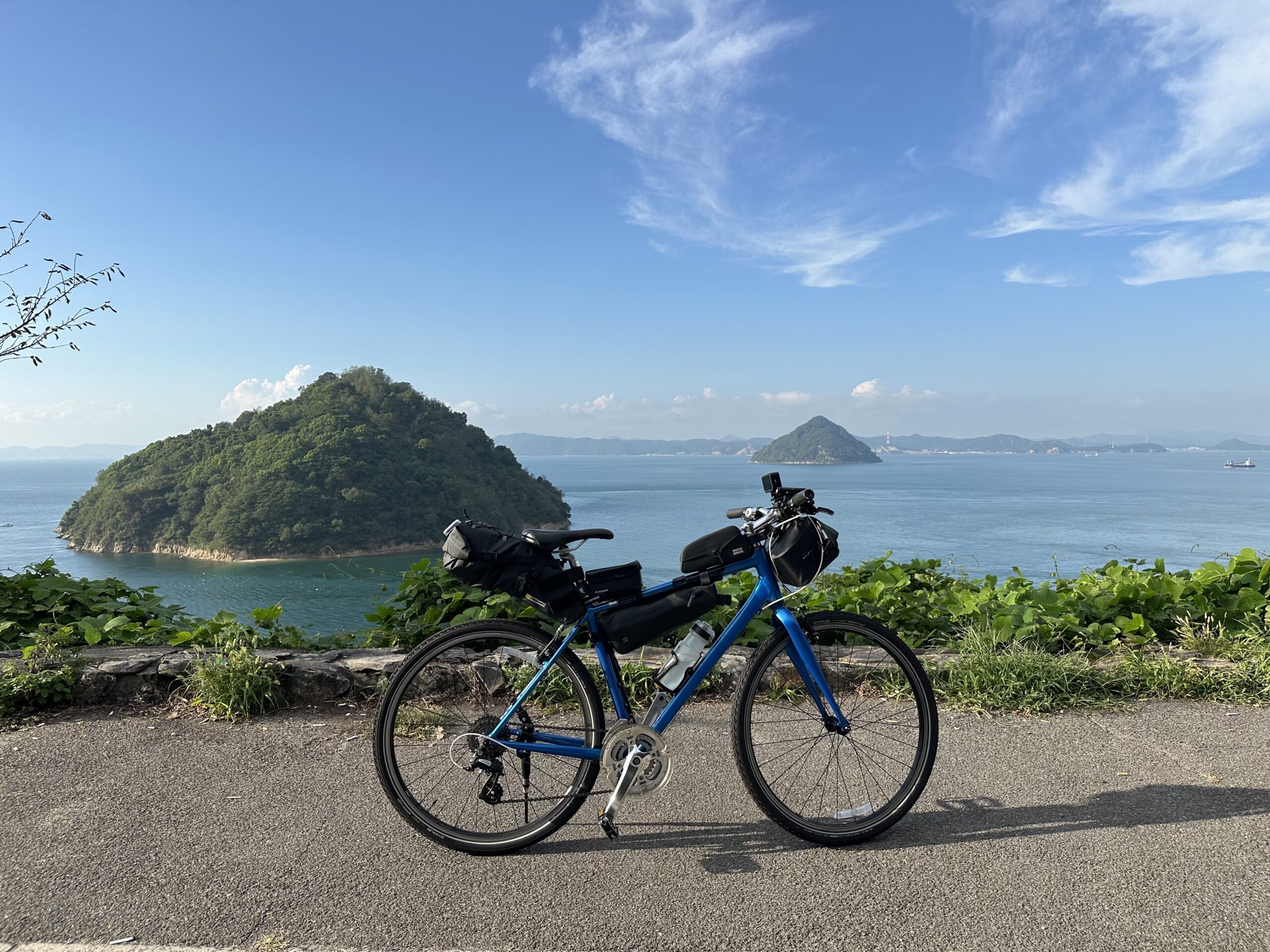
I kept pushing on and at 3:35pm, I reached the top of the hill at Cape Osaki, where I had my “wow” moment for the day. Here, I could see not just Kozuchi Island but also Ozuchi Island a little further behind it. They were tiny, cone-shaped islands and looked very cute. The sun was fully out now and there were wispy white clouds in the sky. Together with the green vegetation in the foreground, it was simply picture perfect. After the cloudy weather I had all day, the sun came out at the right time to give me this splendid view. I thought to myself: everything has its time and place. I felt so blessed to be able to witness this.

I wasn’t the only one here to admire the view. A group of bikers had lined up their four motorbikes in a row along the kerb for a photoshoot. I must say their Honda and Yamaha motorbikes looked really cool, gleaming in the sun. But I like my Gravier bike better!


I bought a can of cold Georgia milk coffee from the vending machine and recharged myself before the last burst to Takamatsu. I had initially targeted to reach my hotel by 3:00pm but of course, that was way too ambitious since there was about 14km to go. At 3:50pm, I left Cape Osaki and enjoyed the ride downhill. Always remember: what goes up must go down. So, there will always be a reward after a big climb.
After reaching the bottom of the hill, I stopped by the side of the road near Kagawa Athletic Park because I realised that my Apple Watch was about to run out of battery. Hence, I quickly plugged it to my powerbank to charge for 10 minutes before resuming my ride. I usually charge my Apple Watch during my lunch break but I forgot to do it today. That’s the annoying thing about Apple Watch – even on a full charge, the battery cannot last a whole day of riding with GPS tracking.

The rest of the journey to Takamatsu was pleasant but uneventful. I was trying to get to my hotel quickly so I didn’t make any unnecessary stops to take photos. As I got closer to the city centre, the density of tall buildings increased and the roads became busier. I was happy to see that there were dedicated cycling paths on the sidewalks, which means the city is bike-friendly.


At 4:42pm, I arrived at WeBase Takamatsu hotel. My Strava showed that I had cycled a total distance of 82.92km today, with an elevation gain of 639 metres. This was about 17.7km longer and 293 metres more elevation gain than the official route, due to the various detours I took. The ride was more strenuous and longer than planned but it was well worth the extra effort and time because I could slowly enjoy the ride and scenery along the way.


Overall, it was a great day of cycling. My nose was cooperative today; I wasn’t sniffing like the previous two days, which made it much more comfortable. The weather was cloudy and cool for most part so it wasn’t as physically taxing compared to the past two days. With Day 3 of the Shikoku Challenge completed, it was time to check in to my hotel and enjoy the rest of the evening.


The lobby of WeBase Takamatsu was located on the second floor of the building and there was no elevator in sight; only an escalator. According to the hotel’s website, there is actually a private elevator from the employee entrance so strollers and wheelchair users can request to use the elevator if needed. But for those with bicycles, you can use the escalator. As my bicycle was quite heavy with all my gear, I carefully positioned and balanced it on the single-width escalator to go up.
The hotel is bike-friendly and they have pumps and bike racks at the lobby where cyclists can store their bikes overnight. However, they also allow guests to bring their bicycles to the room. In fact, they prepared a mat and a bike stand for me, and they were already in my room when I checked in, great service!


The room was quite spacious and modern. The hotel doesn’t have a public bath/onsen so I took my shower in my room. And of course, I hand-washed my laundry at the same time, then wrung dry my clothes using the towel twisting method. I recorded a video clip to show you how it’s done:
By the time I was done with all the usual SOP (standard operating procedure), it was 6:05pm and time for dinner. Bearing in mind my friend’s insistence that I try udon while in Kagawa, I asked the hotel for recommendations. Many of the udon restaurants the staff suggested were closed when I checked Google Maps, perhaps due to it being Sunday. But thankfully, one was open and it was quite near the hotel so I set off to find it.
Upon stepping out of the hotel, I realised that WeBase was in a great location, right in the middle of the shopping district. Along the main road were boutique stores for The North Face and Onitsuka Tiger, so I knew it was a nice, classy area. The hotel was also just one minute away to Minami-Shinmachi, the main shopping street. It was bustling with activity and people on this Sunday evening.


When I arrived at Udon Bou restaurant at 6:20pm, there was a queue of around 15 people. But since I was done with my day’s work (unlike the lunch situation at Ikkaku earlier today), I could afford to wait. And I knew that I had to try udon tonight because I’ll be going to Tokushima Prefecture tomorrow, so this was the last chance to try udon in Kagawa. In the end, I waited only for about 10 minutes before I got a seat, so it wasn’t that bad.


I was assigned a counter seat. It was a bit like Ichiran, with individual booths, perfect for solo diners. For larger groups, regular tables were also available. There were many types of udon on the menu, both hot and cold, so I asked the staff for recommendations. I picked Onichiku-Bukkake, hot version (850 yen/S$7.40), and additionally ordered a crabstick tempura (450 yen/S$3.90) and eggplant tempura (230 yen/S$2.00).
The food was served quite quickly. I seldom eat udon but this was so good. The noodle texture was firm, the egg was perfectly done and the broth was light but tasty. The udon came with one piece of Chikuwa tempura, a tube-shaped fish cake made from minced fish paste. The crabstick tempura was huge. And I don’t eat eggplant unless it is done tempura style. Everything about the meal was perfect.


When I left the restaurant at 7:05pm, the staff switched off the lights outside, signalling that they were closed for the day. I was lucky I went in time. For the rest of the evening, I thought it would be nice to listen to some live music, so I searched for music bars on Google Maps. Two interesting results showed up.
I first went to Grandfather’s Music Inn, located in the basement of a side street near the main shopping arcade. It was dark and dinghy and there was only a couple of customers seated at the bar. However, they were smoking and the bar didn’t feel very welcoming so I left.

I then went to Fifty, located on the second floor of a building on the main road close to WeBase. It started to drizzle as I walked to Fifty. The moment I stepped into Fifty, I knew it was the right place for me. The bar was very cosy but well-lit, with carpeted floor and a depressed counter table with movable cushioned seats that came with backrests. There were also two regular tables with three chairs each. Two other guys were already in the bar, and another male customer came in shortly after me.


For Fifty, there is a seat fee (i.e. cover charge) of 1,000 yen (S$8.70). Drinks and food/snacks are charged separately. Many types of alcoholic drinks are available – whiskey, wine, sake, shochu (distilled liquor), chu-hi (a combination of “shochu” and “highball”) and beer. Soft drinks and coffee are also available for those who don’t drink alcohol. I went for the simple option of a draft Kirin beer (750 yen).


The interesting thing about both Grandfather’s Music Inn and Fifty is that they are not live music bars. Instead of a live band, the owner selects and plays vinyl records from his collection based on his mood. For Fifty, the owner’s extensive vinyl collection was displayed on the shelves behind his bar. He would run his fingers along the spines, pull out an album, place the record on the turntable, and play a few songs before switching to another record. Essentially, you are paying to listen to the owner’s music playlist.


Fifty specialises in modern jazz and vintage audio. The owner has impeccable taste and deep knowledge of jazz music. He played some Stan Getz, Pres and Teddy and a lot of other obscure (to me, at least) artistes that I had never heard of, but the music was always good. The sound system was excellent and the cosy vibes made it a pleasure just to sit there and listen to music.
The owner spoke limited English so I didn’t chat much with him. Another young Japanese guy then came into the bar. He ordered a Bourbon Whiskey and sat beside me. I started talking to him after a while, and found that he spoke rather good English so we started to chat more.
He hails from Fukuoka and came to Takamatsu for a short vacation. He’s a doctor by profession, but jokingly confessed that he drinks too much alcohol. He shared that he has been to Malaysia but not Singapore yet, because it is a bit more expensive. He would like to try our famous Singapore Sling cocktail one day. We chatted only sporadically because the purpose of visiting the bar is to listen to the music.
A Japanese lady then entered the bar, as did another couple. The bar was evidently quite popular. I decided to ask the owner why he named his bar “Fifty”. As he struggled with his English, the Japanese lady and the young guy helped to translate for me. He revealed that he named it after a famous jazz bar in Tokyo, which was also called Fifty. He used to work in the Tokyo Fifty bar but it closed in 1983. When he had the opportunity to open his own bar in Takamatsu in 2022, he decided to take on the same name.

The owner then pulled out a vintage copy of Jazz & Records magazine from his shelf. It was from April 1974. He flipped to a page with a small advertisement of the original Tokyo Fifty bar and showed it to me as proof of its existence. He then pointed me to a printed photograph pinned to the wall at the back of the bar. The photo showed the owner sitting at the Tokyo bar, with the giant Fifty logo beside him. He was much younger then, with a head full of black hair.


I love hearing his explanation and seeing the photo! If I had never asked, I would never have known the backstory. He must have had great memories and deep affection for the original Fifty bar. It goes to show that language is not a barrier, and you should never be too shy to ask and be curious.
I ended up spending two hours at Fifty and having two beers. It wasn’t for the sake of making the cover charge worth it, but I genuinely enjoyed the experience of sitting there and listening to jazz while chatting with fellow music lovers. I hope to open a similar bar one day, but I will play CDs instead of vinyl. And have lots of vintage magazines and posters on the walls. This visit to Fifty would end up as one of my favourite things I did on the trip.
After leaving Fifty at 9:40pm, I went to Don Quijote to buy some snacks before heading back to my hotel to call it a day. There was no onsen in the hotel so no soaking tonight. What a wonderful day it had been. Day 3 of Shikoku Challenge completed, 8 more days to go!
