Day 12: 22 May 2023, Monday
It felt strange to wake up today and not have to put on our cycling jerseys and go through the paces of collecting our bikes, warming up and having Jeffrey brief us on the day’s cycling route. Reality had finally set in – our Tour de Taiwan was over. Nevertheless, AT and I will still be cycling today as we booked a 4-hour bike tour of Taipei city this morning. However, it will be much more relaxing as we will slowly pedal through the city’s streets and learn about history and culture. We booked the tour through Tripadvisor and paid S$89.56 per person.
At 7:40am, AT and I left our hotel and took the Metro from Ximen to Zhongshan (中山) station, two stops away. The fare was NT$20 (S$1.10). I observed that Taiwanese are very orderly when it comes to queuing for the escalator at Metro stations. Even the passengers alighting from the doors of the train closest to the escalator will walk to the back to join the queue instead of trying to cut in from the side. This is something we can learn to become a more gracious society.


After alighting at Zhongshan station, we walked to the tour meeting point. We had some difficulties locating the shop on Google Maps initially but managed to find it after a while. The shop was shuttered but there were bikes chained up at the shopfront so we knew it was the right place. We still had some time to spare so we went to search for a place to have a quick bite. We found a simple roadside stall nearby selling toast and egg pancakes so we went for it.


It was as authentic as you can get – a no-frills, pushcart stall with a long retractable table and two wooden benches. I ordered a peanut toast, an original-flavoured egg pancake (蛋餅) and a cup of hot coffee, while AT had a butter toast. Our breakfast cost NT$85 (S$3.74) altogether.
I love eating at such food establishments. It was a very local experience and I enjoyed it. We sat on the bench and watched the lady chef cook our breakfast on a large rectangular grill. I could hear the sizzling of the meat and observe up close how she multi-tasked and cooked different items simultaneously. Someone ordered a bacon egg pancake and it smelled good and looked super yummy too.


After the meal, we walked back to the Taipei Bike Works shop for our 9:00am tour. The shop was now open and a lady was busy unlocking the bikes and setting them up. She introduced herself as Beatrice and informed us that she would be our tour guide. It was a small group today with only five participants. We were each given a bottle of refrigerated mineral water for hydration.
After setting up our bikes, Beatrice conducted a very detailed safety briefing for us. We will be cycling about 12km to 15km today in four hours. We will be mostly be on pavements, and cycle against traffic twice. Helmets are compulsory in Taiwan. She then explained how the bikes worked, how to park and lock the bikes whenever we make a stop, and reminded us about right hand driving in Taiwan. When she saw that AT had a GoPro camera, she said that she doesn’t like to be featured on social media, and requested that we don’t take photos or videos of her. Okayyy…

We started the tour just after 9:00am. Our first point of interest was the Dadaocheng Circle Air Defense Cistern (大稻埕圓環防空蓄水池). This historic circular structure in the middle of a roundabout was built in 1943 when Taiwan was under Japanese colonial rule. When the Pacific War broke out, the authorities prohibited lighting at night. The hawker stalls at the circle were ordered to stop operating and a cistern was built here as a civil defence water supply for firefighting during air raids. After the war and the end of Japanese colonial rule in 1945, the cistern was preserved as an affirmation of the city’s commitment to honouring civilian stories of endurance and adaptation.


At 9:25am, we stopped at a small eatery called Shi Ji Dou Jiang (世紀豆漿) for breakfast. We knew that breakfast was included in the tour so it wasn’t a surprise. It was a typical Taiwanese eatery selling local staple breakfast items like egg pancake, steamed bao and carrot cake, fried dough fritters and soya bean drink. Beatrice bought us a variety of these items to try.

Even though I had just eaten some egg pancake earlier, I was happy to have a second round. For AT and I, most of these dishes are similar to our Chinese food in Singapore (with the exception of the egg pancake), but for the other three Western guests on our tour, it was a good chance for them to try some local food. The breakfast stop also provided a casual setting for us to chat and bond with each other.


We resumed the tour 20 minutes later and walked to the nearby Wenchang Temple (台北市文昌宮). Wenchang is a Taoist deity known as the God of Literature, so students will flock to the temple to pray for good luck and success, and make offerings during exam periods. Some of the food offerings include green onions for intelligence and cleverness (because 青蔥 qing cong sounds like 聰 cong, which means “cleverness”) and garlic for meticulous calculation to avoid careless mistakes (because 蒜頭 suan tou sounds like 算 suan, which means “calculation”). The temple is popular not only with students but with working adults too, who come here to pray for a promotion.

We then took a stroll through Shuanglian Market (雙連菜市場), an open-air marketplace with pushcart stalls lining the small road next to the park. We saw vendors selling clothes, sugarcane juice, corn, chicken and other food items.


We got back on our bikes at 10:09am and continued cycling, making a brief stop at Yixian Park (逸仙公園), where Dr. Sun Yat-Sen Memorial House is located. Yixian is the Mandarin pronunciation of “Yat-Sen” in Cantonese. Entry to the park is free but we didn’t enter; we stopped at the entrance, where we could see a bronze statue of Dr. Sun Yat-Sen (孫中山) in front of a hedge.

Dr. Sun is the founding father of Taiwan, officially known as the Republic of China (ROC). He was the paramount leader of the 1911 Revolution and is credited with overthrowing the Qing imperial dynasty, bringing an end to over 2,000 years of imperial rule in China. He developed the political philosophy, Three Principles of the People, to improve and modernise China. The three principles refer to nationalism (民族), democracy (民權) and welfare of the people (民生).
Dr. Sun visited Taiwan three times – in 1900, 1913 and 1918, when the island was still under Japanese colonial rule. On the second occasion in 1913, he stayed for a few days at a hotel named Ume Yashiki, or Plum House, a traditional wooden Japanese-style house in the middle of a park. The house and park eventually became a memorial site for Dr. Sun. However, the house and park are not in the original location as they had to make way for the expansion of the underground rail system for the nearby Taipei Station. The current house and park we visited are located 50 metres from the original site.

We then cycled past the Taipei East Gate (景福門). Taipei’s city centre used to be surrounded by walls. Completed in 1884, the walls stretched nearly 5km in length, with access five gates. Shortly after the Japanese took control of Taiwan, they began tearing down the walls and gates. The East Gate was reconstructed but it did not retain its original appearance. The East Gate is the most familiar gate because protestors and parades always pass by it due to its location in front of the Presidential Office Building.

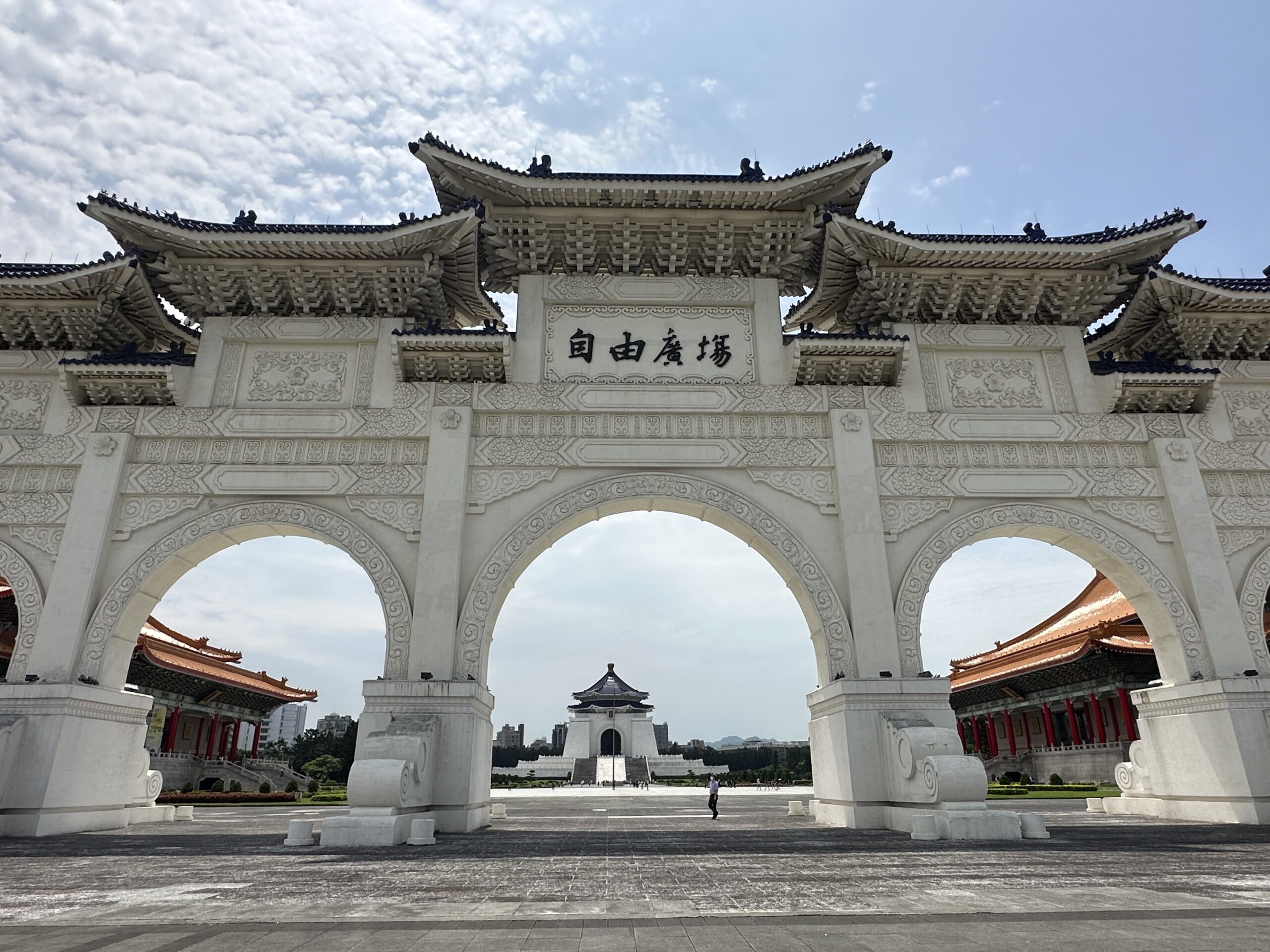
We soon reached Liberty Square (自由廣場) and stopped for photos in front of the imposing archway (真面牌坊). The archway stands 30 metres tall and 80 metres wide. The primary structure is made from white concrete, mimicking the look of white marble. The archway has 5 entryways, 6 pillars and 11 roofs. This 5-6-11 configuration means that this archway is of the highest rank, according to the traditional Chinese architectural classification system.


Beyond the main gate was a sprawling plaza covering over 240,000 square metres, with the Chiang Kai-shek Memorial Hall at the other end, the National Concert Hall on the left and the National Theater on the right. The two performance venues are modern in function and purpose but designed with traditional elements of Chinese palace architecture. I imagine it will be a really cool experience to watch a performance here one day. It was very impressive to stand in the middle of the huge square, surrounded by the grand buildings.


After locking our bikes, we quickly walked towards the Chiang Kai-shek Memorial Hall to catch the Changing of the Honor Guard ceremony at 11:00am. The ceremony is conducted daily from 9:00am to 5:00pm, totalling nine times a day, and lasts approximately 15 minutes.
The memorial hall was built to remember President Chiang Kai-shek (蔣介石) after he passed away in 1975. Completed in 1980, the main hall has four walls constructed with white marble and a two-layered octagonal roof covered with royal blue glazed tiles. The combination of blue and white evokes both the national emblem and that of the Kuomintang, the party that Chiang led.


We climbed up a long flight of stairs to reach the main hall on the upper level. The two sets of white stairs, each with 89 steps to represent Chiang’s age at the time of his death, led to the main entrance. After passing through the two large bronze doors, we were greeted by the view of a giant statue of Chiang seated, flanked by a Taiwan flag on each side. The caisson ceiling is designed in the shape of the national emblem, symbolising the link between the man and the country.


We arrived just in time for the ceremony. Three smartly dressed soldiers started marching out from the right side of the hall, taking slow, measured steps with military precision. Their movements were in perfect unison, with the clanking of the metal plates attached to the soles of their boots reverberating across the silent hall.

Upon taking position at the middle of the hall and facing Chiang’s statue, the two soldiers on sentry duty at each side of the hall got off their posts and marched in coordinated fashion to join the newly arrived soldiers. After performing some drills, the new guards marched to their respective posts to take over sentry duty before the old guards marched out of the hall, led by their commander. The entire ceremony was over in less than 15 minutes.


Like the one at Buckingham Palace, the Changing of the Honor Guard ceremony at Chiang Kai-shek Memorial Hall is a major draw for tourists and I’m glad we got to witness it, even though it took up 15 minutes of our tour duration. I’m also glad we got to see it being performed inside the hall because since 15 July 2024, the ceremony has been moved outside to Democracy Boulevard in front of the Hall stairs.
The reason for the change is to move away from “worshipping authoritarianism”, according to the Ministry of Culture. The military Honor guards’ sentry duty at the Hall has also been removed but their performance has been maintained. Hence, the new ceremony is shorter at about five minutes because unlike the old ceremony, the guards no longer remain afterwards – they simply march back to behind the Hall.
The fate of the bronze statue of Chiang Kai-shek in the Hall is also up in the air as it is seen as a legacy and reminder of Taiwan’s authoritarian past and historical mainland ties. For young Taiwanese especially, Chiang is a polarising figure, negatively perceived by some for his brutal military regime and brand of authoritarianism. After the ceremony ended, we walked through the grounds past the garden and pond before going back to our bikes.


After the lengthy break, we resumed cycling at 11:33am and made a brief stop at the Monument for the Victims of the White Terror (白色恐佈政治受難者紀念碑), located at a corner of Jieshou Park, near the Presidential Office Building. The monument comprised of a circular structure with a spiral ramp leading to the lower level, which looked like it contained a fountain or a shallow reflective pool, but it was mostly dry. Its nondescript appearance notwithstanding, the memorial stands as a poignant reminder of the victims of Taiwan’s White Terror period.

After the end of World War II and the defeat of the Japanese in 1945, the Republic of China took over Taiwan, under the rule of Kuomintang (KMT), led by Chiang Kai-shek. However, the failed administration of KMT caused the local residents to be resentful of what they viewed as high-handed and corrupt conduct by the KMT authorities. The tension culminated with the February 28 Incident in 1947 (also known as the 228 Incident).
On 27 February 1947, a Nationalist agents from the Tobacco Monopoly Bureau enforcement team struck a woman suspected of selling contraband cigarettes with the butt of his gun. The situation escalated and an officer fired into a crowd of angry bystanders. One man was shot and he died the next day. The death of the man sparked protests island wide on 28 February and the military was called in to quell the uprising, eventually brought to an end using violent means.

Two years after the 228 Incident, the KMT and ROC troops retreated from mainland China to Taiwan following their defeat in the Chinese Civil War. The KMT imposed martial law in 1949, marking the start of the four-decade period of repressive rule in Taiwan, known as the White Terror period. Around 140,000 Taiwanese were imprisoned under harsh treatment, with many indirectly dying or suffering health problems. An estimated 3,000 to 4,000 people were directly executed for their opposition to KMT’s Chiang Kai-shek government. The White Terror period finally ended in 1992 with the repeal of the last law enabling the persecution of people for “anti-state” activities. As such, the monument was a reminder of the Taiwan’s tumultuous journey to democracy.
Next, we cycled past the Presidential Office Building. The Baroque-style building with its red brick façade was completed in 1919 during Japanese rule to house the Office of the Governor-General of Taiwan. Today, this is the work place of the President of Taiwan.


After cycling through the Ximen shopping district, we reached Bopiliao Old Street (剝皮寮老街) just after noon. This was originally a collection and distribution centre of Chinese fir, a valuable tree transported from Tang Shan in China, and the locals processed and stripped the bark. Hence, the place is called Bopiliao because “bo pi” means “strip the bark”.


The one- and two-storey brick buildings in this historic street date back to the Qing Dynasty and are over 200 years old. The old buildings underwent a major six-year restoration process from 2003 and the district is now a cultural hub hosting art exhibitions and heritage education programmes. The Bopiliao Historic Block is closed on Mondays so we didn’t have the chance to enter to see it.


We also cycled past Lungshan Temple (龍山寺), also known as the Bangka or Mangka Lungshan Temple (艋舺龍山寺). Bangka or Manga is the Taiwanese Hokkien name of Wanhua District, where the temple is located. Wanhua is the oldest district in Taipei. There are other Lungshan Temples in Taiwan but the one here in Wanhua is the oldest and the most famous.
The main deity in Lungshan Temple is Guanyin, the Goddess of Mercy, but like many other temples in Taiwan, it is a mix of Buddhism, Taoism and Confucianism, so there are also statues of other deities like Mazu (Goddess of the Sea) and Guan Yu. The temple and the surrounding area were badly damaged during World War II but the statue of Guanyin survived the bombings intact, which strengthened the locals’ belief in the deity’s mythical powers.
Lungshan Temple’s layout resembles that of a Chinese siheyuan, a traditional residential architecture with a courtyard enclosed by four buildings on all sides. The temple is also a fine example of mosaic art, with vibrant porcelain tiles and dragons adorning the top of the main gate. We didn’t have time to enter the temple but it will be fascinating to step in, I’m sure.

We then cycled past the flood walls of Taipei to the bike path running parallel to the Tamsui River. These massive walls stretch across much of Taipei City’s riverfront as a flood control measure because Taipei is very prone to flooding. This is due to its low elevation, being surrounded by mountains on three sides and positioned between the Tamsui and Keelung Rivers. Not to mention it experiences typhoons several times a year. Hence, the flood walls and network of water pumps help to prevent the city’s streets from being inundated.


We cycled on the same bike path along the Tamsui River on Day 1 of our Tour de Taiwan (but in the opposite direction), so this brought back memories. We soon reached Dadaocheng Wharf (大稻埕碼頭), a popular spot for the locals to chill out at night among the waterfront cafes and food vendors. It was quiet when we were there at 12:40pm.


We then stopped at a roadside stall because Beatrice wanted to buy some fresh orange juice. We watched as the male stallholder used a handheld squeezer to extract the juice from the oranges, one by one. It was a lot of work for a little bit of juice but he filled the 1-litre clear plastic bottle to the brim. He did it on the spot so we could see that it was 100% pure orange juice, with no ice or water added. AT and I also bought one bottle to share. It was a little pricey at NT$170 (S$7.48) but the male stallholder deserved it for his hard work.


After getting our juice, we cycled through Dihua Street (迪化街), a narrow, 19th century street with traditional shophouse-style buildings and shops selling tea, medicine and herbs. Our last stop was at the Taipei Xia Hai City God Temple (台北霞海城隍廟). The temple was built in 1856 and it is very small and not particularly eye-catching. It is dedicated to the City God, a deity that protects the people and the city. The temple is popular among the locals seeking relationships and marriages.


A short ride later, we were back at Taipei Bike Works and ended the tour just after 1:00pm. Overall, the tour was a good way to see some of the main sights in a short time. TH and S came to the shop to meet us and the four of us had lunch together. We went to an eatery called Piao Xiang Niu Rou Mian Guan (飄香牛肉麵館), which S had found through her research. The shop is located at Ningxia Road, which transforms into a bustling night market after 5:00pm every evening. We ordered the beef noodles, which was really tasty.


After lunch, we went our separate ways to do our own shopping. As usual, I was on a mission to visit all the CD and record shops in Taipei. From Ningxia Road, I walked south towards Zhongzheng District. Along the way, I popped in to Taipei City Mall, the largest and longest underground street shopping mall in Taiwan, for a quick look.


The first store I went was Kuang Nan Wholesale Taipei (光南大批發大批發) at Xuchang Street in Zhongzheng District. This is not a dedicated music shop but a wholesaler that also sells stationery, cosmetics and household items. The ground floor had a small CD section with a selection of International titles but it wasn’t fantastic.

Around the corner was Five Music (5大唱片), which had a much wider collection of new and catalog titles. Besides Mandarin and International titles, it also carried Japanese, Korean, classical, jazz albums and vinyls. The store is spacious and neat, making it a very comfortable shopping experience.


Not far away was Chia Chia Record (佳佳唱片) at Hankou Street. The main branch is at Ximending (which I had already visited) and this is a slightly smaller store but it is just as well-stocked. Chia Chia carries a great selection of the latest releases and catalog albums of Mandarin and International artistes. They have CDs, vinyls and DVDs and Blu Rays. Definitely the number 1 place to go if you have time to visit only one music store in Taipei for new music and movies.


The next store I visited was Music Affair Records (愛樂唱片), located at Chongqing South Road Section 1, Number 44, 3rd floor (重慶南路一段44號3樓), only two streets away from Chia Chia Record at Hankou Street. The shop entrance on the ground floor is very easy to miss as it is an old building and the staircase is very narrow and inconspicuous. The shop specialises in used/secondhand music CDs.

After climbing up the stairs, I saw many cardboard boxes stacked messily on top of each other, partially obstructing the entrance and extending into the shop as well. It’s a sign that the owner is a true music lover and I knew immediately that I would unearth some great finds here.
The store has many Mandarin and International titles arranged in alphabetical order on the racks, but many of the CDs were left lying in the boxes because the owner didn’t have time to unpack them. I managed to dig out some coveted Taiwan pressings of MJ and Janet titles here. The owner is also very friendly, so this is a great place if you’re looking for secondhand CDs and hard-to-find titles.


Satisfied with my haul, I walked back to the hotel to deposit my shopping and took a shower before heading out again. I took the Metro to Gongguan (公館), where there were two CD shops that I wanted to visit. After walking past the night market, it started to rain and all the motorbike riders stopped by the side of the road to put on their ponchos. I took out my umbrella and continued walking.


I soon reached Mollie Used Books (茉莉二手書店,影音館), located at Number 17, Alley 10, Lane 244, Section 3, Roosevelt Road in Zhongzheng District. Mollie has two other branches in Taipei selling used books primarily, but this branch sells used music CDs and movie DVDs. I have been here before on my previous visit in 2017 so I am quite familiar with it.
The selection at Mollie is huge and the titles are well catalogued and arranged. The store is spacious and comfortable to shop in. I was pleased to add three more CD albums here to my collection. I was pleasantly surprised when the staff informed me that membership is for a lifetime, and I just had to enter my mobile number to retrieve my membership details to enjoy 15% discount. Wonderful!


The last store on my list for today was Indimusic Records (個體戶唱片行), located on the 3rd floor of Number 5, Lane 297, Section 3, Roosevelt Road. Like Music Affair Records, the staircase entrance was very small and narrow and I almost missed it.

Indimusic sells used CDs and vinyl records and the entire store was filled to the brim with them. All the albums were stocked on the shelves so it was relatively neat, but there didn’t seem to be a particular order they were organised. To save time, I asked the owner where the MJ and Janet titles were and he pointed me to them.
There was lots of good stuff here! I didn’t buy as much as I could because I already picked up some of the albums at Music Affair earlier. Indimusic was probably the best among all the shops I visited today – in terms of the breadth of the catalog, quality titles, price and shopping experience. I like my record shops to be a bit cluttered and haphazard, with an indie record shop feel.

Unfortunately, I ran out of Taiwan dollars so I went to the Family Mart convenience store nearby to withdraw some cash. However, none of my credit cards worked and I couldn’t get any cash from the ATM. I went back to Indimusic to buy whatever titles I could with my limited cash left, and thought of making a return trip tomorrow after changing some money at the bank. However, the owner said he could accept my Singapore dollars so I paid for my purchases with a mix of Taiwanese and Singapore dollars. As I only had Singapore $50 bills with me, the owner gave me the change back in Taiwanese dollars. Such a friendly and helpful owner!
I then searched for somewhere to have dinner but most of the places were cash-only. I ended up at Burger King, where I could pay using my credit card. Some observations about my dining experience at Burger King: they ask you if you need a straw before they give you one, and it’s a paper straw. They only have ketchup sauce; no chilli sauce. They take waste and food recycling seriously – there is a receptacle for draining your unfinished drink and ice, and also a separate bin for food waste.

I was done with my dinner around 9:00pm and booked an Uber to take me to EZ5 Live House to meet AT, TH and S. While waiting for my car to arrive, it suddenly started to pour and the heavy rain was accompanied by strong winds. I quickly took shelter at the Taipower Building.
One minute after the rain started, my Uber car arrived but it was parked along the main road, about 20 metres away. Taipower Building has a sheltered driveway but apparently, the entrance was blocked and it could not be accessed by taxis or Uber cars. If I ran out to the car, I would be completely drenched despite having an umbrella because the rain was very heavy. I decided to cancel the ride and wait for the rain to get lighter or find another pickup point with an accessible shelter.

Even though I was hiding under shelter, I was getting soaked because the wind was very strong, like a typhoon-force wind. I searched for other pickup points on the Uber app but there was nothing nearby that was sheltered. After waiting for about 15 minutes, I concluded that the rain was not going to get lighter and I had no choice but to brave the rain. I rebooked a ride on Uber, and discovered that the price had more than doubled since my last booking. The car eventually arrived, parked at the same location, and I ran out to the car with my umbrella and got wet. Actually, it wasn’t so bad. I should have done that earlier. Oh well.
After a long delay, I finally arrived at EZ5 Live House at 9:35pm. AT, TH and S were already there half an hour ago. We came to this live music bar because TH and S had visited EZ5 during their previous visit to Taipei and they enjoyed the music and ambience so they wanted AT and I to experience it too. They made a reservation so we had a good view from our table close to the stage.

The bar was quite cosy and intimate and it was fully packed on this Monday night. The cover charge of NT$800 (S$35.20) includes two coupons that can be used to redeem food or drinks. Some drinks and food items require one coupon while others require two coupons. We used our 8 tickets to redeem two jugs of cocktails, one jug of hot milk tea, fries and fried chicken.


Three singers took turns to perform with the house band, with each singer taking the stage for 45 minutes. The first set was from 9:45pm to 10:30pm, with the subsequent sets taking place after a 15-minute break. The house band comprised of a female keyboardist (who played at Jay Chou’s concert the week before), a drummer, a bassist, guitarist and a trombone player (which felt a little extra).
The first singer was a lady who had a smoky voice. She sang some English songs by Corinne Bailey Rae (Like A Star) and John Mayer (Back To You) but most of her repertoire consisted of Mandarin songs, including one by Shunza. Apparently, she chose songs that fit the mood of the rainy weather outside. She didn’t get much reaction from the audience but I liked her performance.

The second singer was a gentleman who previously participated in the Voice of China television singing competition. He had a husky voice, but wasn’t really to my liking. He sang only Mandarin songs, and I thought he completely butchered Faye Wong’s classic 天空. In fact, I almost fell asleep while listening to him. Unlike the first singer, he took song dedications. He also had many friends and supporters present and bantered with the audience, so he proved to be quite popular among the crowd that night.
The final singer was another gentleman who had a strong, powerful voice. He could really sing. He looked awkward on stage for the first two songs but eased into the night as he started to banter, joke with the audience and take song dedications. An audience member requested for an English song and he bravely took it on. He said he hasn’t sung the song for 15 years but he pulled it off beautifully.

After the final set ended at 12:30am, AT and I bade farewell to TH and S as we went back to our respective accommodations. AT and I booked an Uber car to take us back to our apartment in Ximen while TH and S went back to their friend’s apartment. It had been a long day out and I was very tired, but it was a very productive and enjoyable day in Taipei city.
