Day 6 – 2 May 2025, Friday
After the dreary conditions yesterday, we were hoping for much better weather today for our last day of cycling in Okinawa. When I woke up at 6:15am, I immediately checked the forecast and it was promising, with daytime temperatures between 21 and 24 degrees C and sunny conditions throughout the day. I pulled open the curtains and was greeted by the most welcoming view from our apartment’s balcony – calm blue ocean and light blue skies. What a beautiful sight!

By now, there’s a running joke/superstition that whatever I say about the weather will turn out to be the opposite. On the morning of our first day of cycling, I said that the weather “would probably hold” but it ended up raining for our entire ride. So, I have to say that it “will definitely rain today”, and it will turn out the opposite. And it only works if I say it, not anyone else.
For today, we will be cycling around the hills east of Nago city. The suggested route on the Velodash app is 41.7km long with an elevation gain of 610m. The ride is expected to take around 5 hours. Even though the cycling distance is short, the elevation will be greatest among the three days of cycling, with three big climbs and a smaller climb. Depending on how we fare later, we have an option to take a shortcut by skipping the last big climb to Haneji Dam if we feel too tired or if we don’t have enough time. We will need to return the bicycles to Hub Cycle by 7:30pm today.


After having breakfast at our apartment (FamilyMart sandwiches of course, what else?), we geared up and got ready for our ride with great anticipation. We left our apartment at 8:00am, set up our bikes, took photos to commemorate the occasion and started our ride officially at 8:20am. Once again, PL took on navigation duties while I took on the role of capturing photos and videos. However, I decided to abandon the use of my chest harness because it was too troublesome to mount and dismount my mobile phone from the harness, so I just kept my phone in the back pocket of my cycling jersey. I’ll just whip it out whenever I need it, much more nimble and flexible.


As we headed northeast, we retraced the same route as the last part of yesterday’s ride, but in the opposite direction. Once we cycled past the bridge that led to Ojima Island, we were in new territory. Here, we cycled along the coast and the scenery was absolutely stunning, with the road flanked by the blue ocean on the left and the green forests on the right. I was overcome with happiness when I felt the breeze and morning sun hitting my face as I pedalled. This was what I imagined cycling in Okinawa to be like, and I finally got to experience it.


However, the coastal section didn’t last long and we soon had to leave the coast and head inland for the hills. This is where the real challenge begins because we will start to tackle the three big climbs, with the first climb being the biggest one for the day. Before diving in to the hills, we took some nice photos by the sea and had a little break before we deviated from National Route 58 and turned inland to Route 14 at 9:15am.


As we entered Genka district, the climb started almost immediately. Oh boy, it was not only steep but sustained. This was the first of many such climbs to come. I dropped to the lowest gear and kept pedalling slowly and steadily without stopping. Even though I was huffing and puffing, I tried to control my breathing to keep it as regular as possible. It helped that this was a quiet mountain road through the forest so it was mostly shaded. I distracted myself from the task at hand by looking at the beautiful scenery around me, and eventually made it to the top of the hill.


Being the fittest among us, PL reached the top of the hill first. I joined him after that, followed by ZY (assisted by her e-bike), KP and IH. We munched on chocolate bars and drank up before continuing the ride. When tackling hilly terrains like this, just remember that what goes up must go down. The uphill was tough but the downhill was super shiok! With the road as dry as a bone today, we could cycle down confidently and quickly, whilst still controlling the brakes intermittently. We don’t ever get such long stretches of downhill in Singapore so I savoured every moment of it.


What followed for the rest of the morning was a series of uphills and downhills. It was tough for sure, but having gone through such similar terrain in Taiwan, I found it manageable. In fact, I relished the challenge of pushing myself on the slopes because we don’t get to do this on a normal basis, with Singapore being almost completely flat. The beautiful mountain and coastal scenery made it even more worthwhile.


After conquering the two big climbs and the smaller climb, we decided to reward ourselves and break for lunch. I found a restaurant on Google Maps called Minaminohatake near Sedake Beach and we stopped there for our lunch break at 11:35am. It was a simple restaurant with indoor and outdoor seating and we sat at one of the two tables outside so we could watch our bikes while we ate.


ZY ordered the pork belly Okinawa soba while the four guys ordered the tonkatsu curry with rice because we were famished. We also ordered a portion of the SPAM and egg set to share because we saw someone eating it and it looked good. The food was very reasonably priced, just 950 yen (S$8.75) for my tonkatsu curry rice set, with free flow coffee (hot or iced). The food tasted good too. It was a satisfying lunch.


We resumed cycling at 12:42pm. The next 3km were relatively flat and we enjoyed the last of the coastal scenery before heading back inland. We started climbing again at 1:00pm but we were energised by our full bellies. The sun was out and it was getting hot but the surrounding greenery provided an extra morale boost. After the big climb, we entered a long tunnel through the mountain. We didn’t have lights with us but thankfully, there weren’t many cars so it was safe for us to ride through the tunnel.


Upon exiting the tunnel, we had two options – the first option was to stay on route 18, which would lead us directly back to Agarie and Nago city; the second option was to turn right and head north to Haneji Dam, as per the Velodash route. The first option is shorter in terms of distance and likely less strenuous (actually, we don’t know the elevation profile of this section but we assume it is less hilly). The second option is much longer and definitely more strenuous because the elevation profile on the Velodash app shows a series of ups and downs.

We considered the time – it was still early and we could definitely complete our cycling before 7:30pm. We also considered everyone’s physical condition – ZY had an e-bike so it was not a problem for her; IH and KP were tired but they were game for it. They would just get off and push their bikes if they needed to. Since it was our last day of cycling, and the weather was beautiful, we decided to go all out and do it!
As promised, the way to Haneji Dam was full of slopes but it wasn’t as bad as the previous climbs. The uphill sections were shorter and we also had long stretches of downhill to recover. At one point, the vegetation cleared up and we had a marvellous view of the reservoir below. We paused to soak in the view and catch our breaths.


At 1:40pm, we reached Matakina Bridge, a striking vehicular bridge held together by white and pink cables. The bridge and the surrounding scenery were gorgeous so we stopped to take many photos. The views really made the effort to get here worth it. We felt justified in our decision to take the “detour” to Haneji Dam and not take the shortcut.


Moving along, we found another good vantage point with Matakina Bridge in the background so we stopped again to take more photos. PL and ZY went ahead while IH, KP and I hung around to snap more pics.


After a small climb, it was a steep downslope. As I was going down the slope, I saw PL in the distance, standing with his bike around a bend where there was a T-junction. He was trying to direct us to turn left and go downhill, where ZY had already gone ahead (but I didn’t know yet). As I cycled downslope, I saw a sign that pointed the way to Haneji Dam on the right. I thought we should turn right to go see Haneji Dam.

However, IH, who was cycling in front of me, didn’t see the sign. He also didn’t spot PL and somehow PL also didn’t see him because he was cycling fast, so IH went straight down the slope and missed the turn to Haneji Dam. The slope was too steep so there was no point trying to chase after IH to come back up the slope.
PL managed to successfully intercept KP, who was a little behind me. We decided that KP and I would go ahead to check out Haneji Dam while PL would continue down the slope to meet ZY and IH, in case they wondered what happened to us. So in the end, only KP and I went to see Haneji Dam. That was the reason why we came this way so we thought we should at least see the dam.


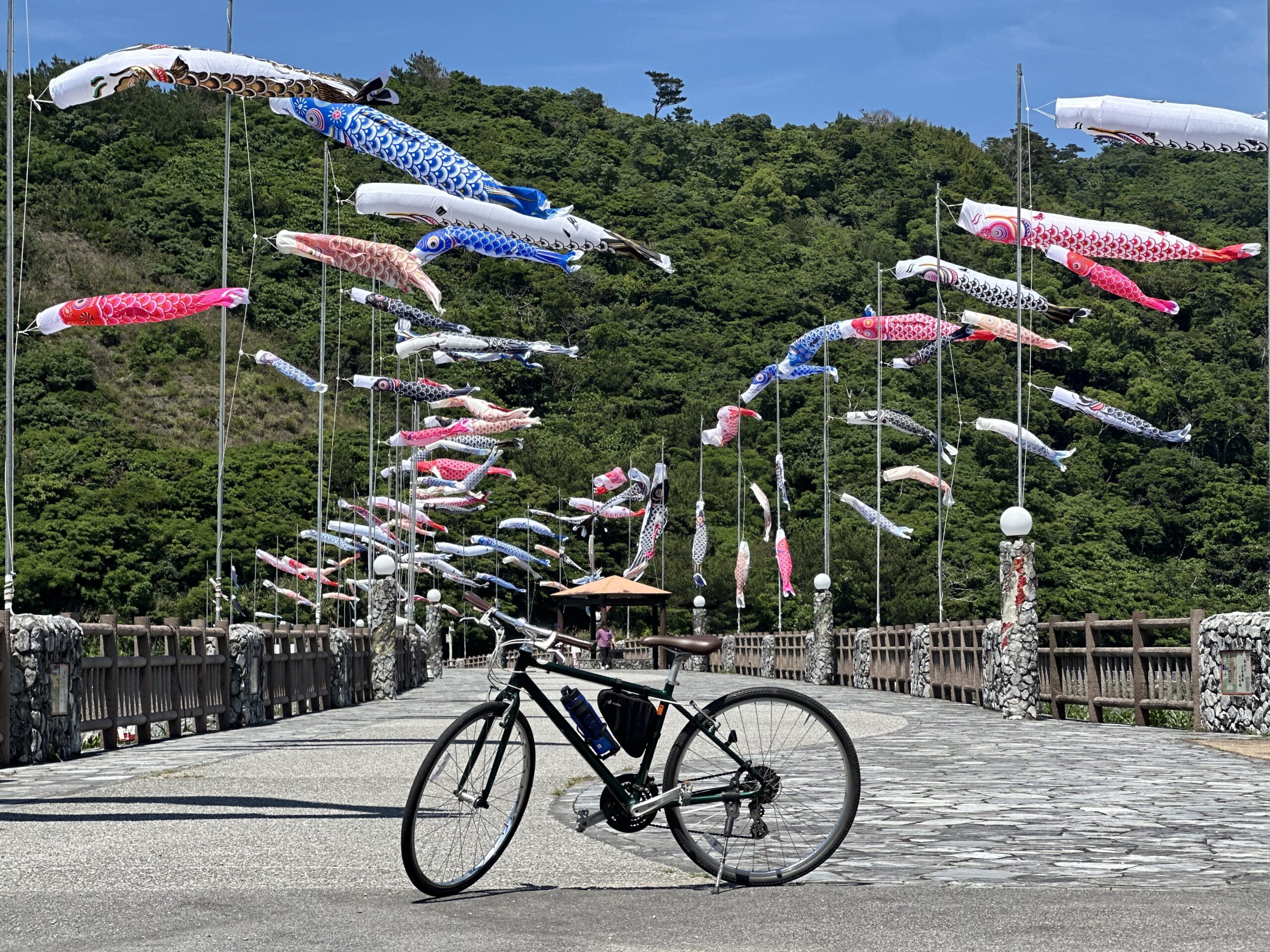
Haneji Dam is a rock-fill embankment dam on the Haneji River, completed in 2004. It helps with flood control and water supply. The dam itself is a wide pathway where dozens of fish-shaped wind socks in red, blue and black hung on poles along the walkway, fluttering with the breeze. The entire area was very calm and serene. With the dam overlooking the reservoir and surrounded by lush green forest, it was a nice spot to escape the stress of everyday life.


After taking our fill of photos and videos, KP and I cycled down the slope to rejoin the rest of the group. It turned out to be the last downhill section and we found ourselves at sea level when we met up with ZY, PL and IH again. After that, we cycled through the busy town, using the same route we had travelled several times over the past couple of days.
At 2:35pm, we reached Hub Cycle and completed our ride. We cycled a total distance of 54km today, with an elevation gain of 817m. According to my Strava stats, the first big climb through Genka was my second biggest climb lifetime and today’s ride was the second most elevation gain. Number one positions for both stats were recorded in 2023 when I did the Taiwan round-the-island ride. Nevertheless, today’s ride was one of the most physically demanding I have ever done.


We all felt super accomplished and happy with the ride today. This was what I expected when I came to Okinawa. The previous two days of cycling were largely through urban and countryside areas, with not much coastal scenery. We had a bit more coastal views today but the route does not hug the coast like in Jeju so it’s different. But whenever we had coastal views today, it was splendid.
The nice weather today helped a lot too. It was hot but we had a fair bit of shade cycling through the forested areas. The downhill sections ensured we had plenty of breeze too. The sunny weather made the water in the sea and reservoir sparkle. Over the three days of cycling, we experienced completely different conditions – cold and wet, with heavy rain for the first day; cool and gloomy skies for the second day; hot and sunny for the third day. We had a bit of everything and couldn’t have asked for a better way to end our cycling adventure in Okinawa.
After returning the bicycles at Hub Station, we took bus number 120 back to our apartment. But of course, there is always time for an A&W root beer float, a well-deserved reward for our hard work today. After gulping down the root beer floats and coney dogs, we went back to our apartment to shower and rest for the afternoon.


As the evening went on, the sun drew ever closer to the horizon. We had the most amazing view of the sunset from our balcony. However, we thought we should also head to Agarie Beach in front of our apartment to watch the sun go down, since it would be a crime to come to Okinawa and not visit the beach.


When we went to the beach at 6:50pm, we saw several other people there who also had the same idea. We sat on the steps near the breakwater and watched the sun set slowly. It is always humbling to witness Mother Nature’s daily magic show. Accompanied by my buddies and having a front row seat to the spectacle, this was one of my most cherished moments from the trip.


After the sunset at 7:00pm, the sky darkened gradually and the temperature fell steadily. It was time for dinner. We wanted to try a ramen restaurant called Danbo near our apartment but we were surprised to see a snaking queue of more than 20 people standing in line around the small building. Surely it can’t be as good as Ichiran, why are so many people queuing for it? We deduced that it would take a long time before it was our turn so we decided to try something else, and perhaps return again later tonight for supper.

We walked around our neighbourhood to search for alternative restaurants but nothing good came up. We even toyed with the idea of eating at Sukiya again but IH vetoed the idea. Even though it was only around 21 degrees C, the night was quite chilly, even colder than last night when it rained. I thought that was unusual because it was so hot today. I was getting a bit tired and hangry after walking around aimlessly. Thankfully, PL found a shabu-shabu restaurant quite close by so we decided to go for it.
When we arrived at Ton Ton Byoshi at 7:37pm, the female staff member informed us that the restaurant was full and she turned us away by making a large “X” sign with her hands. We told her that we could wait, and asked her how long it would take. She said we might have to wait for 20 to 30 minutes. After having walked a distance in the cold to get here, we were quite determined (or rather, desperate) to dine here because there were no other good options nearby, so we agreed to wait. Luckily for us, a family of five soon walked out and we were ushered to a table after only 10 minutes of waiting.


Shabu-shabu is a Japanese hotpot dish of thinly sliced meat and vegetables boiled in water and served with dipping sauces. The optimal temperature for shabu-shabu is about 80 degrees C. For sharing, we ordered a variety of dishes – the Yanbaru Shima Buta Pork & Yanbaru Agu Pork Set (4,158 yen/S$38.25), Local Wagyu Beef Shabu Set (5,808 yen/S$53.45), Umibudo Sea Grape seaweed (550 yen/S$5.05), grilled pork spring rolls (748 yen/S$6.90), Okinawa noodles (385 yen/S$3.55) and stewed Yanbaru Buta pork rafute (748 yen/S$6.90).


Yanbaru is the name of the northern area of Okinawa’s main island. Yanbaru means “densely forested mountains” and much of this region is protected area under the Yanbaru National Park. Shima Buta means “island pork”, and the Yanbaru Shima Buta pork meat offered at Ton Ton Byoshi is sourced from organic farms surrounded by the Yanbaru forests. The pigs are raised stress-free and fed with nutrient-rich feed, resulting in tastier and healthier meat.
Okinawa is famous for its Agu pork, a specific breed of pig that is rare and highly prized because of its scarcity. It grows slowly and is much smaller than the average modern pig. Agu pork meat has beautiful marbling and is both sweet and savoury. Its fat has a lower melting point than regular pork so it literally melts in your mouth. We had some grilled Agu pork yesterday at the yakiniku restaurant, but Agu pork is actually perfect for shabu-shabu because cooking the thinly-sliced meat in a broth allows the melt-in-your-mouth fat to really shine.
The Yanbaru Shima Buta Pork & Yanbaru Agu Pork Set were served in a platter across two plates, along with an assortment of raw vegetables, short sticks of bamboo containing the meat for the Tsumire dumplings, and Mozuku seaweed, which are thick strands of black seaweed containing fucoidan, a substance with many health benefits.


The restaurant had an English menu and it provided helpful instructions on how to enjoy shabu-shabu. The way to eat it is to first cook the loin meat shabu-shabu style in the soup stock in the pot, i.e. to cook it quickly by dipping the meat in the broth for only a short time. Next, wrap the meat around some sea grapes and dip it in the special, homemade shikwasa ponzu (Japanese citrus juice) sauce. The saltiness of sea grapes is supposed to enhance the flavour of Agu pork.


The Agu pork was rolled into the shape of a rose, and it contained a lot of fat, much more fat than meat. Agu pork is known for its high fat content, which adds to its umami flavour. The wagyu beef came with beautiful marbling and it looked very impressive when it was served on a platter. With the gentle Okinawan music playing in the background, we enjoyed the shabu-shabu while recounting the best parts from the ride today. It was nice to have hotpot in cold weather, and I’m very glad we chose to eat this instead of Sukiya.
We initially didn’t know how to cook the meat dumplings but ZY figured it out. Tsumire is derived from the word Tsumi-Ireru, which means picking something up (by hand or using a spoon) and putting it in (into a hotpot). That was what ZY did, but she used chopsticks instead of a spoon to scrape the meat off the bamboo to form smaller balls, into the hotpot.


After finishing our dinner at 9:05pm, we walked back towards our apartment. Along the way, we dropped by the huge Big 1 discount store, where we bought more snacks and PL bought a massage gun to soothe his aching muscles. We also dropped by our favourite FamilyMart kombini to pick up more sandwiches and line socks before heading back.
We didn’t play Bridge tonight because ZY went to bed early. PL, IH and KP went out again at 10:45pm to eat the ramen from Danbo but I didn’t join them because I was still full, and lazy to go out again. They were determined to try it so that they could know what the hype was about. Their verdict: it was good, but not as good as Ichiran, so I didn’t miss much. And with that, it was the end of Day 6, a thoroughly wonderful and fulfilling day of great cycling and good food.
