Day 4 – 30 April 2025, Wednesday
Today, we’ll be leaving our cosy apartment in Naha and renting a car to drive to Nago city located in the northern part of Okinawa island, about 67km away. We really loved our Naha apartment because it was so cosy and comfortable, and we had lots of fun hanging out in the living room and playing cards together. But after spending three nights here, it’s time to move on to Nago.
At about 8:25am, PL and I walked to Prefectural Office station and took the Monorail to Omoromachi, four stops away. The train ride took 8 minutes and the fare was 250 yen (S$2.30). The train was quite crowded because it was a weekday morning so we squeezed with all the other Japanese salarymen and women who were on their way to work.


Upon alighting at Omoromachi at 8:50am, we walked to the T Galleria shopping mall, which is right next to the Monorail station. The mall only opens at 9:00am so we tried to locate the TOYOTA Rent A Car shop in the meantime. We initially thought it was inside the multi-storey carpark at the adjacent building, but eventually discovered that the service counter is located on the second floor of the mall, alongside other car rental companies like OTS and Nissan.

After processing the necessary paperwork, the staff handed us a folder containing our booking form, JAF membership card (for roadside assistance), ETC card (for expressway tolls), a printed list of map codes to popular places of interests in Okinawa and a map showing directions to the car pick-up point, which is on the ground floor of the multi-storey carpark.
We needed a big vehicle for our party of five so I rented a Voxy, a big and boxy minivan that can seat up to 8 people. It was extremely spacious inside and very comfortable. We folded the last row of seats to free up space for our luggage. The car had an inbuilt navigation system with voice prompts in English so we used it to guide us to our destinations.

After inspecting the car and making sure that everything was ok, we left T Galleria and drove to our apartment to pick up the rest of our travel party and luggage. With everything locked and loaded, we started our drive out of Naha at 9:55am, in a northeastern direction towards our first stop, Mihama American Village.
I helped to navigate while PL took on driving duties. It was a very sunny day, 22 degrees C outside. We were happy to sit in the comfort of the car with A/C and music, chatting away and watching Okinawa go by. It had been a while since I’d done a road trip and I’d forgotten how fun it was.


After a 40-minute drive, we reached American Village at 10:35am. It’s great that parking is free here. The moment we got out of the car, we heard the booming sounds of fighter jets flying overhead. There is a huge U.S. presence in Okinawa – around 80,000 Americans, of which 30,000 are active-duty military personnel from all branches of the armed forces, with the rest being civilian employees, teachers, staff and almost 25,000 family members.
Okinawa has been a strategic location for the U.S. Armed Forces since the Battle of Okinawa in 1945 and the end of the Second World War. After the war, Okinawa was placed under the U.S. administration until 1972 when Okinawa reverted to Japan. The U.S. military maintains 32 facilities on Okinawa, with many of them in the central and southern part of the island. That is the reason why the American Village is here, because it is near Ginowan City and Kadena Town, two large military bases.
The American Village was created to provide the Americans living in Okinawa with a home away from home. The village is based upon traditional American culture and has themed restaurants, shops and entertainment. In fact, the whole place feels like a theme park, with many buildings sporting brightly painted exteriors, palm tree-lined avenues and even a Christmas Land with Santa Claus and Christmas decorations. Some of the colourful buildings and the staircases even look like sets from Squid Game. Just larger than life and unreal.


We decided to have breakfast at Seaside Café Hanon, which ZY sussed out during the drive here. The café is located on the second floor of the Ouk Fashion building overlooking the Depot Island boardwalk with amazing views of the sea. Apparently, it was a very popular café. We put our names on the waiting list and got an outdoor terrace table about 25 minutes later.

The café’s décor gave off Greek vibes and reminded me of my time in Mykonos, except for the constant drone of planes flying and landing at the airbase nearby. The view was pretty awesome, with the Okinawa Blue sea meeting the cloudless sky. In the evening, the sunset view here would be quite spectacular.


The concept of Café Hanon is to promote eating pancakes for breakfast, which is something not familiar to Japanese people. Hence, all the menu options involve pancakes. Hanon’s original basic pancakes are the Mihama Pancakes, which contain a subtle sweetness and buttermilk aroma. But I was also curious about the French Pancakes, which are fluffy and crispy finished in French toast style, an interesting combination of pancake and French toast. The Egg & Bacon and Eggs Benedict combination set meals also looked great. In the end, we ordered a bit of everything so we could share and try them all. I ordered the Egg & Bacon combination with scrambled eggs and two pieces of French pancakes and it cost 1,700 yen (S$15.64).

As each pancake is made fresh from scratch and cooked one by one, it takes about 20 minutes to prepare the food after the order is placed. We spent the time chatting away and enjoying the vibes. After building up our appetite, the food finally arrived and I’m glad to say it didn’t disappoint. The Mihama Pancake was very fluffy while the French Pancake had a nice, crisp topping.


As I ate, I was reminded of the fluffiest pancake I’ve ever put in my mouth – the one at Matsunosuke restaurant in Daikanyama, Tokyo, in 2013. That pancake was so soft and fluffy it just seemed to melt when I sliced it with my knife. I drool just thinking about it. However, Hanon’s pancakes were also excellent and we enjoyed the meal very much. It was another good find by ZY. She has a track record of discovering nice cafes, the last one being Antoinette Café & Bistro in Jeju last year.
After the amazing brunch, we walked along the waterfront to soak up more of the vibes. Honestly, it was too hot at noon time but I can imagine it will be much more pleasant when it’s cooler in the evening, especially if there’s a beautiful sunset. There was an outlet of Potama here so KP bought a SPAM Onigiri to try since he wasn’t with us when we had it on our first day in Okinawa. I noticed that they didn’t have the Fried Gurukun-fish one that I ate in Naha but they have different Special items here, which are specific to each outlet. The Philly Cheesesteak Potama looked really good but I was too full so I didn’t buy it.


We spent a short while shopping at the various blocks. There were many shops selling apparel of American brands, fashion accessories and souvenirs. Some were very interesting and sold exquisite handcrafted glass objects. They all looked so pretty but expensive and difficult to bring home so we didn’t buy any.


I came across a shop called Potte, a pottery factory selling handmade cups, plates and ornaments. I was immediately drawn to the beautiful plates and cups in Okinawa Blue. The design was simple, with strips of just three colours – white, light blue and a deeper blue. According to the shop owner, the colours depict the sand, sea and blue sky. To me, that is the quintessential image of Okinawa.
Actually, Okinawa Blue also refers to the fact that Okinawans have one of the highest life expectancies in the world and Okinawa is one of the world’s Blue Zones – regions where people live exceptionally long lives. This is due to their healthy diet, active lifestyle and strong social networks.
I would have loved to buy the dining plates but it would be odd to buy just one plate, so I bought a cup for dad as a present. Each piece is hand painted and the proportion of white, light blue and deep blue varies with each piece, so I spent some time finding the one with the perfect proportion of white and blues. The cup was quite expensive (4,500 yen/S$41.40) but I loved it.

There were several other blocks but we didn’t have time to visit them as we had to leave for our next destination. I think it will be good to spend more time here at American Village, half a day at least. After having brunch or lunch, it will be nice to stay on for sunset and dinner, because the whole place will be completely transformed at night and come alive with the lights and décor. Next time, perhaps!
At 1:05pm, we left American Village and continued our drive north towards Nago. The National Route 58 hugged the coastline for most part and we got beautiful ocean views as we drove down the highway. The scene was exactly like the cup that I bought, a perfect harmony of sandy beach, expansive sea and endless blue skies.


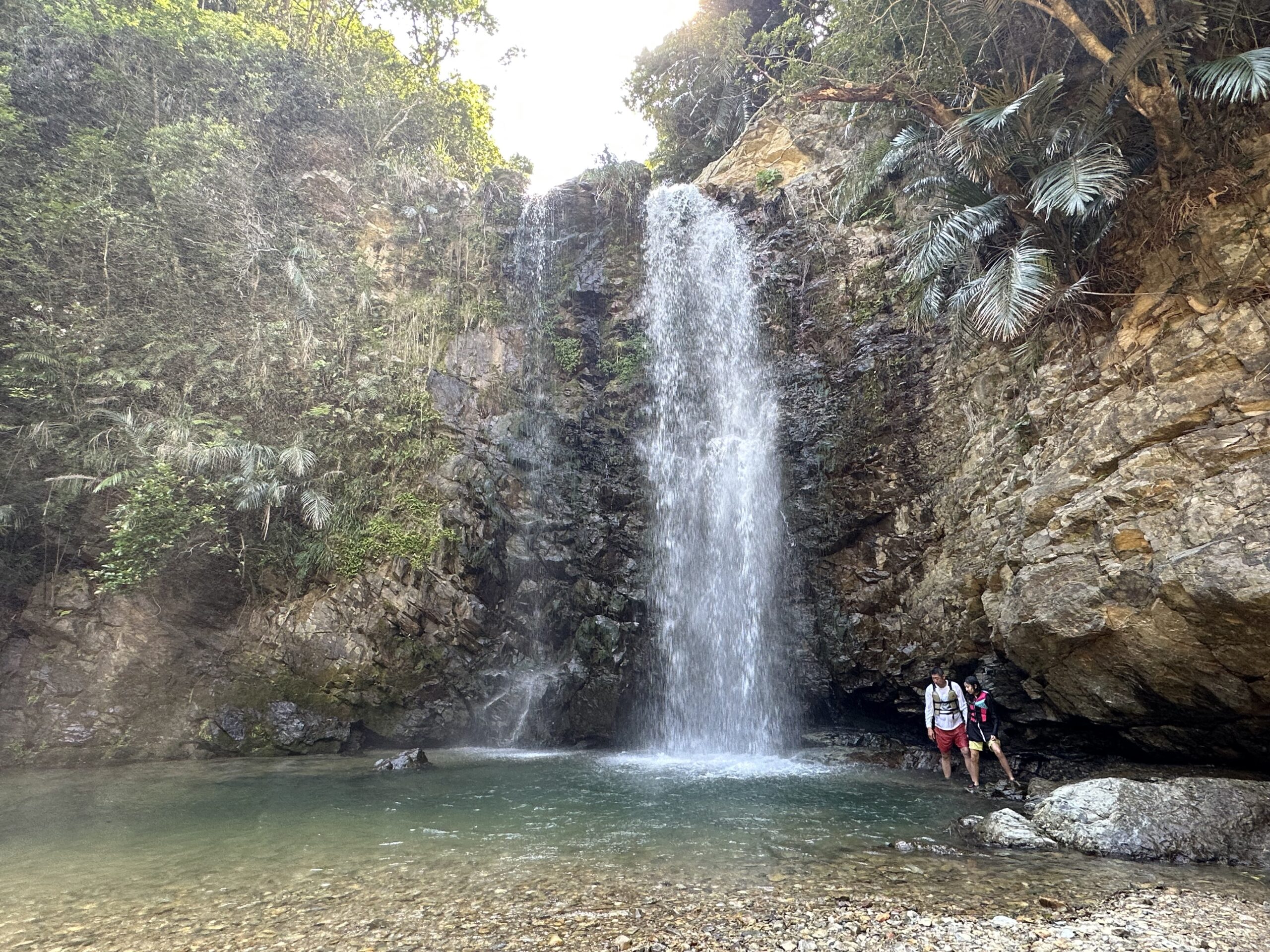
At 2:30pm, we arrived at Ta-taki Waterfall, located about 16km northeast of Nago City. The waterfall is open from 8:00am to 5:30pm daily, with last entry at 4:00pm. This is because it takes about 5 minutes to walk from the carpark to the start of the trail, and another 25 minutes to hike from the start of the trail to the waterfall, so you’ll need at least an hour to hike to the waterfall and back. The parking rate is 500 yen for 2 hours, with additional 50 yen charge every 30 minutes.


The carpark was manned by a staff member, who handed us a laminated poster in English providing information about the parking rates but more importantly, what the hike to the waterfall entails. The hike is not so straightforward because it involves walking in the river so you’ll definitely get wet up to the knees at least. It also requires some climbing of rocks so it might not be suitable for young children or the elderly. Of course, we had done our research beforehand so we were aware of the terrain and the risks, and we were well-prepared with proper footwear and a change of clothes.


If you’re really cautious, you can rent a full set of safety equipment for 1,500 yen. It comes with a life jacket, rash guards and felt shoes. We saw a group of young students who did just that. They were probably here for a school outing and were supervised by their teachers. For adults, it is not really necessary to rent the safety equipment.

The first part was a five-minute walk from the carpark to the start of the trail on a paved vehicular road, so it was easy and uneventful. At 2:50pm, we reached the starting point of the trail. This is where we will leave the road and walk along the Henan river to Ta-taki Waterfall. Apart from cycling and street karting, this hike to Ta-taki Waterfall was one of my most-anticipated activities for the trip. So excited…let’s go!


The water level at the river was quite low at the beginning so we were able to walk on the rocks along the riverbed without getting our feet wet. However, we soon had to traverse the river itself, but I felt very safe stepping on the wet rocks and pebbles because I had my trusty Keen sandals on, which have very good grip. The forest provided shade and the water was very cooling so it was an extremely enjoyable hike.


About 13 minutes into the hike, we encountered the most “challenging” section, which required the use of a rope to climb up a big boulder about six metres high. It wasn’t that difficult or dangerous but you do need to be careful. With teamwork, we managed to conquer this section quite easily.


The terrain became rockier as we progressed further. We had to use our hands to climb over the bigger boulders and wade through knee-deep water at some parts. It became a little trickier as the river flowed faster and we had to choose the path of least resistance and avoid slipping. At 3:15pm, we achieved our objective. And there it was, Ta-taki Waterfall in all its splendour!


Ta-taki Waterfall is not very high, only about 15 metres tall. The water poured straight down to create a huge splash zone at the base. It was a simple waterfall but gorgeous all the same. The other guys were initially hesitant to get into the water but the hot weather and beautiful scenery made them change their minds quickly.


We took off our T-shirts and waded into the rock pool towards the base of the waterfall. The pool was deceptively deep at some parts. When we reached the foot of the waterfall, it felt like being hit with a very powerful jet spray – the water was forceful and relentless. I could barely keep my eyes open. The water was cool and refreshing, it was super shiok!


We spent about 20 minutes enjoying the waterfall and taking lots of photos before turning back. We all grinned from ear to ear as we hiked back to the carpark. This was hands down, the funnest thing we did on the trip. So glad we visited Ta-taki Waterfall, and were blessed with beautiful weather to make it even more memorable.


At the carpark area, there are shower and changing facilities but we didn’t use them as we were mostly dry by the time we reached our car. We left Ta-taki Waterfall at 4:15pm and drove back towards Nago City. We arrived at the TOYOTA Rent A Car shop at Agarie just in time, 10 minutes before we were due to return the car by 5:00pm.


Our accommodation in Nago was an apartment in the Winbell Coralview building, conveniently located just two minutes away from the car rental shop on foot. That was one of the main reasons I chose the apartment. We dragged our luggage over and followed the instructions provided by the owner to gain access to our apartment on the 8th floor, which was the top floor of the building.


When we stepped in, our jaws dropped when we saw the view of the sea and Nago Bay from our balcony. It was astounding. I’d seen pictures of the apartment when I was booking it online but it was even more impressive seeing it in person. The apartment was splendidly cosy and we fell in love with it immediately. Even though it had only one bedroom with two single beds, the apartment was larger than our previous one in Naha. We let PL and ZY take the bedroom while the three of us (IH, KP and me) took the tatami room, which had one single bed and two futons.
The living room was huge and it had a nice bar table with high stools, which was perfect for a morning coffee while gazing into the sea. The bathroom and toilet were also very spacious, and the throne (toilet bowl) was even bigger and more advanced than the one in Naha. In Japan, you can tell how good an apartment or hotel is by the toilet bowl – the more buttons and functions it has, the better quality it is.


We took our time to shower and settle down in the apartment. As the evening went by, it got cooler and we had the most gorgeous view of the sunset from our balcony. At that moment, I just felt happy and completely relaxed. That’s what being on vacation is about. At 6:30pm, we left our apartment for dinner at a yakiniku restaurant called Oba-no-ie, located about 7km away. The restaurant is very popular so IH made a reservation in advance.


Once again, we had difficulties booking a large Uber car for the five of us so we booked two cars. Perhaps of our location, it took a while for our bookings to be accepted. I rode the first car with KP while IH, PL and ZY took the second car. The drive to Oba-no-ie was 15 minutes and the fare was 2,100 yen (S$19.32). KP and I arrived first. We were 5 minutes late for our reservation but thankfully they let us in.


The restaurant was in a small standalone building, which was more like a house than a commercial building. After removing our shoes, we were ushered to one of the two outdoor dining areas on the porch, which came with tatami mats and low tables. All the other tables were occupied and the whole place was filled with smoke and the smell of meat being grilled over charcoal.


After KP and I were seated, we were puzzled that the second car carrying IH, PL and ZY had not arrived yet. When they did arrive about 10 minutes later, IH told us that their taxi driver had issues with the Uber app and the destination mysteriously disappeared from the driver’s app when he arrived to pick them up. As a result, they had to manually provide Oba-no-ie’s address for the driver to navigate his way here using Google Maps.
Upon reaching Oba-no-ie, the driver insisted that they pay the fare to him in cash since the trip was apparently not captured in the driver’s Uber app. Because of the language barrier, it was hard to communicate with the driver, so IH eventually relented and paid him the fare in cash so as not to create a scene, even though it was quite fishy because the ride was still appearing on IH’s Uber app. He also couldn’t cancel the ride on his Uber app.
As we were discussing this at the restaurant, ZY noticed that IH’s mobile phone screen suddenly changed to display the driver’s face, which meant the ride had only just started and was currently in progress. It seemed that the driver did not start the trip on the Uber app in the first place. This also meant that IH was being double charged since his credit card will also be charged on the app. ZY then saw that the taxi’s present location was just outside our restaurant, so IH and PL quickly ran out to try to intercept him to get our fare back.
It turns out that the driver was parking his taxi because he finally realised what happened and wanted to return us the cash. He was not trying to run away. We’re not sure if he had already driven away and had come back specially to find us, or he was just hanging around in the vicinity trying to figure things out, but his intention was to return the cash. He was quite old and probably wasn’t very familiar with how the Uber app worked. He apologised profusely and returned IH the money. Actually, while we were having the discussion at the table earlier, ZY said that Japanese people are very honest and he wouldn’t be out to cheat us, and she was right. Faith in humanity restored!
After the Uber drama, we were ready for dinner. We ordered the Teru Special Set (23,780 yen), which serves 3 to 4 persons. It included assorted cuts of Wagyu beef (sirloin, skirt steak, special beef round, fatty rib), special beef tongue, small intestine, Agu pork, sausages, veggies, prawns, kimchi, soup and rice. We also ordered an additional serving of black pork, and ice-cold Orion beer of course. The total bill amounted to 32,140 yen (S$296).


We had to cook the food ourselves using the charcoal grill on our table so I left it to the experts (IH and PL) to cook the expensive meats while I tended to the veggies. The beef was very good and we liked it more than the pork. The restaurant was as smoky as IH described to us before we came here, and it got smokier as the oil from the fatty meats dripped onto the grill. By the time we finished our dinner at 8:30pm, we all smelled of yakiniku.


After our struggle with booking the taxis earlier, we asked the restaurant staff to help us call two taxis to take us back to our apartment. This time, there were no problems as the restaurant staff communicated clearly with the drivers and there was no dispute over the fare or destination. But our stomachs still had room for dessert so we stopped at the huge Blue Seal parlour at Agarie to have some ice-cream before going back. For tonight, I chose Okinawan Salt Cookies flavour. Yummy!


After that, we dropped by the Lawson convenience store next door for a look. We saw fireworks for sale, probably because it was Golden Week in Japan. The fireworks were prominently displayed on the rack in front of the cashier counter, and they weren’t too expensive so we bought one packet with three sticks of fireworks for 700 yen (S$6.45). We thought of setting them off at the breakwater in front of our apartment later or tomorrow night.
Fireworks are banned in Singapore so we don’t have the chance to play with them. KP and I had the experience of setting off fireworks when we visited England 16 years ago. I remember we drove to a quiet carpark where there was no one around. We stuck the sticks of fireworks in the ground before lighting the fuse, and they whizzed into the night sky, bursting in a kaleidoscope of colours. It was so fun.
Walking further along, we saw a huge supermarket called Town Plaza Kanehide Nago Bay Market so we went in to buy more groceries, snacks and beer. PL is a snack monster so he bought many packs of his favourite chocolate bars and snacks. We were all influenced by him and I grabbed several boxes of Pocky and packets of Calbee crackers.

As we walked past the police station beside the supermarket, we suddenly wondered if we would get into trouble setting off fireworks in Okinawa. The fact that the fireworks were being sold openly at Lawson and the supermarket means that it is not illegal, but perhaps they could only be released at certain places or times? Even after consulting the Internet, we were not sure of the rules so IH and KP decided to enter the police station to ask the officers. I stayed outside with PL and ZY initially and we joked that IH and KP should be careful because of the language barrier – the police officers might be mistaken that IH and KP were asking about a bomb rather than fireworks.
When I stepped into the police station later, I found it to be rather dimly lit and quiet because there were no members of public around, only a few officers on duty at 9:30pm. The officers’ work stations on the ground floor were open concept and everything looked rather old. It felt more like a community or social services centre, a welcoming place where people can just walk in and make enquiries. Evidently, there is not much crime in Okinawa, or Japan in general.
A few officers gathered around as IH tried to explain his enquiry about the fireworks. Perhaps they had nothing to do and this was the only exciting incident they had all day, so they all tried to chime in enthusiastically. One of the officers made a phone call to his colleague, who spoke better English and acted as translator.
Essentially, the officer said that fireworks are allowed only at designated areas, and are not allowed at parks or beaches. Even then, the use of fireworks is discouraged because members of the public may call the Police if it causes annoyance or disturbance, which is not good. In short, don’t play with them. We thanked the officers for their clarification and left.
We flirted with the idea of setting off the fireworks from our balcony, but our apartment is just one block away from the police station and they would surely know it was us. And it would be twice as damning after having been told not to do it. None of us wanted to get in trouble so we gave up the idea. Even though we didn’t get to play with the fireworks, I found the experience of interacting with the local police meaningful.
We then walked to our favourite shop, FamilyMart, to grab more sandwiches and socks. This time, I influenced everyone to buy the FamilyMart colour line socks and wear them for our bike ride tomorrow. The line socks sport the trademark green and blue lines of the FamilyMart logo and they come in white and black versions. I bought a white pair in Tokyo last October and loved it so much. Everyone else saw me wearing it, and we all decided to buy it and make it our uniform for the bike rides. It cost only 429 yen (S$3.95) a pair, and it makes for a great souvenir too. I bought the white and black pairs, and also the Ryukyu Golden Kings ones, a special collaboration with the professional basketball team from Okinawa.

After all the shopping, we went back to our apartment. I took another shower and we played Bridge again till 12 midnight. For tonight, my luck wasn’t as good and I was on the losing team most of the time. What a wonderful day it had been, having a nice brunch at American Village and hiking to Ta-taki Waterfall. Really looking forward to the cycling tomorrow!