How It All Began
Following last year’s successful Jeju cycling trip with my buddies IH, PL and ZY, we planned a sequel for this year. Our other cycling buddy KP wasn’t able to join us last year but he promised to join us this year, so we had a party of five this time round, which made it even more fun. I really like the idea of round-island cycling trips, having done Taiwan (905km over 9 days) in 2024 and Jeju (234km over 4 days) in 2024. So the idea for the 2025 sequel was another round-island cycling trip.
There aren’t actually that many islands that are suitable for short (4 to 5 days), multi-day, round-island cycling trips and our shortlist was quite short, with Okinawa in Japan being the top (and in fact, only) contender. Depending on the route you take, a round-island tour of Okinawa typically covers around 336km to 400km and it can be done in 4 to 5 days. The other option we considered was the Incheon to Busan cross-country route in South Korea, but that requires more time – 7 days of cycling to complete the 630km distance.
I was quite keen to cycle from Incheon to Busan, especially during the cherry blossoms period, but having just visited Jeju in South Korea last year, we thought we should try another country this time. Furthermore, the Okinawa distance is more manageable in terms of fitness and the amount of leave days required. Hence, we decided on Okinawa for 2025! The only catch is that IH has just been to Okinawa two years ago, so it will be a very quick return visit for him.
However, our plans changed somewhere down the line as work commitments popped up and KP could only spare 6 days of leave for this trip. That made it a bit tight to do a proper round-island cycling tour of Okinawa. We decided to modify the trip from a round-island cycling tour to one that incorporated cycling and some sightseeing during the 8 days, with KP joining us from the third day onwards.
Cycling Routes & Itinerary
Since we couldn’t do a straightforward round-island tour, we had to plan the cycling routes ourselves. I came across a useful website called Okinawa Travel Brochures providing useful information on cycling in Okinawa. They published a PDF brochure in 2020 about cycling holidays in Okinawa and I referenced the brochure to plan our cycling routes. Click here to download the brochure.
I decided to follow three of their routes – Southern part of the island around Naha (about 68km), Motobu Peninsula around Nago (about 58km) and Hill climbs around Nago city (about 42km). I thought these three routes provided a good balance between distance, difficulty level and variety of sights. The brochure also provided QR codes for the course maps on the Velodash cycling app, which we eventually used for our trip.
With the cycling routes settled, it was time to plan the itinerary. Since KP will only be joining us from the third day onwards, we decided to spend our first three nights in Naha, the capital of Okinawa Prefecture. We will do the first ride around Naha on the second day, without KP. After that, we will rent a car and drive towards Nago in the north, where we will spend another three nights and do the other two rides. Following that, we will rent a car again and drive back to Naha to spend one more night there before flying home.
Flights
For our flights, Jetstar is the only airline offering direct flights from Singapore to Okinawa so we didn’t have any choice. We each paid S$616.14 for the two-way flights. This is the Starter Plus fare, which includes 20kg checked baggage, 7kg carry-on baggage, seat selection and a meal.
[Update: On 11 June 2025, Jetstar Asia announced that it will cease operations on 31 July 2025, thereby terminating the direct flight from Singapore to Okinawa. Its competitor, the budget airline Scoot, has since announced that it is interested to take over the route.]
Accommodation
For accommodation, ZY found a nice apartment in Naha called Hotel Tenshi Kan Kumoji, conveniently located near the main Kokusai-dori shopping street. Best of all, it has two bedrooms and five single beds, a tatami room with futons and a living room where we can all hang out together. I booked the Superior Family Room on booking.com and it cost 108,766 yen (S$1,015.95) for 5 persons, for 3 nights.
For our accommodation in Nago, I found an apartment on booking.com that had a wonderful view of the sea and sunset. The apartment doesn’t have a proper name but it is located in Winbell Coralview building at Agarie. The best thing is that it is located right beside the car rental shop, which makes it super convenient. We paid 123,120 yen (S$1,111.95) for 5 persons, for 3 nights, utilising my 20% Genius member discount on booking.com.
For our last night in Naha, I wanted to book Hotel Tenshi Kan Kumoji again but it was much more expensive for that single night. Perhaps because it is right smack in the middle of Japan’s Golden Week (29 April to 6 May 2025) so hotels are expensive everywhere, especially in Naha. We settled for The Orion Hotel Naha, managed by the Okinawan beer company, Orion. Besides the hotel’s strategic location (3-minute walk to the Monorail station and Kokusai-dori), the other thing that attracted me was the free welcome drink at the bar and free Orion beer in the room fridge. The hotel looked pretty new and nice too. We booked two rooms – Deluxe Twin Room at 29,960 yen (S$225.42) and Deluxe Triple Room at 30,480 yen (S$275.28), a total of S$500.70 for 5 persons, for 1 night. I booked the rooms directly via the hotel’s website.
Bicycle Rental
For our three days of cycling, I found two companies providing bicycle rental services – e-CHARIty NAHA (click here) and HubCycle in Nago (click here). We decided to rent cross bikes (aka hybrid bikes) for the guys and an e-bike for ZY. For e-CHARIty NAHA, the full-day rental rate is 2,800 yen (S$25.30) for a cross bike and 3,800 yen (S$34.30) for an e-bike. For HubCycle, the two-day (overnight) rental rate is 5,400 yen (S$50) for a cross bike and 6,300 yen (S$58.30) for an e-bike.
Car Rental
For car rental, I chose a reliable and established company, TOYOTA Rent A Car (click here). Since we had five adults, we needed a big vehicle to store our luggage so we went with a Wagon type car with 7 seats, like NOAH or Voxy. We will require the car for two days – one day to drive from Naha to Nago, and another day to do the reverse. For the two days of car rental, the full-day rate for a Wagon from 9:00am to 5:00pm is 27,049 yen (S$243.10), after a 5% credit card discount. This amount includes a one-way fee (pickup at Naha and drop off at Nago, and vice versa) and the Full Package comprising rental of ETC Card (a stored value card for paying tolls), Collision Damage Waiver (CDW) and Rental car Assistance Pack (RAP).
Other Expenses
Additionally, we also applied for an International Driving Permit (IDP) each, which allows the holder to drive a motor vehicle overseas. We needed the IDP not because all of us will be driving in Okinawa, but because we wanted to participate in a street go-kart activity in Naha. You can apply for the IDP at the Automobile Association of Singapore (AA), either online or at one of the AA centres. The IDP costs S$20 and it is valid for one year from the date of issue.
We also bought travel insurance from MSIG. For the four of us (excluding KP since his travel dates were different), we paid S$185.60 for the Elite plan. Lastly, I paid S$16.00 for an eSIM from Yoowifi, providing me with 2GB data daily for 8 days. With everything in place, we were ready to roll!
(Exchange rate: approx. S$1 = 108 yen / 100 yen = S$0.92)
Day 1 – 27 April 2025, Sunday
After a hectic day at work, I went home to shower, rest and had a short nap before taking a taxi to Changi Airport, arriving at Terminal 4 at 11:35pm on 26 April 2025, Saturday. I met up with PL and ZY first (IH was late, as usual) and we had a small bite at Burger King before boarding. Our Jetstar flight 3K791 departed Singapore at 2:00am and I quickly closed my eyes, determined to catch as much sleep as possible on this red eye flight.


However, we were surprised when the cabin crew woke us up at 2:45am and offered us food. We had completely forgotten that our air ticket bundle included meals. PL and ZY (seated across the aisle) thought they needed to pay for the food so they rejected it and continued sleeping. IH also initially thought the same, but when the cabin crew addressed me by name, I clarified with her if we needed to pay for it and she said no, so we said ok. I chose Nasi Lemak while IH had Chicken Rice. The food wasn’t fantastic but it was a hot meal and I was mildly hungry so I ate. After that, I managed to sleep for about two hours before I started to feel bloated and couldn’t get back to sleep anymore.


We touched down at Naha Airport at 8:00am sharp (Okinawa is 1 hour ahead of Singapore). After clearing immigration and customs, we walked to the Monorail station and bought our tickets from the vending machine. The Okinawa Urban Monorail, or Yui Rail, is the only public rail system in Okinawa Prefecture and it has 19 stations. The one-way ticket from Naha Airport to Makishi station costs 320 yen (S$2.95).


We departed Naha Airport at 9:10am and alighted at Makishi station 16 minutes later. The Monorail is clean and comfortable, an efficient way to get into the city. Best of all, it is above ground so we could see how the city looks like. Okinawa is certainly not as dense and populated as other big Japanese cities like Tokyo and Osaka.


After alighting at Makishi, we walked along Kokusai-dori towards Don Quijote. It was a cloudy day and the temperature was a pleasant 22 degrees Celsius, perfect weather for walking. Kokusai-dori is the main shopping street in Naha and our accommodation is somewhere along the street so we will be visiting this roughly 2-kilometre street a lot during our stay in Naha.


As we walked, some of the shops were just about to open for business. Those that were already open were mostly souvenir shops and we saw that they all sold the same stuff – merchandise and T-shirts bearing images of Orion Beer, Blue Seal or SPAM, three of the most iconic emblems of Okinawa. If not, they were selling boxes of Japanese cookies and confectionery wrapped in cute and pretty packaging. Despite being the main shopping street, I noticed there was an absence of big department stores or fashion retailers like Uniqlo or international brands like Nike on Kokusai-dori. It mainly comprised of small shops and restaurants housed in low-rise buildings, very different from Tokyo and Osaka with their skyscrapers and tall buildings.


As it was way too early to check in to our accommodation (officially at 3:00pm), we had to find a way to store our luggage. We considered using one of the luggage transfer services like Yamato or Airporter, which delivers your luggage from the airport to your hotel at a fee of 1,000 yen (S$9.20) per luggage. Click here for more information about these services. However, our accommodation in Naha was not a proper hotel but an apartment and it didn’t have a Reception counter, so this option was not available to us.
I managed to find a luggage storage service at T Membership Lounge, located on the 5th floor of Don Quijote at Kokusai Street. Click here to visit the website. The lounge doubles as a storage facility and they charge 500 yen (S$4.60) per piece of luggage per day. Items like small bags that can be placed on top of a suitcase can be stored free of charge. You can also access your luggage anytime and take it in and out of the lounge multiple times for free, unlike a locker, which charges each time you unlock it. As our accommodation is located within walking distance from here (about 600 metres away, 8 minutes’ walk), this was our best option. However, T Membership Lounge only opens at 10:00am so we were still a bit too early. Hence, we decided to have breakfast nearby first.
I did my homework and bookmarked two eateries near Don Quijote so we went to check them out, lugging our suitcases along. They were located right next to each other, and both had snaking queues when we arrived at 9:45am. On the left was C&C Breakfast, a small café serving pancakes topped with Okinawan fruits, acai bowls, smoothies, sandwiches, French toast, waffles and omelettes. There were only about six tables inside and everyone seemed to be in no hurry to finish their food so we knew that was out.


On the right was a small shopfront for Potama, with its kitchen behind the cashier counter. Potama is short for Pork Tamago Onigiri. This is an Okinawan specialty and it is a twist of the classic Japanese onigiri (rice ball wrapped with seaweed) because it contains a slice of pork luncheon meat and egg (tamago). The addition of luncheon meat to onigiri is an adaptation to cater to the tastes of the numerous American troops stationed in Okinawa. SPAM is the famous American brand of luncheon meat and hence, that’s why there are so many SPAM souvenirs and merchandise sold all over Okinawa. IH said that the SPAM onigiri is one of the must-try dishes in Okinawa so we decided to go for it.

There are three types of Potama available – Standard, Special and Limited Edition. Standard Potama come with basic ingredients like mentaiko and bonito kelp, and are available in all stores throughout Japan. Special Potama come with more premium ingredients like bitter melon tempura and shrimp and are also available in all stores throughout Japan. Limited Edition Potama come with local ingredients unique to the region and can only be eaten at that specific store. Even within Okinawa, there are different Limited Edition Potamas offered at their four stores. The Standard Potama are the cheapest while the Limited Edition Potama are the most expensive.
We queued for 30 minutes to place our order, and waited another 12 minutes to get our food. To make the queue worth it, each of us ordered two items – a Standard and a Special/Limited Edition Potama. I ordered the Mentaiko Mayo (460 yen/S$4.23) and the Fried Gurukun-fish (850 yen/S$7.82). There was a separate eating area located near the shopfront with tables and chairs and we went there to eat.


So, was it worth the long wait? The answer is a resounding yes. The SPAM luncheon meat was not as salty as I expected and it went well with the rice and egg. In a way, it is similar to the rice burgers from MOS Burger, just that the Potama is wrapped with seaweed. The portions were bigger than expected and it was actually very filling. I was quite full after eating the first Fried Gurukun-fish Potama, but if I ordered only one, it would have left me craving for more. For maximum enjoyment, you must eat the Potama when it is hot and fresh.
After spending an hour at Potama, we went to T Membership Lounge on the 5th floor of Don Quijote to deposit our luggage. The lounge has sofas, chairs, tables and it is air-conditioned so it can also serve as a workspace or resting area if you need a place to wait for other members of your group to finish their shopping. After dropping off our luggage at 10:50am, we were free to explore Naha!

But first, we needed a caffeine boost. We searched for cafes around the area but many were not open yet. Those that were open were very tiny and they were all full. Hence, we settled for the safest but most boring option – Starbucks. Actually, we went there because they had seats. Interestingly, you cannot order a Flat White in Japan so I went for a Latte.
As we sat at Starbucks and watched the world go by at Kokusai-dori, I noticed that buses and taxis suddenly stopped passing through the road and the whole street became very quiet. I glanced at my watch and saw that it was 12 noon, and I figured that it must be car-free Sundays at Kokusai-dori from 12pm onwards. In fact, Kokusai-dori is closed to vehicular traffic every Sunday from 12:00pm to 6:00pm, subject to weather conditions. Pedestrians started pouring onto the empty street to take photos so we followed suit.

We then wandered down a covered shopping arcade adjacent to Don Quijote. The arcade was narrow and long and it was flanked with shops selling all kinds of souvenirs and food products, very similar to the shopping arcades in Osaka. We saw a lot of shops selling sea grapes, a type of edible seaweed that is a specialty of Okinawa. They come in clusters and resemble tiny green grapes. I tried a free sample later but I didn’t really like it.


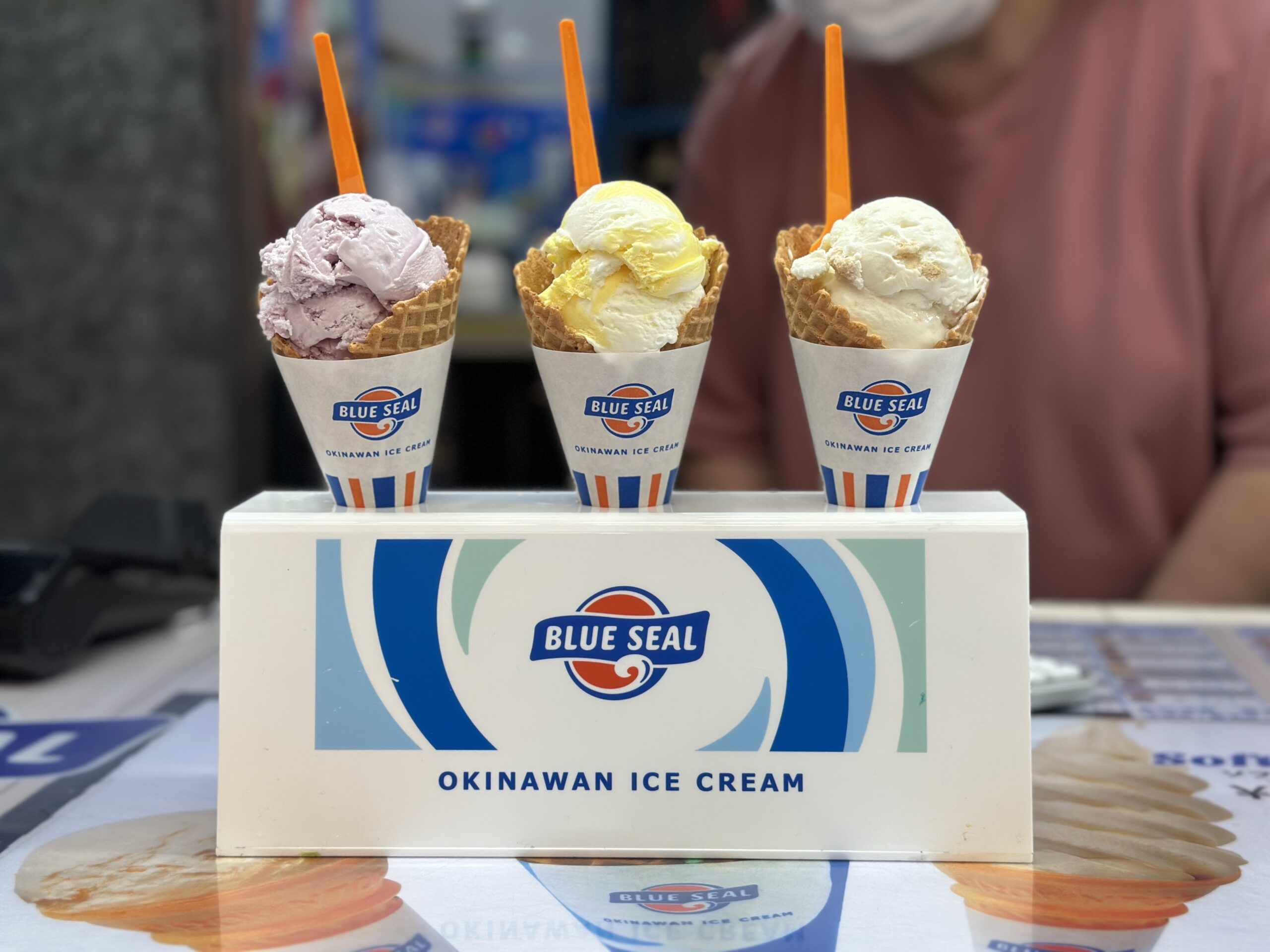
We came across a Blue Seal ice-cream parlour and decided to have our first Blue Seal ice-cream, another must-try food item in Okinawa. Blue Seal is an ice-cream specialty store “Born in America, and raised in Okinawa”. The business started in 1948 when the US-headquartered Foremost company set up a milk plant at the American military base in Okinawa to supply dairy products to its military personnel. The company moved out of the military base to Urasoe City in 1963 and started making ice-cream, and quickly gained a following among the locals. In 1976, the company adopted the name Blue Seal, derived from the prestigious “Blue Ribbon Award” given to dairy products of excellent quality in the United States, reflecting its commitment to serving the best quality ice-cream. Today, Blue Seal is one of the most iconic brands in Okinawa.
IH, ZY and I ordered the Okinawan Salt Cookies, Okinawa Pineapple Coconut and Beni-imo flavours respectively. A single scoop with waffle cone costs 450 yen (S$4.14). The ice-cream was indeed very good. In fact, all three flavours we chose were delicious. I set a target to eat a Blue Seal ice-cream every day. Let’s see if I’ll achieve it!


We soon arrived at Makishi Public Market but it was closed. Unbeknownst to us, Makishi Public Market is closed every 4th Sunday of the month, and we happened to be there on the one day of the month that it is closed. Nevertheless, IH said we didn’t miss much because he visited it before and found that it wasn’t that great.

We proceeded to our next destination, Tsuboya Yachimun Street, the epicentre of Okinawa’s pottery traditions. This winding, limestone-paved street contains many charming, independent pottery shops and a few small and cool cafes. We popped in to a few stores to check out the exquisite handcrafted plates, cups, decorative items and Shisa figurines, which are traditional guardian figures in Okinawa culture. I saw a beautiful plate in Okinawa Blue that was really pretty but also expensive so I resisted the temptation to buy it. We spent about 25 minutes at Tsuboya Yachimun Street, a short but pleasant visit.


As we walked back towards Kokusai-dori, PL decided to hang out at Ryu Haku Café while the three of us continued shopping. We walked to the other end of Kokusai-dori, where Palette Kumoji shopping mall is located. The mall has nine floors and its tenants include Ryubo department store, Tower Records and Muji, while its basement houses a supermarket and a food hall.


My main objective was of course, Tower Records. I was disappointed that the store was quite small and its selection was rather limited. I bought only five CD albums, which is very modest by my standards, compared to my haul in Tokyo and Osaka last October. After meeting up with IH and ZY, we walked back to Kokusai-dori again and reunited with PL at Ichiran for lunch. PL told us he was so tired that he fell asleep at Ryu Haku Café earlier. I think we were all quite exhausted after our red eye flight.


When we arrived at Ichiran at 2:45pm, there was a short queue and we waited only for about 15 minutes before we got seats. We split up and sat separately since they were all counter seats with individual booths anyway. I ordered the classic tonkatsu ramen Select 3 with extra chashu and a soft-boiled egg (1,520 yen) and additional seaweed (160 yen), amounting to 1,680 yen (S$15.50). The ramen was excellent, as always. I know I won’t be able to get a bowl of ramen of this quality in Singapore at this price so I must definitely eat at Ichiran at least once whenever I visit Japan.

After the satisfying meal, we went back to T Membership Lounge to retrieve our luggage and walked to our accommodation, about 600 metres away from Don Quijote. Hotel Tenshi Kan Kumoji is conveniently located in a quiet street just off Kokusai-dori. The property owner sent us detailed instructions on how to access the building and apartment unit so we were able to check in by ourselves without any hassle.

The apartment was really nice. It had a kitchen, a large living room, two bedrooms with five single beds, another tatami room with additional futons, a big bathroom and a separate WC. It was very spacious and comfortable, we really loved the apartment. This was a great find by ZY!


We took some time to settle down and shower before heading out again at 5:20pm. We had a dinner reservation at 7:00pm so we booked an Uber car to take us to Sports Depo at Ameku, which is near our dinner venue. The Uber ride cost 900 yen (S$8.28) and the drive took 8 minutes.


This was the flagship store of Sports Depo and it was really huge. Unlike Decathlon, which sells mostly its own house brands, Sports Depo carries international brands like Nike, Adidas, New Balance, Asics, Mizuno and Puma. And while its range is not as extensive as Decathlon, it offers apparel and equipment for all the major sports like running, football, basketball, baseball, badminton, cycling and swimming. It’s like a sports version of Toys ‘R Us. These days, I buy almost all of my sports gear from Decathlon so I didn’t buy anything here at Sports Depo. Furthermore, it was very crowded with locals on this Sunday evening (also because of an early Golden Week sale) and the queue for payment was very long so I didn’t think of trying to buy anything.

Besides Sports Depo, there was also Muji, Uniqlo and Best Denki nearby in the same cluster at Ameku. I did some shopping at Uniqlo, together with PL. We combined our purchases so that we could hit the minimum spend of 5,500 yen (tax inclusive) in a single receipt to enjoy 10% VAT refund. One thing I love about shopping in Japan is that it is very convenient to get a tax refund for tourists. The minimum amount of 5,550 yen (S$50.60) is quite easily attained, and most retail shops are able to process the tax refund on the spot – giving you the refund either in cash or crediting it back to your credit card. Very fuss free. Just remember to bring your passport along whenever you’re out shopping!
After completing our purchases, we walked to the dinner venue, an izakaya restaurant called Mekiki no Ginji Shintoshin (on Google Maps, it is called Connoisseur Ginji Shintoshin), just around the corner. The restaurant is very popular and reservations are required.

IH discovered this restaurant from Tik Tok. It had a very eye-catching façade made up of larger-than-life wooden sake barrels with planks sticking out of them, replicating the display menus typically found at izakaya restaurants. The décor inside the restaurant was just as quirky, with the upper seating areas carved out from the wooden barrels and dozens of wooden pails resembling those found in sentos/onsens hanging from the ceiling.


To truly soak up the vibes of an izakaya, it will be better to sit at the bar table, where you can see the chefs preparing the food behind the counter. However, for a group of four, it is more conducive to have a proper table so we were escorted upstairs where the bigger tables were.
Even though it is an izakaya restaurant, it also sells sashimi. Before coming to Okinawa, PL said he wanted to eat as much good-quality sashimi as possible so we ordered a platter of assorted sashimi and some other tuna sashimi specially for him. We also ordered grilled beef, tonkatsu and chawanmushi. Additionally, we also ordered a plate of fried rice but it never came. Of course, we also had beer. The bill came up to 9,540 yen (S$87.80). Overall, the food was so-so. It wasn’t bad; it just wasn’t exceptional. I think you come here more for the fancy décor than the food.


We left the restaurant at 8:00pm and took an Uber car (1,200 yen/S$11.04) back to our apartment. We had an early night because we were all tired from the red eye flight and a day of exploration. I took another shower and went to bed at 9:40pm. That’s the end of Day 1, many more exciting days ahead!