Day 6: 2 May 2026, Saturday
It was pretty chilly when I woke up at 6:35am this morning, with the temperature currently at 11 deg C. The forecast showed that it will rise to 18 deg C at 11:00am, which will be very pleasant. For our breakfast, we went to the McDonald’s restaurant near our hotel in Myeongdong. Mum and dad had the Sausage Egg McMuffin meal (5,200 won/S$4.58) while I had the Bacon Egg McGriddle meal (5,900 won/S$5.20). Interesting that McDonald’s is cheaper in Seoul than in Singapore.

After breakfast, we walked to Euljiro 1(il)-ga station and took the Metro to Gyeongbokgung, with a transfer at Euljiro 3(sam)-ga station. The train fare was 1,550 won (S$1.36). Upon alighting at 9:12am, we took Exit 5 and entered Gyeongbokgung Palace via a small side gate on the western side, near the National Palace Museum of Korea.


Gyeongbokgung Palace (景福宮) was built in 1395 as the first royal palace of the Joseon dynasty. It is the largest of the five grand palaces built during the Joseon era from 1392 to 1897. The palace was destroyed during the Imjin War in 1592 and remained vacant for 273 years before it was restored by King Gojong. During Japan’s colonisation of Korea from 1910 to 1945, many of the palace’s buildings were destroyed again. The palace restoration project began in the 1990s and many important buildings were rebuilt to their original state and stand to this day.

Gyeongbokgung Palace has four entrances. The main gate is Gwanghwamun Gate (光化門) in the south. The side gate we entered on the western side was called Yongseongmun, historically used by the king when travelling toward the northern or western outer palace gates. Twice a day at 10:00am and 2:00pm, there is a Royal Guard Changing Ceremony in front of Gwanghwamun Gate. However, we didn’t wait till 10:00am to watch the ceremony, and just explored the grounds freely on our own.


It is common to see people wearing hanbok, the Korean traditional costume, because visitors who wear hanbok can enter Gyeongbokgung Palace (or the other four royal palaces in Seoul) for free. The historic palace buildings provide a grand and beautiful backdrop. Many people also engage photographers to take professional shots of them dressed in the traditional costumes, a nice way to remember their visit.


Beside hanbok wearers, seniors aged 65 and above, as well as those aged 18 and below, can also enter the palace for free. Adults aged 19 to 64 have to pay an admission fee of 3,000 won (S$2.64), which is actually very affordable. Mum and dad were both eligible for free entry so I was the only one who paid the admission fee. They still had to obtain an admission ticket to enter, though. Only hanbok wearers can enter the palace without a ticket.

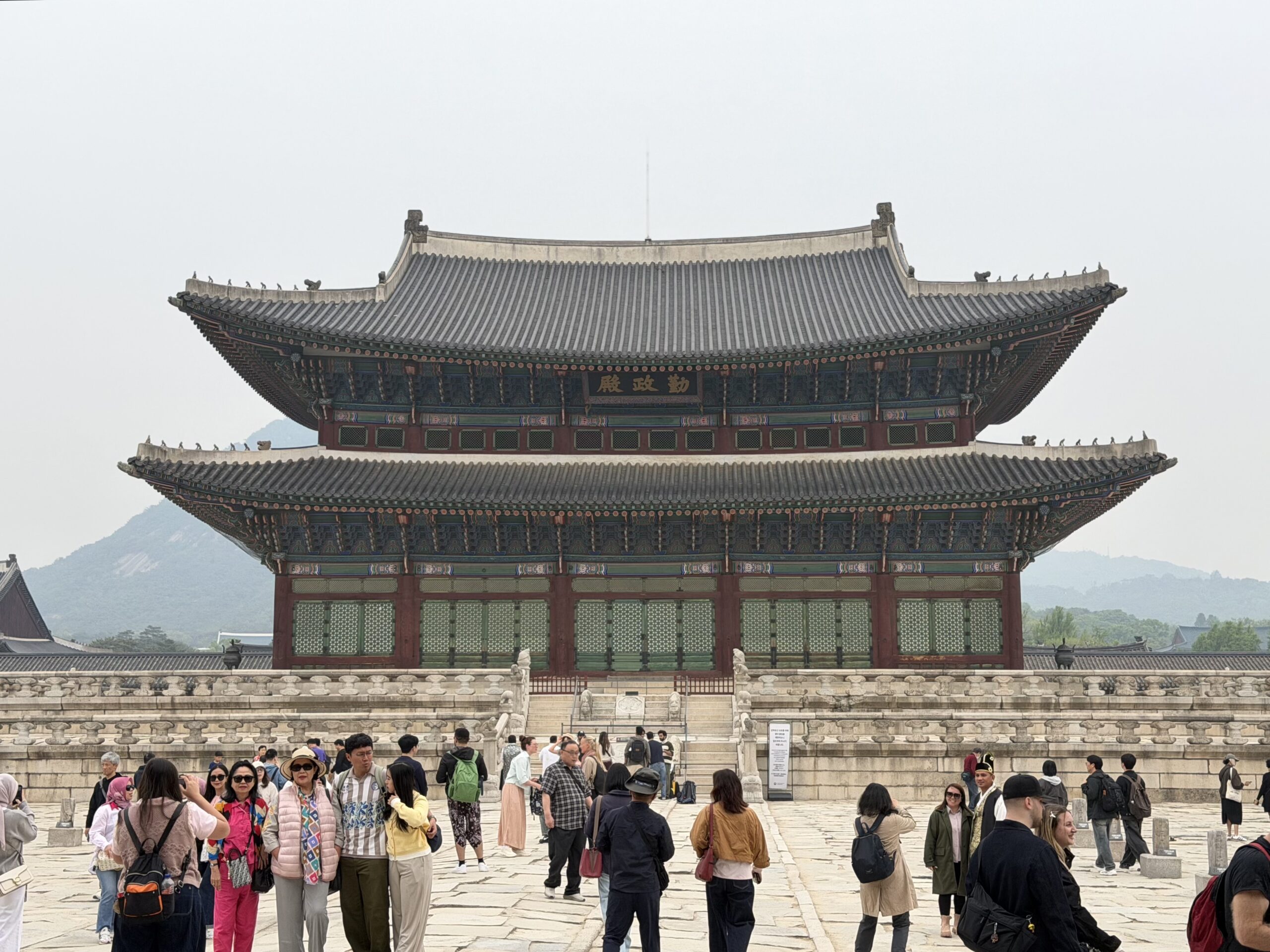
Gyeongbokgung Palace opens at 9:00am daily, except on Tuesdays, when it is closed. We thought we were early but there was already a lot of other people when we visited at 9:30am. Entry to the main palace grounds is via Heungnyemun (興禮門), a gate just north of Gwanghwamun. After passing through Heungnyemun gate, we passed through another gate (Geunjeongmun 勤政門) before emerging in the massive open grounds where the main hall, Geunjeongjeon (勤政殿) stood.


The architecture and layout of the palace grounds reminded me of the Forbidden City in Beijing, albeit on a smaller and less grand scale. But Mount Bugaksan to its rear provides a majestic backdrop, adding gravitas to Gyeongbokgung Palace.


As we walked through the grounds, we found some nice spots to take photos but there were people everywhere. We managed to snap a few nice ones here and there while trying to avoid the hanbok-clad tourists vying for the same spots.


As we didn’t have a guide, we walked around aimlessly. On Google Maps, I saw a large pond called Gyeonghoeji with a pavilion that looked quite pretty. I tried to navigate to the pond but it seemed like there was a perimeter wall surrounding the pond and I couldn’t find a way to it so we gave up.


The further we walked, the buildings started to look kind of the same. Without a guide to explain the context and purpose of the buildings, it became a rather fruitless outing. We started to get bored so we decided to leave via a side gate on the eastern side where the National Folk Museum of Korea is located.


My original plan was to walk to Bukchon Hanok Village nearby to see the narrow streets and traditional Korean houses. However, we were a little tired from exploring the palace grounds so I called an Uber taxi to take us to a café I had bookmarked called Artist Bakery. The ride took only 3 minutes and we alighted at 10:47am. The Uber fare was 4,800 won (S$4.22).
Surprise, surprise, there was a long queue outside Artist Bakery. We gave it up as a bad job and walked to the start of Insadong-gil, a 630m-long pedestrian-friendly street that is closed to traffic between 10:00am and 10:00pm daily. Insadong is Seoul’s traditional culture and arts district, with many art galleries, antique shops, teahouses and boutique stores.


The first section of Insadong-gil is a leafy boulevard, giving off European old town street vibes. The wide walkway is flanked by trees and colourful lanterns celebrating Buddha’s upcoming birthday. It is a very pleasant area for a relaxed stroll. We browsed the shops at will, though some of the shops were not open yet even though it was almost 11:00am.


Just like how I love to buy CDs and vinyl records when I travel, Dad loves to collect art pieces capturing local scenes. He bought a couple of small oil paintings that now hang proudly in our bathrooms at home.


After spending about an hour at Insadong, we walked over to Jongno 3-ga, where I had also bookmarked some cafés to check out at Ikseondong Hanok Village. The area is filled with many cosy cafés housed in traditional buildings along a labyrinth of narrow alleyways. We didn’t know it then, but TimeOut magazine later named Jongno 3-ga the World’s Coolest Neighbourhood in 2026.


Ikseondong Hanok Village was predictably crowded at noon time on this lovely Saturday. A majority of the of people here were tourists but there were many locals as well. We went to Soha Salt Pond to buy their famous salt bread, or shio pan. The café was full so we bought some to take away.


For the uninitiated, salt bread is a Japanese-style butter roll with a rich, buttery core and crispy, sea salt-topped crust. The classic version is simple butter and salt, but new versions with toppings like Dubai chocolate and blueberry cream cheese have sprouted up in recent years.

The bakery shop had limited standing space so only four guests could enter at a time. I queued for a short while before it was my turn to enter. 11 flavours of salt bread were available. We bought the deep chocolate, garlic butter, and their signature Soha salted bread (soft) and plain salted bread (hard). We ate them fresh on the spot and I must say the breads were really good.


We left Ikseondong Hanok Village around 12:30pm and walked to a CD shop located along the Jong-ro main road, not too far away. The shop is called CD Mart and it has an impressive selection of international and domestic titles on CD and vinyl. They even have some old VHS video tapes, cassette tapes and DVDs. I was happy to unearth a Korean pressing of Janet Jackson’s Design of a Decade 1986/1996 album, complete with hype sticker.


A few units away is another CD shop called Seoul Record. The selection was decent but not as extensive as CD Mart so I left empty-handed, sadly.

At 1:24pm, we took an Uber car to go to Dongdaemun. The ride was only 4 minutes long and the fare was 5,000 won (S$4.34). It wasn’t far but we were too tired to walk. Along the way, we passed by Gwangjang Market. I had considered visiting Gwangjang Market but I saw that most of the stalls were selling food we I decided to skip it.
We alighted at Dongdaemun General Market, near JW Marriott Hotel. Across the hotel stood Heunginjimun, the east gate and one of the eight gates of Seoul. In fact, Dongdaemun’s name (东大门) is derived from Heunginjimun, which means “Great East Gate” in Korean. The original gate was built in 1398 during the Joseon period but the current one was rebuilt in 1869.


We realised that where we alighted wasn’t exactly where we wanted to go so we walked south, passing by Cheonggyecheon Stream. The 11km-long Cheonggyecheon Stream flows through the heart of Seoul, from Gwanghwamun to Dongdaemun. It is a wonderful success story of urban renewal. The stream used to be an open-air sewer and the pollution was so bad that the government decided to fill it with concrete and build an elevated expressway on top of it in 1968.
In the early 2000s, the government began a major project to restore the stream. The highway was removed and water began flowing again. When the makeover was completed in 2005, it wasn’t just water that was flowing – people were thronging the waterway too. The refreshed stream was designed with fountains, waterfall features, walking paths and steps where people could sit and soak their feet in the running water. Cheonggyecheon Stream became a popular place for people to hang out both in the day and at night, a great example of urban renewal done right.

After crossing Cheonggyecheon Stream, we went into the first building we saw, which was Pyoung Hwa Fashion Plaza. This old-school, wholesale market occupies three floors, selling mainly clothes for men, women and children. The passageway is pretty narrow but the stalls are neatly arranged along the long, rectangular-shaped building. We did a quick walk through and left soon after because the fashion wasn’t really compatible.


Located behind Pyoung Hwa Fashion Plaza is Hyundai City Outlets, a modern shopping mall with over well-known local and international brands. The 12-storey building also houses many cafes, restaurants, retail shops and a CGV cinema. We also went in for a quick look but didn’t linger long.

Next, we went to Doota Mall next door, another trendy fashion mall with seven floors, including two basement levels. We had lunch at the food court in the basement before doing some shopping at the Innisfree store for some beauty/skincare products.


Next to Doota is Migliore, another clothing fashion mall with 11 floors. Migliore is a bit like Platinum Fashion Mall in Bangkok. The products at Migliore are more mid-range, not branded, trendy yet inexpensive. Whereas Pyoung Hwa Fashion Plaza has a long, horizontal layout, Migliore has a vertical, stacked layout. We spent some time shopping at Migliore.


Located directly opposite Migliore is Dongdaemun Design Plaza, popularly known as DDP. It is a multifunctional cultural complex hosting exhibitions, fashion shows, product launches, conferences and art festivals. The massive, aluminium-clad building was designed by renowned architect Zaha Hadid and it opened in 2014. Built to replace the old Dongdaemun Stadium, DDP has become the centerpiece of South Korea’s fashion district. Its curved and undulating surface resembles the flow of liquid and is made up of 45,133 uniquely shaped exterior panels. We just admired the building from across the road,


We briefly walked through Hello apM mall and Good Morning City mall before crossing the road to Dundun shopping mall. Dundun is a relative newcomer to the scene and opened only in 2024. You can tell it’s new because of its striking façade. There is a large Uniqlo store on the ground floor and Daiso on the third floor. The Daiso here at Dundun is much more spacious than the two stores at Myeongdong. It’s definitely more pleasant to shop here as you can browse the items slowly and the check-out queue is not as long.


Lastly, we went to Dongdaemun Sports Underground Shopping Center, located right beneath the main road in front of Dundun and directly connected to Dongdaemun History & Culture Park Metro station. It is a typical underground shopping mall but with a large concentration of shops selling sportswear, especially football jerseys. I’m not sure if everything here is authentic so I didn’t buy any.


After wrapping up our shopping at Dongdaemun around 5:00pm, we hopped on the Metro and alighted two stops later at Euljiro 1(il)-ga station. We went back to our hotel to drop off our shopping and had a short rest before heading out again for dinner at 7:20pm.

I know Myeongdong probably isn’t the best place for Korean BBQ but it was convenient as it was right at our doorstep. We went to a restaurant serving Jeju black pork and Korean beef, located in the basement. The place looked quite decent but we later found out that the owners were not Korean and they were quite pushy to get us to order more.

We weren’t super hungry so we ordered a portion of the Jeju black pork and sliced beef for the BBQ, as well as ginseng chicken. We also had two bowls of rice, a bottle of Sprite and Terra beer. The total bill was 75,000 won (S$66). The pork was quite fatty and it tasted alright, but the beef was better. The ginseng chicken soup was thick and nourishing and the chicken meat was very tender. We also loved the sweet onion slices that were served as a side dish. Overall, the meal was within expectations.


After dinner, we shopped around Myeongdong. It was especially crowded on this Saturday night, busy but in a nice way. We went to our new favourite shop, Top Ten, and bought more clothes there. One great thing about shopping in South Korea is that you can get immediate tax refund at the point of purchase. Best of all, the minimum spend is only 15,000 won (S$13.20), which is super easy to attain.


We also dropped by the CGV cinema because I wanted to check if there were any special leaflets, posters or merchandise for the Michael movie, which was due to open in South Korea on 13th May 2026. Sadly, there wasn’t anything but there was a large movie standee so I struck my best MJ toestand pose with it.

Even though the street food in Myeongdong is overpriced compared to other places in Seoul, the variety is great and the quality is pretty good. We were still quite full so we only bought a packet of roast chestnuts, which mum loves to eat. We soaked up the buzz for a while before calling it a night at around 9:30pm. And that’s the end of Day 6. Not a particularly eventful day. Looking forward to better shopping tomorrow!


