Day 3 – 10 March 2026, Tuesday
When I woke up at 6:00am today, I inadvertently turned a year older. My age may have increased but the body still feels the same. Grateful to be able to stay healthy, travel and do the things I enjoy. For my special day, I’ll be celebrating it with an overnight tour to Wae Rebo, a remote traditional village in the Manggarai Regency of Flores island.

I booked the tour through a local tour operator called Green Rinjani (click here). You can find out more details from their website but essentially, the 2-day, 1-night tour includes hotel pick-up and drop-off, transport, food and drinks, a local guide, accommodation and free documentation (photos and videos).
The tour takes almost two full days, with hotel pick-up between 7:30am and 8:30am on Day 1 and drop-off around 5:00pm to 6:00pm on Day 2. It will be an adventure because Wae Rebo is located deep in the highlands and it will take considerable effort to get there. It involves a 5-hour car ride from Labuan Bajo to Denge village, followed by a 10-minute Ojek (motorcycle) ride to the starting point of the trail, and finally a 2- to 3-hour hike to Wae Rebo village. The long and indirect journey is what makes it exciting.
For this morning’s breakfast, I didn’t manage to place my order in time last night for a takeaway breakfast box from my hotel. And due to deep cleaning being done at the hotel restaurant today, breakfast service will only start at 8:00am instead of the usual 7:00am. Hence, I had no choice but to have breakfast in my room, consisting of a protein bar and buns I bought from my first day in Labuan Bajo. It wasn’t the best breakfast but it did the job.
As predicted by the weather forecast, it started raining at 7:30am. After checking out of my room, I deposited my luggage at the hotel’s storeroom for safekeeping, since I will be returning here tomorrow night. I will be using a backpack for the overnight trip to Wae Rebo.

While waiting at the lobby, I met another lady, K. She was also going to Wae Rebo so we started chatting. Our driver arrived at 7:57am and we were the first to be picked up. We then swung over to Meruorah Komodo hotel nearby to pick up another two guys, HS and CW, before driving over to the tour operator’s office. Turns out HS and CW are also Singaporeans. With limited flights to Labuan Bajo, it is perhaps not a big surprise to bump into my fellow countrymen everywhere.
At the office, we met our guide, Irwan, and two other female Dutch participants, F and M. Hence, we have six people joining the tour – three (Singaporean) guys and three ladies. After I made the balance payment for the tour, Irwan gave a short briefing about the itinerary before we split into two cars for the drive towards Wae Rebo. The three guys took one car while the three ladies took the other car with Irwan. We left Labuan Bajo at 8:30am and began our road trip to Denge village.
There is only one big road out of Labuan Bajo, with only one lane in each direction. The winding mountain road passed by villages and farmland. We saw many dogs and cows along the roadside, with lots of greenery all around. It was quite a scenic ride. The rain stopped around 9:00am but dark clouds still hovered threateningly in the sky.

At 10:07am, we made a pit stop at Lembor town for a toilet and coffee break. There was no café here but we could buy a packet of instant coffee mix from the Zasgo Mart Express convenience store and use the hot water dispenser to make a cup of coffee. I tried the avocado coffee; it tasted good.


Beside Zasgo Mart was a fruit stand, where HS bought some fresh avocados. The stall also sold a native Indonesian fruit called salak. We sometimes see it in Singapore but I have never tried it. Salak is also known as snake fruit because its brown, scaly skin looks just like a snake’s. When I commented that I have never eaten salak before, HS cajoled the stallholder to give us one to try.


The skin was surprisingly thin but pretty sharp because of the scales so I had to be careful when I peeled it with my hands. Inside, the teardrop-shaped fruit was like a clove of garlic, with three pieces closely stuck to each other. Each clove contained a brown hard seed. The fruit’s flesh was dry and crunchy like an apple. It tasted lightly sweet and was quite nice actually.

After the short break, we resumed the drive at 10:55am. From Lembor, we deviated from the main road and turned into the small village road. Up till Lembor, the road had been smooth and well-paved. From here onwards, it will be a much bumpier ride as the road is filled with many waterlogged potholes. Our driver Rino said that 20 minutes from now, we will not have reception on our mobile phones anymore, until we reach our lunch stop. We are now heading into the wilderness, but this means we really get to see the local side of the villages.
It is clear that these remote parts of Flores are still very undeveloped. The deeper we went, the smaller and more broken the roads got. Many of the houses were made of wood with zinc roofs. The ones with concrete had bare walls and exposed bricks. The dogs and goats were super chill, lying in the middle of the road before being gently nudged to move by the car horn.


The long car ride was a good opportunity for me to get to know my new friends better. As we chatted, we discovered that the three of us worked for the same organisation at some point in our lives. What a small world! It was really nice to have something in common and to hear about each other’s travel experiences as we shared a love for hiking and adventure. The chats made the time go by faster and made the experience more memorable.
At about 11:45am, we reached the coast and had our first glimpse of Mules Island, or Nuca Molas, in the distance across the water. Rino said that Nuca Molas means “island of beautiful woman”. From a certain angle, you can see the island forming the silhouette of a woman lying down with her head titled back and chin sticking in the air. There were clouds obscuring Poco Kepi, the highest peak on the island at 566 metres so we couldn’t really make out the shape of the beautiful woman. But even from afar, the island looked stunning, like something straight out of Hawaii or Jurassic Park.


The road conditions also deteriorated as we passed by several areas where the river overflowed onto the road before reaching the sea. It was a slow and bumpy ride but I thought it was very fun. There were a few river crossings where Rino had to get out of the car to rearrange the large rocks so that the undercarriage of his car would not be damaged as he drove across them.

The most serious one was where the river was very fast flowing and had completely washed away the road. Rino removed the leg sleeves from his pants as he prepared to wade in the knee-deep water to rearrange the rocks. A local man also helped to move the rocks and direct Rino to steer away from danger as he drove across the flooded section.


At 12:45pm, we arrived at Satar Lenda to have lunch at Thalya Resto. The restaurant was a small building made of bamboo and wood with a nice stone path and colourful flowers lining the path. Surrounding the restaurant were huge padi fields stretching towards the coast. The long stalks of rice plants swayed with the breeze and Nuca Molas was just across the water. The view was awesome.


Lunch comprised of steamed white rice, glass noodles with vegetables, fried chicken and stir-fried green leafy vegetables. It was a simple but delicious meal. Lunch was also a good time for us to catch up with the other three ladies and know each other better.


At 1:33pm, we left Thalya Resto and drove 15 minutes to a small building with a carpark, where all the Ojeks were waiting for us. This was as far as the cars could go. We got out of our cars, picked a driver each and hopped on the Ojeks. The next 8 minutes will be the most adventurous part of the tour.


After leaving the carpark, the Ojek sped up a paved road that was filled with numerous potholes and rocks. One section was particularly muddy and waterlogged from the rain so we got off the Ojeks to walk across it. I held on for dear life (slightly exaggerating here) as my driver expertly navigated the slopes with ease. Even though helmets are not provided, I didn’t feel it was dangerous but rather, thrilling. These guys ply the same route probably every day so I was confident they knew what they were doing.

We reached Pos 1 (Wae Lomba), the starting point of the hike, at 2:00pm. A minor accident happened here. As F alighted from her Ojek, she accidentally pressed her right calf against the exhaust pipe of the motorcycle and suffered a burn. She was wearing shorts so there was nothing to protect her bare skin. Even though the contact with the hot exhaust pipe was brief, quite a big patch of skin was burned and it will definitely turn into a blister over the next few days. I’m sure it must have hurt terribly as F wiped tears from her eyes, trying to suppress the pain.


Our guide Irwan carried a first aid kit but there wasn’t anything suitable for burns. F wasn’t bleeding so we assessed that the best thing to do was to wrap up the injured area with a bandage to prevent bacteria from getting to the wound. Thankfully, a fellow Dutch solo traveller, V, was also there and he carried a more well-equipped first aid kit with a larger bandage and gauze. V helped to dress the wound and we were able to start our hike at 2:13pm. Love it when fellow travellers help each other!

The hiking distance from Pos 1 to Wae Rebo village is about 6km. Actually, there are 7 checkpoints altogether (Pos 1 to Pos 7), but we had already covered the distance to the first checkpoint by Ojek so we had 6 more checkpoints to go from here. The hike typically takes around 2 to 3 hours, depending on your fitness level. The first part is the steepest and hence, the toughest. However, the stone path is nicely paved so it is not difficult, just a little slippery because of the rain.
For a safe hike, it is essential to have proper footwear with good, grippy soles. The best is to wear waterproof hiking boots because you’ll be crossing some streams and hiking in mud for some parts. I also recommend wearing long pants because you are likely to encounter leeches, especially in the wet season. The leeches will latch on to your skin and suck your blood without you realising it.

We reached Pos 2 (Onto Lui) and Pos 3 (Wake Haju) at 2:26pm and 2:41pm respectively. The incline wasn’t too bad and I could still carry a conversation while walking at a comfortable pace. The lush greenery and clean forest air made the hike very enjoyable.


After Pos 3, the stone path turned into trail so the terrain became more natural and raw. We passed by small waterfalls and waded across streams. We reached Pos 4 (Poso Roko) at 3:01pm and had a view of the mountains and sea beyond the clearing. We were almost at the level of the clouds so it became foggy as we continued our ascent.


We reached Pos 5 (Reho Poso Roko) at 3:18pm and took a short water break at the pondok, a hut. Not all the checkpoints have pondoks. While resting here, HS saw that his sock was stained with blood and realised that a leech had latched on to his ankle and sucked his blood unwittingly before being discovered. That alerted us to the presence of leeches and to do a “leech check” on each other every 10 minutes.


We reached Pos 6 (Nampe Bakok) at 3:35pm. There was a small observation tower but we didn’t climb it as the view was obscured by fog so we pressed on. From there, it was downhill almost all the way so it was easier. We passed by an area where a landslide appeared to have occurred quite recently.


At around 3:50pm, the heavy clouds finally gave way and it started to rain so we hastily put on our ponchos and rain jackets. The path became muddier, which made our progress slower. Along the way, we saw many coffee plants, identifiable by the clusters of green unripe coffee cherries growing on the branches. Coffee grows best at high altitudes in tropical climates near the equator.


We reached the final checkpoint, Pos 7 (Ruman Kasih Ibu) at 4:06pm. From there, it was a short walk to Wae Rebo village. As we made our way towards Wae Rebo, the rain started to fall even more heavily so we sought shelter at a café at the entrance of the village at around 4:23pm. Thus, it took us around 2 hours 10 minutes to hike from Pos 1 to Wae Rebo. I didn’t manage to fully track the hike on my Apple Watch but I estimate the elevation gain should be around 400m.


As the rain continued to pound heavily, we decided to wait it out at the café since Irwan said that the Village Chief was not ready for us. I ordered a cup of hot coffee (Rp 10,000 / S$0.77) to warm myself up. As we waited, the rest of the ladies changed into their long pants and covered tops to get ready for the welcome ceremony by the village chief. They then discovered more leeches clinging to their ankles. Startled, I did a thorough inspection of myself.

When I pulled up the sleeves of my right pants, I saw a round-shaped insect on my skin just above my sock line. I initially thought it was a harmless brown beetle. But when CW removed it and flicked it to the ground, I saw that there was blood on my leg where the insect had been. I then realised that it was a leech, and it had sucked so much blood from my leg that it swelled to the size of a beetle!
CW stomped the leech on the ground to try to kill it, but all it did was to expel my blood from its body, and it continued crawling. After squishing the leech a few more times, the ground was stained with two big patches of my blood and the leech returned to its original slim shape. However, it was still very much alive. These thirsty bloodsuckers don’t die easily, gross!


The thing about leech bites is that they don’t hurt so you won’t know that you’ve been bitten. Their saliva contains a potent anticoagulant called hirudin, which results in prolonged bleeding once detached. Before this, I imagined leeches to be much bigger but the ones we had were small, around 2cm long. Because they’re so small, it’s hard to spot them. Even with my long pants, the leech still managed to get to me. Hence, my further advice will be to wear thick socks and tuck the sleeves of your pants into your socks to prevent the leeches from crawling in and attaching to your skin.


While waiting at the café, the rain subsided before it got heavy again, then light and heavy again. There was some miscommunication because we thought we were waiting for the village chief to be ready for us. But we saw other groups of people entering the village chief’s hut while we were waiting at the café. We wondered what was going on because Irwan didn’t tell us anything. He seemed content to just wait and chill here.
After waiting at the café for more than half an hour, I finally asked Irwan if we could proceed because the rain looked like it wouldn’t be stopping anytime soon, and he said yes. I think if I didn’t take the initiative to ask him, we would continue to sit there for another hour. Finally at about 5:05pm, we put on our ponchos and rain jackets and trudged the path down towards the village chief’s hut. Before entering the village, Irwan briefed us that we are not allowed to take photos or videos until the welcome ceremony is over. This is to show respect to the ancestors.
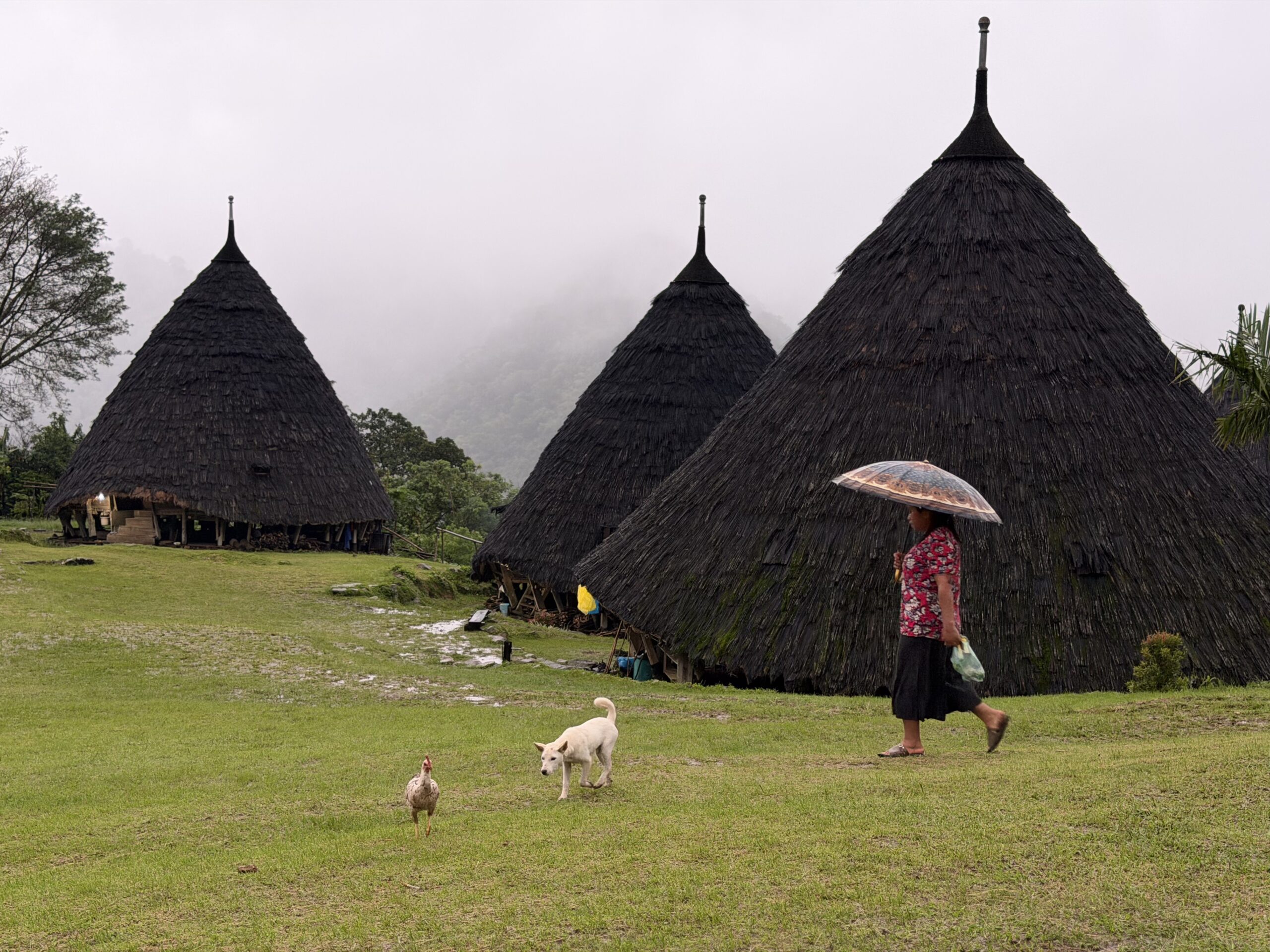
At 1,100m elevation, Wae Rebo is surrounded by mountains and lush green vegetation, with a cool climate all year round. The main village of Wae Rebo consists of seven large conical huts called Mbaru Niang. They are laid out in a semi-circular shape on a small plateau, with the village chief’s family occupying the hut in the middle.

After removing our footwear and ponchos, we stepped cautiously into the hut and sat on the long rectangular mats laid on the floor. The village chief sat in the middle of the hut, with his son seated on his right. The younger man spoke to us in English and explained the significance of the welcome ceremony. Basically, they need to seek the blessings of their ancestors to welcome us to this sacred land, and give us protection while we’re here. After the ceremony, we will all be part of the family, and we are welcome to take photos and videos of the village.
The son asked us which countries we are from, and relayed the information to his father. We listened in reverence as the village chief spoke to his ancestors using his native Manggarai language. After the short procedure, the son briefed us on the Do’s and Don’ts during our stay at Wae Rebo. For example, we are not allowed to step on the sacred round platform outside the village chief’s hut; alcohol is forbidden here. After the ceremony, we left the village chief’s hut and went to one of the other huts where all visitors will stay for the night.
Afterwards, HS said he thought the ceremony would involve the chief and villagers putting on their traditional costumes to welcome us with a dance or ritual. That’s the impression he had when Irwan said earlier that the chief was not ready to receive us yet – HS thought he needed time to get dressed and prepare for our arrival. In fact, there was nothing fancy about the welcome ceremony and it was over in five minutes!
We stepped into our hut at 5:23pm. It looked similar to the village chief’s hut but without the cooking area. Everything was made of wood, including the floorboards, support beams and furniture. There were no rooms so it was one big common area for eating and sleeping. The space in the centre is used for eating and socialising. I counted 23 mattresses in the hut altogether. The mattresses were kept in place by wooden planks on the floor and laid out around the perimeter of the hut.


The toilet was located in a separate building behind our hut. It was equipped with a Western-style seated toilet bowl but with a manual flushing system. Next to it was a separate bathroom for taking a shower but hot water was not available. There was also another small hut connected to ours, where the kitchen is located and where our meals are prepared over charcoal fire.

Besides the six in our group, there were seven other guests staying at Wae Rebo tonight. We had already met the solo Dutch guy, V, earlier. There was also a family of four from Denmark and two other guys from Singapore, MH and JX. Singaporeans are everywhere in Flores!
After laying down our stuff, we were served a welcome drink of either hot tea or coffee. I chose tea because I just had a cup of coffee not long ago. After finishing our drinks, we headed out to snap some photos to take advantage of the remaining sunlight and a break in the rain.

Wae Rebo was really what I imagined it to be. Up in the highlands, seeing the seven Mbaru Niang huts up close while being surrounded by the misty mountains, it was something special indeed. The rain and fog only added to the mystique and made the experience even more surreal.


It started to rain again shortly after that so we went back into the hut, where we remained for the rest of the night. On a good day, you can stargaze because there is no light pollution at Wae Rebo. But with the rain and heavy cloud cover, we had zero chance of seeing any sunset or stars tonight.
Electricity is available only from 6:00pm to 10:00pm. Apparently, the electricity is generated by solar power. There was a multi-plug extension socket in our hut so we all used it to charge our electronic devices. There is also no mobile service or Internet connection at Wae Rebo so you will really be off the grid during your stay here. But that presents a valuable opportunity to disconnect with the virtual world and connect with the real world in front of you. Some of the ladies took a shower but I didn’t want to shower with cold water so I used wet wipes to clean myself before changing into comfortable lounge clothes – sweatpants and a long-sleeved T-shirt.
Dinner was served just before 7:00pm. It was a communal affair as the food was laid on a long straw mat on the floor, and we each sat on a straw weave-covered cushion to eat. Dinner was a simple meal of hard-boiled eggs, green leafy vegetables, chopped vegetables covered in fried batter, steamed white rice and crackers. Boiled drinking water was also provided. I had a good time chatting with everyone and bonding over food.


After dinner, V and the ladies went to the café outside but it was still raining and I didn’t want to leave the cosy confines of the hut so I continued chatting with the Singaporeans, including the other two newbies. Likewise, MH and JX are also adventurous at heart and they are avid divers and trekkers. It was really nice chatting with like-minded people who have similar interests, as we shared our travel stories and favourite places to hike.
As there was nothing much to do, most of the guests went to bed around 9:15pm. The mattress was quite comfortable and a thick blanket was provided. Even at night, it wasn’t as cold as I expected, perhaps around 20 degrees C, because the hut was well-insulated. At 10:00pm, the lights went out and everyone drifted to sleep. As I lay in bed, I thought about my day and how there was no better way to spend my birthday than a night in the mountains at Wae Rebo…

