Day 4: 30 April 2026, Thursday
It’s our last day in Busan and we’ve got an exciting programme ahead of us. Yesterday, we ventured east to Haeundae. Today, we will be exploring the attractions in the southern centre of Busan, visiting Gamcheon Culture Village, the Nampo shopping district and lastly, Arte Museum. With so much to cover today, there’s no time to waste!
After having breakfast in our room, we headed out at 8:35am and went to a shop near Seomyeon Metro station to buy a pair of in-soles for dad before hopping an Uber Taxi at 9:09am to our first destination. We alighted at the entrance of Gamcheon Culture Village at 9:41am. The Uber fare was 14,000 won (S$12.21).


The first thing we did was to head to the Tourist Information Centre to buy a copy of the Stamp Map for 2,000 won (S$1.76). This map is very useful as it provides information about three walking trails and the various artworks in Gamcheon Culture Village. You can also embark on a quest to collect 12 stamps at the checkpoints along the way. Additionally, you can collect free postcards from two locations. However, the staff at the information centre gave us the postcards in advance since the two designated locations are far away and they know most people won’t make it there.


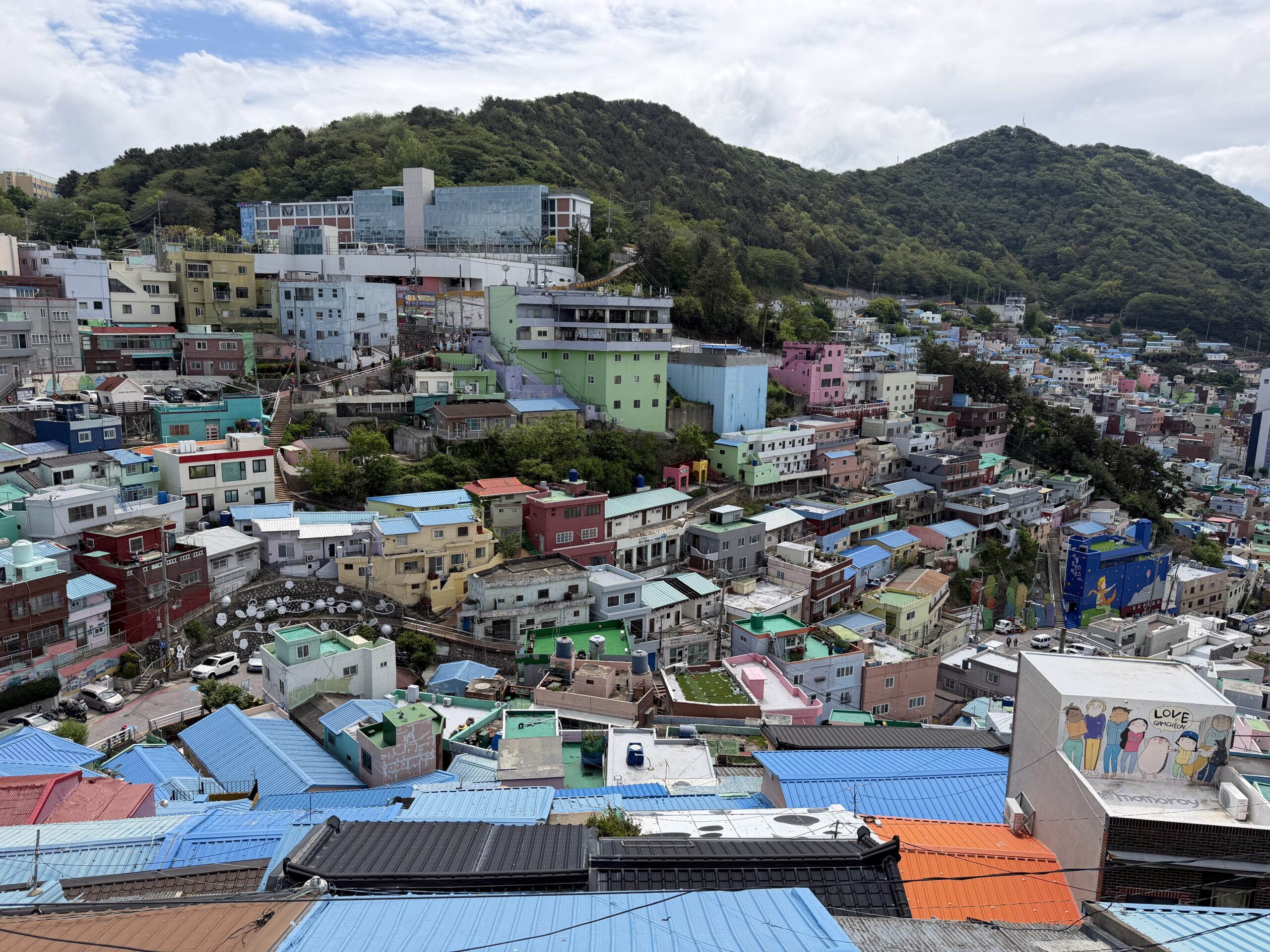
Gamcheon Village was formed in the 1950s by refugees of the Korean War and followers of the Taegukdo religious movement. They built their tightly-packed houses on the slopes of the coastal mountain with labyrinths of staircases and alleys cutting through the community. Each house is intentionally built in a way that it does not block the view of the one behind it. The village’s population peaked around 30,000 in the 1980s and fell to around 8,000 by 2010 as younger people left for the city, leaving the older residents behind.
To rejuvenate Gamcheon Village, the Ministry of Culture, Sports and Tourism initiated a public art movement in 2009 and invited students, artists and residents to maintain, repair and decorate the infrastructure with artworks and installations. Abandoned homes became small galleries, workshops and cafes. The makeover continued when the statue of The Little Prince and the Fennec Fox were installed in 2013, quickly becoming the village’s most photographed spot. Today, Gamcheon Culture Village is one of Busan’s leading tourist attractions and a model for art-led urban regeneration.
You can go on a self-guided walking tour by following one of the three recommended courses in the stamp map. Course A is the Main Street Round-trip Course, where you start and end at the same place (the tourist information centre). It is the shortest course and it takes around 40 minutes.

Course B is the Basic Course, covering the main street and lower sections of the village, ending at the Message of Hope artwork at the base of the village, i.e. a different ending point. The suggested tour duration is 1 hour 40 minutes. Course C is the Stamp Course, covering the same areas as Course B but with an additional loop to include Happy Power Station, which is one of the stamp checkpoints. The suggested tour duration is 2 hours. I set aside about two hours to visit Gamcheon Culture Village but I wasn’t planning to walk the entire village because it looked very big and hilly, so we’ll see how much we can cover.
After visiting the information centre, we were already distracted because a shop nearby was selling cute socks at super low prices. We spent about 15 minutes shopping there and we each walked away with multiple pairs of socks – I bought 10 pairs.

We soon reached the first stamp checkpoint at Little Museum. The stamp and ink pad are placed inside a small wooden “house”. I opened my account by affixing the first stamp on my stamp map booklet. We didn’t enter but Little Museum is a space where you can experience memories of old life and modern culture of Gamcheon Village. Old photos and household items donated by residents are displayed by theme.


Walking along the main street, we saw many souvenir shops, cafés and shops providing hanbok rentals. Everywhere you turned, there were murals and street art. The buildings were all painted in pastel colours, creating a very vibrant atmosphere. The temperature was a pleasant 14 deg C and it wasn’t too sunny yet. It also wasn’t very crowded at 10:00am so the vibes were good.


Shortly after, I spotted a sign for Haneul Maru Observatory so we climbed the steps up the narrow alley towards the observatory. There is a stamp checkpoint at the observatory as well. Along the way, we passed by a few residential units, cute gift shops and cafés. People actually still live in some of these houses so visitors are reminded to be mindful of their noise levels and be considerate when taking photos.


Haneul Maru Observatory is located on the rooftop of a building and it provides a panoramic view of Gamcheon Village stretching towards the port. Because of its dramatic architecture and steep, terraced layout built onto a rugged mountainside slope, Gamcheon Culture Village is often called the Santorini or Machu Picchu of Korea. It really is quite a marvellous sight.


The more we walked, the more artworks we uncovered. It seemed like the entire village was made for Instagram, from colourful, geometric tiles decorating a flight of stairs to a wooden platform painted sky blue complete with puffy clouds. Many of the artworks were simple, proof that you don’t need big budgets or large spaces to create an impact. Just apply some creativity and ingenuity to transform everyday spaces to something beautiful.


The third stamp checkpoint is located at Gamcheon Bakery, where there is also a photo zone for The Little Prince wall mural. In fact, there are paintings of The Little Prince everywhere.


We soon reached the famous statue of The Little Prince and the Fennec Fox overlooking the village. When we arrived at 10:45am, there were about 20 people waiting in line at the photo spot. I did not join the frenzy but I went to the Asteroid B-612 souvenir shop below to collect my fourth stamp. B-612 is the fictional, house-sized asteroid where The Little Prince lives in the 1943 novella by Antoine de Saint-Exupéry.


By this time, it was clear that Course A takes more than the suggested 40 minutes, and we will not be able to complete Course B or C as well. You probably need half a day to complete Course B or C at a comfortable pace, stopping frequently to take photos or visit some of the shops or cafés. We turned back at the suggested U-turn point of Course A and walked towards the information centre, wrapping up our visit in two hours.


Gamcheon Culture Village was one of the places I was most excited to visit in Busan, and I’m glad to say it lived up to its hype. I thought it was really pretty and unique. We were blessed with good weather and it wasn’t as crowded yet when we visited in the morning. But as we were leaving at 11:40am, the big tour groups started to arrive and it got a lot more crowded. Is Gamcheon Culture Village touristy? Yes. But is it worth a visit? Absolutely! But go as early as possible to avoid the worst of the crowds.

We went to the bus stop opposite the information centre to catch a bus to our next destination. At 11:43am, we hopped bus service 2-2, a green-coloured minibus. There were only a few seats so many passengers had to stand and grab on tight to the handrails as the minibus navigated the winding road downhill. Thankfully, it was a short ride and we alighted at Jagalchi Market 7 minutes later. The fare was 1,480 won (S$1.30).


Walking towards the seaside, we saw an outdoor market with colourful parasols lined with vendors selling all kinds of fresh seafood – cockles, clams, mussels, conch, flower crabs, crayfish, squid, prawns, abalone, fish and more. Many of these would have been freshly caught from the sea and brought here directly to be sold.


Next to the outdoor market is Jagalchi Market, a massive seven-storey building right by the edge of Nampo Port. Jagalchi Market is South Korea’s largest seafood market. The fish market occupies the first floor of the building. This is where you can handpick live seafood from one of the stalls and take it to the restaurants on the second floor to be cooked and consumed. The upper floors of the building are mostly occupied by management offices and companies. There is an observatory on the rooftop that is accessible to the public for free.


The indoor market is massive. Hundreds of individual stalls lined both sides of the aisles, stretching endlessly into the distance. The produce was laid out neatly in plastic trays and containers while live seafood was kept in tanks with running water. But despite how massive the market was, it was very clean, tidy and odour-free.


The variety of seafood available was astonishing. There really was everything you could ask for. We randomly selected a stall (stall number 90) and were glad that they offered an English menu with photos of the items and dishes. The stallholder didn’t speak much English so we communicated by using Google Translate and pointing at the things we wanted.


We paid 45,000 won (S$39.60) for 5 dishes – cockles, grilled mackerel, steamed prawns, seafood ramen and abalone porridge (or so we thought). After the stallholder picked out the relevant seafood items, she transferred them into a plastic bucket. She then used a walkie-talkie to communicate with another guy to come collect the bucket and escort us to the dining area on the second floor.


The second floor comprises of stalls selling dried seafood on the inner side and lots of rectangular dining tables on the window side facing the sea. It was almost 12:30pm so there was a healthy lunchtime crowd. We didn’t get a window seat but were close enough, one table away from the window.

How Jalagchi Market works is that after you purchase and pay for the raw seafood on the first floor, you have to pay a separate table setting and cooking fee when you consume the cooked seafood on the second floor. The table setting fee is fixed at 5,000 won (S$4.40) per person. The additional cooking cost is not disclosed beforehand because it depends on how you want your seafood cooked – steamed, grilled, stir-fried, soup etc.


Based on what we ordered, the guy initially quoted us 45,000 won in total, including the table setting fee and cooking cost. Shortly after, he came back and said we had to pay 5,000 won more if we want the mackerel grilled. I refused to pay it because that was not what was agreed upon. A while later, he came back again and asked us if it was ok to put the abalone in the ramen. I didn’t think much of it then, and said ok.
The prawns were the first to be served. They were big, fresh and juicy. The mackerel was nicely grilled too. Next up was the seafood ramen, served in a huge pot, with all the assorted seafood thrown in – flower crab, prawns, scallops, octopus, abalone, clams and cockles. The portion was so big we could not finish it.


We continued to wait for the abalone porridge but it never arrived. Finally, I summoned the guy over. Guess what he said? The abalone that was supposed to be for our abalone porridge was put into the seafood ramen instead, so there is no more abalone porridge coming. It was only then I knew what he was referring to when he asked about the abalone earlier. The guy said that if we still want the abalone porridge now, he will have to charge us an additional fee. I was quite upset because abalone porridge and seafood ramen are two different dishes altogether. I tried abalone porridge in Jeju and liked it, and I wanted to eat it again. I also really wanted mum and dad to try abalone porridge.
After some back and forth using Google Translate, the guy apologised for the error and offered to give us abalone porridge for free. However, we were already full and I was not in the mood for it anymore so I rejected his offer. We paid for our food and left Jagalchi Market at 1:20pm. To his credit, he charged us 40,000 won instead of the initially agreed 45,000 won. I wanted to pay him the 5,000 won but he insisted that we keep it.
I believe what happened was due to the language barrier and the guy was not malicious or out to cheat us. Very likely, the lady stallholder who sold us the seafood below did not communicate what we wanted clearly with the vendor upstairs and ended up messing up our order. It’s tough when you don’t speak Korean and there is no black and white receipt stating what you ordered and the cooking fee involved. I admit it left a slightly bitter taste in my mouth, but when you’re on vacation, it’s better to chill and go with the flow, so no hard feelings.
After lunch, we shopped around the Nampo area. From Jagalchi Market, we crossed the main road via the Nampo Underground Shopping Center over to BIFF Square. This is the historic heart of the Busan International Film Festival (BIFF), a movie district that is also famous for its street food stalls. While mum and dad shopped at BIFF Square, I went to I Love Music, a CD shop I had bookmarked.


The shop is decently big, packed to the rafters with CDs and vinyl records. Unfortunately, I didn’t uncover any MJ or JJ titles here, but I did scoop up a cassette copy of 3T’s Brotherhood album. 3T are of course, MJ’s and JJ’s nephews, and their debut album includes a wonderful duet with MJ called Why.


Back at BIFF Square, I came across a shop called Top Ten. It is similar to SPAO and you can also consider it as South Korea’s version of Uniqlo. Their clothes are functional, trendy and affordable. There was a sale going on and I bought several T-shirts and casual pants here. It is my new favourite clothing store.


After meeting up with mum and dad, we continued walking north to Gwangbok-ro. We entered Arirang Street, a narrow, open-air shopping alley with street food vendors occupying the middle part of the walkway. I wanted to visit a secondhand CD/LP shop here called Mucktong Records but sadly, it was closed.


We browsed at some of the shops in the area but the fashion wasn’t really compatible. Mum did manage to buy a couple of inexpensive handbags and sling bags here. Walking along, we saw a stall selling red bean soup so we stopped for a tea break. We ordered one bowl to try and it tasted not bad so we bought another bowl. It cost 5,000 won (S$4.40) a bowl. The red bean soup was slightly salty and came with a few pieces of chewy mochi. Not bad.


We eventually ended up at Gwangbok-ro Fashion Street. This 600m-long street is Busan’s answer to Myeongdong in Seoul, albeit on a smaller scale. This is where you will find many international clothing, fashion, cosmetic and sports stores like Onitsuka Tiger, New Balance, Puma, ABC-Mart and more.


Walking east, we passed by the escalator that leads to Yongdusan Park. The park is located on top of Yongdu Mountain, one of the three famous mountains in Busan. Many people go to Yongdusan Park to visit the iconic 120m-tall Busan Diamond Tower, which provides a great view of Busan Port and the surrounding area. We didn’t have time to go up for a look, maybe next time.


Upon reaching the end of Gwangbok-ro Fashion Street, we used the underground passage to get to Lotte Mall Gwangbok on the other side of the road. This is a huge and modern shopping mall with a Lotte department store, a large indoor musical fountain and a rooftop park with sweeping views of the city. It was packed with locals on this Thursday afternoon but we didn’t have time so we had a quick look and left soon after. At 4:11pm, we boarded an Uber Taxi to go to our next destination. At 4:29pm, we alighted at Arte Museum. The fare was 9,200 won (S$8.02).


Arte Museum (click here) is located on Yeongdo island, a district on the southern edge of central Busan. There are a few places of interest on Yeongdo like Huinnyeol Culture Village, Taejongdae observation deck and the National Maritime Museum of Korea. But otherwise, Yeongdo is not very heavily visited by tourists because there is no Metro line on the island, making it slightly inconvenient to get here. Arte Museum is also not one of the most frequently cited places to visit in Busan, but I happened to come across it and saw many great reviews so I added it to our itinerary.
Arte Museum is one of the world’s largest immersive media art spaces, reinterpreting Busan’s unique landscape where mountains meet the sea. At 5,600 square metres, it is the largest Arte Museum venue in the world, even bigger than the three others in South Korea (in Jeju, Yeosu and Gangneung) and the overseas ones in New York, Las Vegas, Dubai, Chengdu and Nagoya (opening on 18 November 2026).

Even though there are several branches of Arte Museum around the world, I had never heard of it until now. From what I gathered, it is very similar in concept to teamLab, an international art collective founded in Tokyo in 2001. teamLab has since established many permanent exhibitions around the world, such as teamLab Future World in Singapore (2016) and the hugely successful teamLab Borderless in Tokyo (2018).
Perhaps inspired by the success of teamLab, South Korea assembled its own team of digital design artists and opened the first Arte Museum in Jeju in 2020. Similar to teamLab, Arte Museum also offers large-scale, immersive digital media art exhibitions featuring projections, lights, mirrors and soundscapes. I had visited teamLab Future World before and enjoyed it, so I was very much looking forward to today’s visit to the Arte Museum.
I didn’t book tickets beforehand because I wasn’t sure what time we would get here, and I also read that tickets are usually readily available, so we just bought our tickets on site. Weekday tickets for adults cost 19,000 won (S$16.57). Mum and dad paid the special senior price of 10,000 won (S$8.80) each. After a quick visit to the restroom and depositing our bags at the free lockers provided, we started our visit at 4:40pm.


The first artwork we encountered was a shimmering sphere at the end of a darkened room. We were a little confused at first because it looked like there was nowhere to go except forward. As we walked towards the sphere, we saw a passage hidden behind the digital projection. This set the tone for the rest of the museum – expect surprises at every corner.

The next artwork is called Waterfall Infinite. After pulling open the curtains, we stepped into a room filled with mirrors on the floor and ceiling, and were greeted by the huge roar of a “waterfall” cascading from all sides of the room. Falling from a height of 7 metres, the waterfall surrounded the entire space through the clever use of mirrors, creating a spectacular, surreal illusion of an infinite waterfall. It really was a wow moment and very impressive.


After experiencing the crashing sounds of the infinite waterfall, the next artwork is more soothing, titled Flower Rose. This room is much bigger and irregularly shaped. Beautiful roses and flowers are projected on the floor, walls and mirrors, creating the impression of strolling among an endless blooming field of flowers while accompanied by a sweet breeze and gentle symphony of petals.


The next artwork is a completely different experience. Titled Tornado, the square-shaped room is small and dimly lit, forcing you to direct your attention to the middle of the room, where a tornado takes centrestage. The tornado is made of mist generated by a humidifier, with the white fog being gently sucked towards a hole in the ceiling, creating a spiralling vortex. Accompanied by an ethereal soundtrack, it immerses you in the wonder and harmony of nature while being surrounded by the wind of the tornado gushing up elegantly in the tranquil space.

The next artwork is also water-themed, titled Rain. The meaning of this artwork is a new start bestowed by nature. Rain, which symbolises circulation and change of life, envelopes our skin, purifies our mind and awakens the five senses. Through this artwork, you are supposed to experience the joy of new life by strolling in the rain. Actually, you will largely remain dry as you walk through the passageway with the rain falling on the sides. After the experience, you can use the airguns provided to remove moisture off your clothes.


After the rain, it’s time to experience Romantic Thunder. When lightning strikes from the clouds to the earth, it illuminates a mysterious world unknown. A surreal landscape unfolds, where pink clouds intermingle with colourful creatures in a seamless symphony. In this room, a romantic moment is unveiled by fireworks – thunder.


Next up is the Jungle, where new personas emerge from the tropical rainforest. This is a simple artwork where various jungle animals appear on the video wall, and their colours and patterns change according to the environment and light.

The next artwork is titled Sun. Venture into the centre of the sun, the source of brilliant light and intense energy. After removing your shoes, you can step into the middle of the sun. Strike a pose while bathing in the orange glow and take some nice photos. This is a fun one.


The next artwork, Moon, is where you get to meet dara, the rabbit who lives on the moon. Here, dara closes her eyes and listens to every story of nature with her long ears, from the sound of the passing wind to the faint songs of small birds.

The next section, Live Sketchbook, is a hands-on activity that is a direct copy of teamLab’s. This is where you can use crayons to colour an animal of your choice, have your sketch scanned, and see it come alive as it appears in a digital forest. There are five animals you can choose from: elephant, tiger, wolf, bull and dragon. I chose the tiger. However, there weren’t many colours of crayon available so my tiger ended up quite dull and ugly.


The next artwork is my favourite among all at the Arte Museum. Titled Starry Beach, it is a space entirely filled with the ocean. The artwork is inspired by the essence of waves in the dark night ocean, resembling glistening stars in the night sky. Along with realistic sound, the waves defy gravity as they powerfully stretch upwards along the massive height of the wall, only to recede and rise repeatedly. It really felt as if we were standing on a sandy beach at night, being chased inland by the incoming waves.


The next artwork is Whale, where a whale made of water becomes one with the waves, creating an infinite and surreal harmony. While the water in Starry Beach is blue, the water here at Whale is pink. The exhibition space for Whale is much smaller so the effect is not as good.


The visit culminates with a trip to the Garden, a rectangular room filled with huge video walls on all sides and four smaller panels in the middle. There are three artworks being displayed on rotation. The first is a collaboration with Musée d’Orsay, reimagining the works of Monet, Van Gogh and other legends through breathtaking digital art. Accompanied by original classical music, this exhibition provides fresh inspiration and a new way to experience the masterpieces. This artwork has a runtime of 19 minutes 35 seconds.
The second artwork is called Starry Busan, an ultra-large-scale media artwork created under the concept of dynamism, variety and dream as the three attractions of Busan. This artwork has a runtime of 11 minutes 20 seconds. The third artwork is called Ready, Action!, inspired by the diverse cinematic genres of the film industry in Los Angeles. This artwork has a runtime of 10 minutes 40 seconds.


When we entered the Garden, the Musée d’Orsay artwork was being displayed. It was magical to see many of Van Gogh’s masterpieces being blown up on the big screens, with incredible detail and clarity. When the whole room transitioned to The Starry Night, it was simply stunning as Van Gogh’s famous brushstrokes swirled across the room. It was Van Gogh as you’ve never seen before.


On that high note, we concluded our visit of the Arte Museum at 5:45pm. We spent only about an hour there but it could have been longer if we had stayed on to see Starry Busan and Ready, Action! in the Garden. Overall, I really enjoyed it. It’s such an underrated attraction that deserves much more visitors. On the other hand, a small part of me also wishes to gatekeep it so that it won’t be overcrowded like the teamLab museums. When we visited, there weren’t many other people so we could enjoy the artworks fully and take nice photos without others getting in the way. But seriously, the Arte Museum was one of my favourite things we did on the trip, so I highly recommend a visit if you have a couple of hours to spare, or if you’re in need of a wet weather activity.

After retrieving our bags from the locker, I tried very hard to book an Uber Taxi but to no avail. Due to the remote location, not many drivers venture to this part of Yeongdo island. After trying for 15 minutes, we gave up and went to take a bus instead. At 6:12pm, we boarded bus service 17 and alighted at Nampo Station (where Lotte Mall Gwangbok is located) at 6:36pm. We then transferred to the Metro and alighted at Seomyeon at 6:55pm. The combined bus and train fare was 1,600 won (S$1.40).

It started to rain five minutes later. We searched for a place to have dinner and eventually settled on a simple restaurant near our hotel. It was filled with locals so it was a good sign. We sat at one of the low tables and ordered a serving of the grilled seasoned chicken briquette (20,000 won/S$17.60) and ice-cold Cass beer. The chicken turned out to be so good! It was nicely marinated and grilled, with a nice kick of spiciness along with the smokiness. This was one of our favourite meals in South Korea.


After the satisfying dinner, we went back to our hotel at 8:05pm. We had to pack our luggage because we will be leaving Busan tomorrow morning for Seoul. It had been a marvellous day, starting with the charming Gamcheon Culture Village and ending with the stunning Arte Museum. One more sleep before we say goodbye to Busan. To end off, here’s a video clip I put together of our visit to Arte Museum Busan, enjoy!