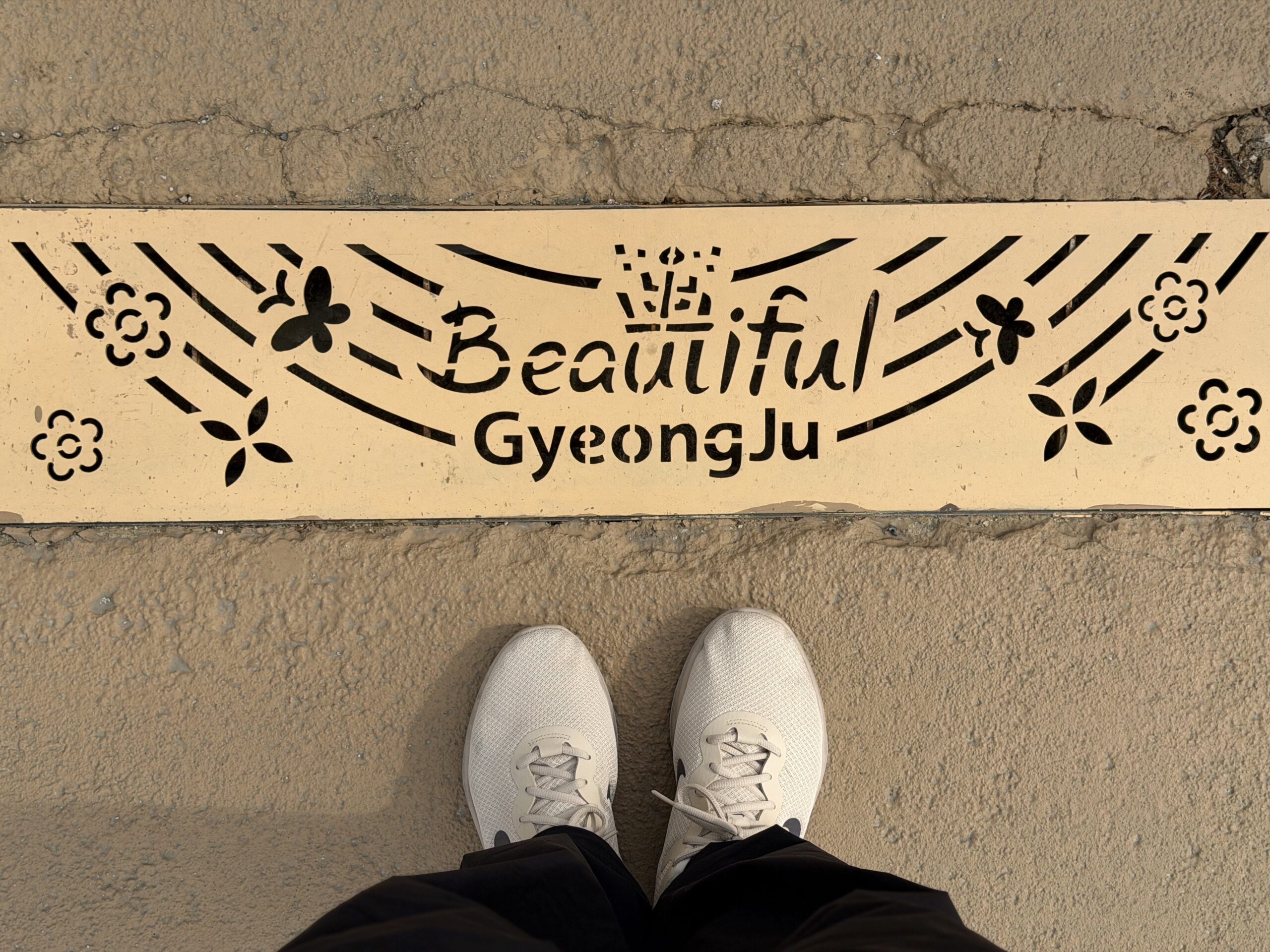
Day 2: 28 April 2026, Tuesday
The itinerary for today is a full-day trip to Gyeongju. I booked a tour via Klook and our pick-up is at 10:10am at Seomyeon Station. Hence, we have a late start to the morning so we decided to try the breakfast buffet at our Lotte Hotel Busan. It was pretty expensive at 67,000 won (S$59) per person so it better be good. Breakfast service starts at 7:00am daily and it was already quite crowded when we went to the La Seine restaurant on the 5th floor at 7:30am.
It was an upscale buffet with over 140 dishes from around the world, including Buddha Jumps Over The Wall, a luxurious Chinese soup. The spread was fantastic and I had a bit of everything – salad, soup, bacon, eggs, sausage, toast, yoghurt, fruits and macarons for dessert. I ate as much as I could to get my money’s worth.


After breakfast, we went to the 6th floor to check out the fitness centre. It was huge. From the breakfast crowd and the size of the gym, you can tell that the hotel is popular among business travellers. There is also a sauna but our room booking does not include access to it. It costs 25,000 won (S$22) per person for a single use.

At 9:10am, we left the hotel and walked towards the tour meeting point at Seomyeon Station. It was a cool and cloudy morning, with the temperature around 17 deg C. I started with a light down jacket but soon removed it as it wasn’t as cold as I thought it would be.


I chose Lotte Hotel because of its excellent, central location. It is just a couple of minutes’ walk away from Seomyeon Station, an interchange station for Lines 1 and 2 on the Metro. There are also many shops and restaurants nearby. We had some time to spare so we explored the surrounding area, and found ourselves at Bujeon Market Town.


Bujoen Market Town is also known as the Market of Memory because it served as a vital lifeline and foundation of survival for refugees after the Korean War. It is a traditional market in a covered arcade selling all sorts of fruits, vegetables, meat and seafood. All the produce looked really fresh; some of the seafood was still alive. This is where the locals go to do their marketing. The arcade stretches a fair distance towards Bujeon Station but we didn’t walk its entire length as we didn’t have time.


At 9:55am, we went to the tour meeting point at the street level of Exit 12, Seomyeon Station. Shortly after, our tour guide, Kayla, arrived. After taking attendance of the tour participants, the 16 of us boarded the bus and we departed promptly at 10:10am. At 10:38am, we arrived at Haeundae Beach, where we made a quick toilet stop and picked up another 15 people, making a total of 31 participants for today’s tour. At 10:54am, we departed Haeundae Beach and drove north towards Gyeongju, about 90km away.


Along the way, Kayla briefed us on the programme for today. The drive from Busan to Gyeongju will take around 1 hour 10 minutes. We will visit six places on the tour – Bulguksa Temple, Yangdong Folk Village, Daereungwon Tomb Complex, Cheomseongdae Observatory, Hwangridan-gil shopping street and Donggung Palace & Wolji Pond. It will be a full-day tour and we will return to Busan around 9:00pm, with three drop-off locations at Haeundae, Seomyeon and Busan Station.
Gyeongju was the capital city of the ancient kingdom of Silla for nearly 1,000 years (57 BC to AD 935). At its height between the 7th and 9th centuries, the Silla kingdom ruled about two-thirds of the Korean peninsula. Gyeongju is often called the “museum without walls” because of the many cultural relics scattered throughout the city. The city has more tombs, temples, palace ruins and other historical artefacts than any other place in Korea, making it one of the most historically important destinations.
At 12:03pm, we arrived at our first destination – Bulguksa Temple. After alighting from the bus, we followed Kalya into the temple grounds. Both sides of the leafy walkway were decorated with colourful lanterns adorned with the cartoon image of a funky Buddha striking a Saturday Night Fever pose while sitting on a lotus flower. The lanterns were put up for the Lotus Lantern Festival (Yeondeunghoe) in celebration of Buddha’s birthday, which falls on the eight day of the fourth lunar month, or 24th May in 2026.


Kayla gave us some background information before letting us explore the temple grounds on our own. Alternatively, we could also follow her to listen to her explanations about the various buildings and features. She gave us about one hour to visit the temple and we would meet back again at 1:10pm.


Bulguksa Temple is a head temple of the Jogye Order of Korean Buddhism. Kalya told us that surprisingly, only about 16% of South Koreans are Buddhists. About 31% of the population identifies as Christian and about 51% have no religion. Bulguksa Temple is a UNESCO World Heritage Site and it is considered a masterpiece of the golden age of Buddhist art in the Silla kingdom. It contains six National Treasures. It was first built in 528 CE as a small temple under King Beopheung before it was reconstructed and expanded over the years. Many of the wooden buildings were burned down during the Imjin War, a series of two Japanese invasions of Korea between 1592 and 1598. The temple was restored gradually and the works were completed in 1973.
The first two National Treasures are the pair of bridges/staircases in front of the main complex. The smaller of the two, on the left, is called Yeonhwagyo (Lotus Flower Bridge) and Chiibogyo (Seven Treasures Bridge). Just by looking at them, you’d think that they are one staircase. In fact, the lower section is Yeonhwagyo (with 10 steps) and the upper section is Chiibogyo (with 8 steps). Together, they lead to Anyangmun (Gate of Fostering Peace), which leads to Geuknakjeon (the Hall of the Pure Land).


The larger of the two, on the right, is called Cheongungyo (Blue Cloud Bridge) and Baegungyo (White Cloud Bridge). Similarly, the upper span is Cheongungyo (with 16 steps) while the lower span is Baegungyo (with 18 steps). They were built separately but designated together as one National Treasure. The bridges lead to the Jahamun (Gate of the Violet Sunset), which leads to Daeungjeon (Hall of Great Enlightenment).
Mum and dad have been here before when they visited South Korea in 2007 as part of a tour group. I tried to recreate the shot with the same angle, but somehow the framing isn’t exactly the same.


As the two historic stairways are closed to the public, we took the stairs on the side to access the main complex. The main hall, Daeungjeon, takes centrestage. It was first built in 681 CE and enshrines the Sakyamuni Buddha. We removed our shoes and entered the hall to have a look. Photography is not permitted inside. It is very old and the wooden floorboards were uneven. A few ladies were busy polishing the brass pots in preparation for Buddha’s birthday festivities.


Another two National Treasures – two famous stone pagodas, reside in the main courtyard in front of Daeungjeon. When facing Daeungjeon, the stone pagoda on the left is called Seokgatap (Pagoda of Sakyamuni Buddha) and the other on the right is called Dabotap (Pagoda of Abundant Treasures).
Seokgatap is a traditional Korean-style stone pagoda with a simple and basic design. It was built over 1,300 years ago, around the time when Bulguksa Temple was completed. The simplicity of the three-storey pagoda stands in direct contrast to its brother Dabotap, which has a more ornate style.

Dabotap has a staircase on each of its four sides, leading to a landing with four stone square pillars supporting the first roof. Above this roof is the body of the pagoda, featuring an octagonal-shaped structure with eight bamboo-shaped pillars supporting an octagonal-shaped lotus stone and finally another roof. It’s as if the architect tried to cram in every architectural style and design element into one pagoda. Dabotap is so famous it is depicted on the reverse of 10-won coin.


Another National Treasure is the Gilt-Bronze Seated Vairocana Buddha residing in the Birojeon (Vairocana Buddha Hall). The Buddha is 1.77 metres in height and made from gilt-bronze. The right index figure of the Buddha is covered by the left hand, which is often used to symbolise the Buddha of Enlightenment. The statue is estimated to be from the 9th century.


The final National Treasure is another Gilt-Bronze Seated Amitabha Buddha enshrined in Geuknakjeon (Hall of Supreme Bliss). I do not have a photo of it. Other notable buildings at Bulguksa Temple are Gwaneumjeon, which enshrines an image of Avalokitesvara, the Boddhisattva of Great Compassion, and Museoljeon (Hall of No Words), one of the oldest buildings in the complex and first built in 670 CE.


After meeting up with the rest of the group at 1:10pm, we walked to our lunch venue, a short distance away. The path was beautifully shaded so we didn’t feel the heat on this sunny, 20 deg C day. We also saw some maple trees and remnants of cherry blossoms.


For our lunch, Kayla messaged us yesterday to inform that we could either choose our own restaurant or go to one of her recommended restaurants. For the latter, she offered three menu options – Mushroom beef stew (minimum 2 persons to order, 17,000 won per person), wild green Bibimbap (13,000 won) or Tteokgalbi set menu (14,000 won). Everyone in the tour group went for the restaurant recommended by Kayla.


We ordered the mushroom beef stew for 2 persons and the Tteokgalbi (beef patty) set menu, amounting to 48,000 won (S$42.24). Lunch was already prepared and set on the table waiting for us when we arrived at the restaurant at 1:25pm. The food was plentiful and we couldn’t finish it all.


After lunch, we popped over to a traditional shop recommended by Kayla and bought some Barley Bread (Chalborippang), a box of 10 pieces for 10,000 won (S$8.80). Barley Bread consists of two small pancakes made of glutinous barley flour wrapped around a filling of red bean paste, similar to a Japanese dorayaki.


Actually, Gyeongju is also famous for Gyeongju Bread (Hwangnam-ppang), a round, golden pastry filled with sweet red bean paste. The difference between the two is that Gyeongju Bread uses wheat flour whereas Barley Bread uses barley flour and it is less sweet. We should have bought some Gyeongju Bread to try, since it is the namesake pastry of the place.

At 2:20pm, we departed Bulguksa Temple and drove 40 minutes to our next destination, Yangdong Folk Village. After alighting at the car park, we walked about 5 minutes to reach the main village area. Along the way, we passed by the Yangdong Village Cultural Center and Yangdong Elementary School. If you visit Yangdong Folk Village on your own, the admission fee is 4,000 won (S$3.52) for adults.

Yangdong Folk Village is also a UNESCO World Heritage Site. It is Korea’s largest clan village, comprising over 150 buildings built in the traditional Korean style, including houses, shrines, pavilions, study halls and more. It was established in the late 15th century by the Gyeongju Son Clan and Yeoju Yi Clan. The origin story and layout of Yangdong Village are representative of Korean clan villages. The head families of the two clans continue to live in Yangdong Village to this day, maintaining their family traditions.

Yangdong Village is located with a mountain to the north and a river to the south. The composition of Yangdong Village is typical of Korean clan villages, with the houses of low-class servants at the entrance to the village near the river and farm fields, and the houses of the upper-class clan members in the back of the village, protected by the mountain. Typically, the houses of the servants have straw roofs while the houses of the upper-class clan members have tiled-roofs. The style of the buildings is typical of the Gyeongsang-do region, with elevated stone foundations and square layouts with a courtyard.


Kayla walked us through the village and we visited some of the most notable buildings that are open to public. Walking past the servants’ homes on the lower levels, seeing the thatched roofs and perimeter walls made of stones and mud felt like stepping back in time to the Joseon era. Signs of modern living that betrayed the illusion include satellite dishes, air-con compressors and motor vehicles.


We climbed towards the top of the hill and visited Gwangajeong House, built in 1514. It was the residence of Son Jung-don (1463–1529), a civil official and a calligrapher of the early Joseon period. The house consists of a women’s quarters, men’s quarters and servants’ quarters. The name Gwangajeong means “a pavilion to see grains growing”. It is named as such because the area in front of the house was originally wide and open such that the Son family could enjoy seeing the picturesque view of the field and river.


Kayla walked us through a few more buildings before we went back to the main village entrance, where she helped us take some photos. Dad commented that the village looks nicer from afar than up close, and I agreed with him. We then walked back to the bus and departed Yangdong Folk Village at 4:10pm.


The next destination is actually three-in-one because the three places we’re visiting – Daereungwon Tomb Complex, Cheomseongdae Observatory and Hwangridan-gil shopping street, are located close to each other. After a 30-minute drive, we arrived at the main gate of Daereungwon Ancient Tomb Complex.


This historic park features 23 large, grass-covered burial mounds from the Silla Dynasty (57 BCE – 935 CE), containing the tombs of kings, queens and nobles. The tombs were first excavated during the Japanese colonial period, with Geumgwanchong being the first to be excavated in 1921. The biggest of the lot here is marked number 10 on the park map, Hwangnamdaechong Tomb, excavated between 1973 and 1975. This is a set of twin tombs belonging to a presumed married couple. The gourd-shaped twin mounds are 80 metres east to west, 120 metres north to south, and 23 metres high.


The tombs have yielded myriad artefacts, including gold crowns and other gold accessories, glass cups, stoneware and paintings, providing vivid glimpses into lifestyles of the time. Most of the artefacts are housed at the Gyeongju National Museum. Only one tomb is open to the public – Cheonmachong (number 6 on the map). Admission costs 3,000 won for adults; we didn’t pay to enter.


Cheonmachong tomb is presumed to date to around the year 500 and belong to a close relative of the king of the Silla kingdom. The burial chamber of Cheonmachong is not a subterranean space because the coffin was not buried but placed above ground and covered with piles of stone and mud. One of the tomb’s most prized artefacts is a gold crown recognised as the largest and most ornate royal headpiece of Silla ever found. The name Cheonmachong means “Tomb of the Heavenly Horse”, so-named because a birch bark saddle flap painted with a depiction of a flying horse was found inside the tomb. An illustration of this heavenly horse is depicted on the floor tiles right after entering the main gate.


After listening to Kayla’s explanations for a while, we decided to break away from the group and roam on our own. We didn’t walk to Cheomseongdae Observatory because it is located a distance away. Kayla tried to manage our expectations by telling us that her previous guests who had walked over to see it felt underwhelmed and said it wasn’t worth the effort. Nevertheless, Kayla sent a picture of the Cheomseongdae Observatory to us over WhatsApp so we could see what it looked like.

In case you’re wondering what is the significance of Cheomseongdae, it is the oldest surviving astronomical observatory in Asia, and possibly even the world. It was constructed during the Silla period during the reign of Queen Seondeok (632–647 CE). The cylindrical tower is 9.17 metres high and built out of 365 pieces of stone, symbolising the number of days in a year.
Since we skipped Cheomseongdae, we could devote more time to explore Hwangridan-gil. This shopping street is about 1.5km long and lined with hanok, traditional Korean buildings. It is trendy and hip, with many photo booths, cafes, restaurants and shops selling interesting things.

For souvenirs, Kayla recommended us to buy Cherry-ju, a special soju (rice wine) that is sold only in Gyeongju. The shop wasn’t hard to find because it was painted in a sweet shade of pink. Gyeongju Cherry-ju is the first cherry-based traditional liquor, co-created with local cherry farmers in Gyeongju. Instead of refined sugar, natural honey is used, creating a balanced sweetness and a sophisticated reinterpretation of traditional Korean fruit liquor. The alcohol content is 15%, which is typical of soju. I bought a 375ml bottle for 19,000 won (S$16.53), and I am pleased to say that it tastes pretty good.


We encountered a group of Chinese tourists dressed in hanbok, the traditional clothing of the Korean people. It is common to see shops at tourist attractions providing hanbok rental services, and many people actually do rent them to dress up for photoshoots. This particular group was standing in front of a shop selling sibwonppang, or 10 won bread, a viral street snack that was first sold in Gyeongju in December 2019.


Sibwonppang is a round-shaped bread/waffle with markings that make it resemble a South Korean 10 won coin. The design was chosen because it was inspired by Gyeongju’s famous Dabotap Pagoda, which is depicted on the actual 10 won coin. The snack later became popular all over South Korea. The original sibwonppang contains stretchy mozzarella cheese but I bought one that contains red bean filling. It cost 3,500 won (S$3.08) and it is really yummy. It tastes just like my favourite taiyaki, a Japanese fish-shaped snack.

As we walked the length of Hwangridan-gil, we popped in to shops every now and then whenever something nice caught our eye. We soon came across a caricature studio that looked interesting so we went in to enquire. We ended up paying 28,000 won (S$24.64) to have our caricatures drawn. The female artist took just five minutes to sketch us using black marker on a canvas frame. I thought the resulting product was pretty cute but dad didn’t really like it because he felt it didn’t really resemble us. Nevertheless, I thought it was good fun and not too expensive, a cute little souvenir from Gyeongju.


We met up with the rest of the group on the bus at 6:35pm and drove to our last destination for the day, Donggung Palace, arriving 10 minutes later. With the sun setting in about half an hour’s time, the temperature dipped steadily and it was a chilly 17 deg C as we walked to the viewing site.
Donggung Palace and Wolji Pond are a former secondary palace and artificial pond built during the Silla era around 674 CE. Three small islands were created in the pond and trees were planted to beautify the landscape. It was mainly used by the royals to hold banquets and host important guests. Imhaejeon Hall was the primary venue for royal events. Its name translates to “pavilion overlooking the sea”, suggesting that Wolji Pond’s design aimed to evoke the vastness of the ocean itself.


This is one of the most popular and photogenic night-view spots in Gyeongju. Many busloads of tourist were arriving at the same time as us but Kayla led us to a “secret spot” at the far end of the pond that was supposedly very scenic but less crowded. We arrived there at 6:54pm, about 10 minutes before sunset. The spot that Kayla chose had a view of Imhaejeon Hall and another smaller pavilion across the water as well as one of the islands. While it was scenic, I wouldn’t say it was breathtakingly beautiful.

Right when the sun set, the lights came on, illuminating the pavilions and walls around Wolji Pond in yellow light. Kayla did manage our expectations beforehand by saying that it is not a dazzling light show with music. It was really just the lights being switched on. However, the sky was still bright so the effect wasn’t fully pronounced yet. Kayla let us take photos for only about 5 minutes before asking us to go back and meet at the bus at 7:20pm.


I thought it was a bit strange because Donggung Palace and Wolji Pond look best at night when the lights are on and the sky is dark. Indeed, when we were rushing to exit the grounds at 7:16pm, the sky was already a few shades darker and the clouds were pink. The scenery already looked much better. We didn’t need to wait for the sky to turn completely dark, but I felt Kayla should have let us stay for another 10 minutes to better appreciate the night views instead of rushing to leave.


As it is, we departed Donggung Palace at 7:23pm and drove back to Busan. The first batch of guests dropped off at Haeundae Beach at 8:35pm before the rest of us alighted at Seomyeon at 9:06pm. As we didn’t have a proper dinner earlier, we went to GS25 convenience store and I bought a bowl of instant noodles for my dinner and also some sandwiches for our breakfast tomorrow. We were back in our hotel at 9:30pm, bringing an end to Day 2 of our trip.

Overall, I felt that this day tour to Gyeongju was so-so. If I may be honest, I thought that the places we visited lacked the wow factor in terms of grandeur and uniqueness. Yes, they are centuries-old historical sites but there wasn’t any particular moment or sight that really took my breath away. The group was also too big for my comfort (31 people). I prefer smaller groups but that’s what you get when you join a popular tour. Gyeongju is quite a long way out from Busan and the tour took up an entire day, so maybe it felt like the effort to get there and back didn’t match the reward. Nevertheless, I appreciated visiting the important cultural sites and learning a bit about the history of the Silla Dynasty.
